
Why Cheap Natural Gas Is Essential for the AI Data Center Revolution
Neil L. Rideout
3/19/20266 min read
Why Cheap Natural Gas Is Essential for the AI Data Center Revolution
The artificial intelligence boom is transforming every industry, from healthcare to entertainment, but behind the scenes lies an energy crisis that few outside the tech sector fully grasp. AI models require vast computational power—think training a single large language model like those powering ChatGPT, which can consume electricity equivalent to hundreds of households for months. Multiply that by the hyperscale data centers being built worldwide, and you have a power demand explosion. According to the International Energy Agency (IEA), global data center electricity consumption stood at 415 terawatt-hours (TWh) in 2024, roughly 1.5% of worldwide electricity use. By 2030, this is projected to nearly double to 945 TWh, or almost 3% of global consumption.
In the United States alone, data centers consumed 183 TWh in 2024—more than the entire country of Pakistan—and are on track to reach 426 TWh by 2030, a 130% surge. Accelerated servers (the GPU-heavy systems driving AI) are growing at 30% annually and account for nearly half the net increase. This isn't just incremental growth; it's a new industrial load rivaling entire sectors.
Yet the grid isn't keeping pace. Utilities face years-long interconnection queues, transmission bottlenecks, and the inherent intermittency of renewables. Solar and wind are vital for long-term decarbonization, but they can't deliver the 24/7, always-on reliability AI demands without massive battery storage that remains prohibitively expensive at scale. Enter natural gas—the fastest, most flexible, and, crucially, cheapest bridge fuel available today. Cheap natural gas isn't a luxury for AI data centers; it's an absolute necessity for keeping costs manageable, operations reliable, and the entire AI ecosystem viable.
The Sheer Scale of AI Power Hunger
Modern AI data centers aren't your grandfather's server farms. A typical hyperscale facility today might draw 100-500 megawatts (MW), but next-generation AI campuses are pushing into the gigawatt range. Meta's planned data center in Louisiana, for instance, will require up to 2 GW just for computation and cooling—enough to power a mid-sized city. Training advanced models can require thousands of GPUs running flat-out, generating immense heat that demands equally power-hungry cooling systems. Cooling alone often accounts for 30-40% of a data center's total energy use.
Projections from industry analysts paint an even starker picture. Data center power demand could add 55-100 GW of new capacity in the U.S. by 2030, equivalent to powering 20-30 million homes. If fully met by natural gas-fired generation, that's an additional 3-6 billion cubic feet per day (Bcf/d) of gas demand—potentially boosting U.S. power-sector gas consumption by 15% and overall production by 10-15%. Without affordable gas, operators face skyrocketing electricity bills, delayed builds, or outright project cancellations. In a world where AI training costs already run into the hundreds of millions, every extra cent per kilowatt-hour erodes competitiveness.
Why Renewables Alone Can't Cut It - Yet
Tech giants publicly tout 100% renewable goals, and many are signing massive power purchase agreements for solar and wind farms. Renewables supplied about 24% of U.S. data center electricity in 2024. But here's the catch: data centers need uninterrupted power. A brief outage can cost millions in lost compute time and data corruption. Wind and solar fluctuate with weather, requiring either overbuilds, vast storage, or backup generation. Batteries help for short bursts but aren't economical for hours-long lulls or the flat, baseload profile AI servers demand.
Natural gas turbines, by contrast, ramp up in minutes. They provide dispatchable power that balances the grid during peak AI workloads or renewable dips. In Texas, home to the ERCOT grid and abundant wind, natural gas fills gaps when wind output suddenly drops—proving its value in real time. As one utility executive noted in regulatory filings, alternatives like solar-plus-batteries are "prohibitively costly" for meeting round-the-clock demand at AI scale.
The Economics: Cheap Gas Makes AI Affordable
Here's where "cheap" becomes non-negotiable. U.S. natural gas prices hit record lows in recent years—averaging around $2.21 per million Btu in 2024, the lowest inflation-adjusted figure ever—thanks to shale fracking and vast domestic reserves. This abundance gives America a massive edge over regions reliant on imported LNG or coal.
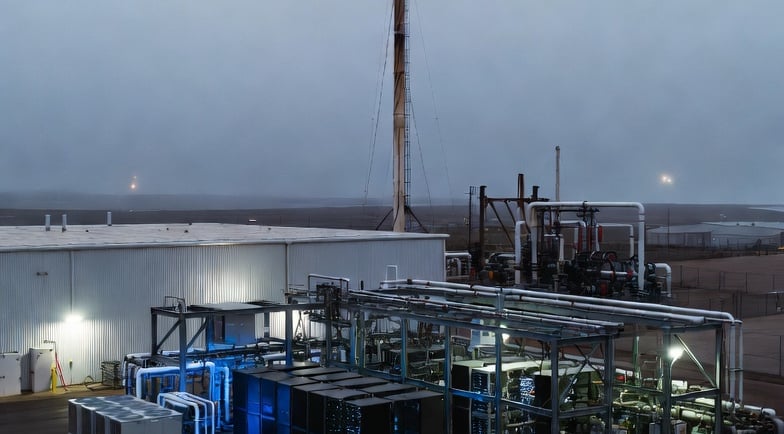
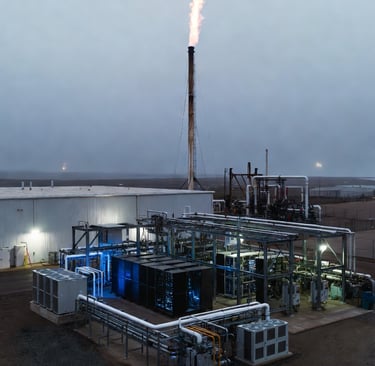
On-site, "behind-the-meter" gas generation is exploding. Tech firms are building private natural gas plants to bypass strained grids entirely. Nearly 75% of new on-site power equipment for data centers is gas-powered, according to recent market intelligence. Companies like Chevron and ExxonMobil are partnering on gigawatt-scale projects in the Permian Basin and elsewhere, delivering power directly to AI campuses at costs far below grid rates in congested areas.
For operators, this translates to savings that flow straight to the bottom line. High electricity prices elsewhere could add tens of millions annually to operating costs, pricing smaller innovators out of the market and slowing AI adoption. Cheap gas keeps training affordable, enables more experimentation, and maintains U.S. leadership against competitors in China, where subsidized coal or hydro may offer alternatives but with different reliability and geopolitical risks.
Texas exemplifies the model: abundant Permian gas, proximity to pipelines, and business-friendly policies have turned the state into an AI powerhouse. Over 40% of Texas data centers sit within a mile of natural gas pipelines. Similar booms are emerging in Louisiana, West Virginia, and the Midwest, where cheap local gas underpins new builds that would otherwise stall.
Reliability and Speed: Gas as the Only Practical Option Today
Data centers require 99.999% uptime ("five nines"). Natural gas generators serve as both primary power (in off-grid setups) and backup, starting in seconds—faster and cleaner than diesel. Pipeline delivery is underground and weather-resilient, unlike fuel trucks.
Building new gas capacity is swift: plants can come online in 2-3 years versus 7-10 for nuclear or large transmission projects. With AI timelines measured in months, speed wins. Proposals for new U.S. gas-fired facilities tripled in 2025, much of it tied directly to data centers. Utilities in Virginia, Georgia, and the Carolinas plan 20 GW of new gas plants over the next decade, largely to serve AI load.
Without this, blackouts loom. The U.S. grid is already stretched; adding data center demand without dispatchable support risks instability.
Environmental Realities and the Bridge to Cleaner Tech
Critics rightly highlight emissions: natural gas plants release CO₂, and methane leaks from upstream operations add potency. Globally, data center power emissions could peak at 320 million metric tons of CO₂ by 2030 before declining. But context matters. Natural gas emits about half the CO₂ of coal per unit of electricity and has displaced dirtier fuels nationwide. Many new projects incorporate carbon capture and storage (CCS)—Google, for example, backed a 400-MW gas plant with CCS in Illinois for Midwest data centers.
Gas also buys time for true zero-carbon solutions like small modular reactors (SMRs) and advanced geothermal, which are scaling but years away. By 2035, low-emissions sources (renewables plus nuclear) are expected to exceed half of U.S. data center supply, but gas remains the largest near-term adder (+130 TWh by 2030).
Low-methane certified gas and efficiency gains further reduce impact. The alternative—delaying AI or relying on coal—would be far worse for both climate and innovation.
Case Studies: Gas in Action
Meta in Louisiana: A $10 billion campus needs 2 GW. Utility Entergy is building gas plants because nothing else matches cost and reliability. Renewables come later.
Texas Off-Grid Projects: Crusoe, Oracle, and others deploy jet-engine gas turbines alongside solar for hybrid reliability at Permian sites.
Chevron/GE Vernova: Targeting 4 GW by 2027 for data centers, proving gas as a "contracted service" for schedule certainty.
These aren't hypotheticals; they're operational blueprints showing cheap gas enabling rapid deployment.
The Road Ahead: Policy and Production Must Align
AI could drive U.S. natural gas demand up 20-40% in some forecasts, coinciding with LNG export growth. Pipeline expansions, streamlined permitting, and sustained drilling are essential. Policymakers should avoid knee-jerk restrictions that spike prices—higher gas costs would inflate AI expenses, slow adoption, and cede ground to less transparent rivals.
Investors are already betting big: midstream companies like Williams, Kinder Morgan, and Energy Transfer see data center tailwinds. Gas isn't fading; it's evolving with AI.
Conclusion: Cheap Natural Gas Isn't Optional - It's Foundational
The AI revolution hinges on electricity that is abundant, reliable, and affordable. Cheap natural gas delivers all three today, powering the GPUs, cooling systems, and backup that make modern intelligence possible. Without it, data centers face delays, higher costs, and reliability risks that could throttle innovation precisely when we need it most.
This isn't about choosing gas forever—it's about using America's shale advantage as a bridge while scaling nuclear, renewables, and storage. For now, supporting domestic production, infrastructure, and on-site generation isn't just good energy policy; it's critical industrial policy for the AI age.
The data centers of tomorrow will be built where power flows cheaply and steadily. Thanks to abundant, low-cost natural gas, that place can—and must—be right here in North America. The alternative is an AI future that's slower, more expensive, and less secure. In the race for intelligence supremacy, cheap natural gas isn't a footnote. It's the fuel.
Contact
Head Office
Green Life Enterprises LLC
8 Biltmore Est
Suite 310,
Phoenix, AZ 85016
greenlifedatacenters@gmail.com
+1-813-220-0001
© 2026. All rights reserved.
* The American Government has now redefined the industry, Artificial Intelligence (AI) is now defined as Super Intelligence (SI) Our website reflects that change.
Canadian Office
Green Life Enterprises LLC
3142 Nicholson Ave
Suite 10
New Waterford, Nova Scotia B1H 1N8