
The Future of Policing: How AI Will Transform Law Enforcement
Neil L. Rideout
4/30/20264 min read
The Future of Policing: How AI Will Transform Law Enforcement
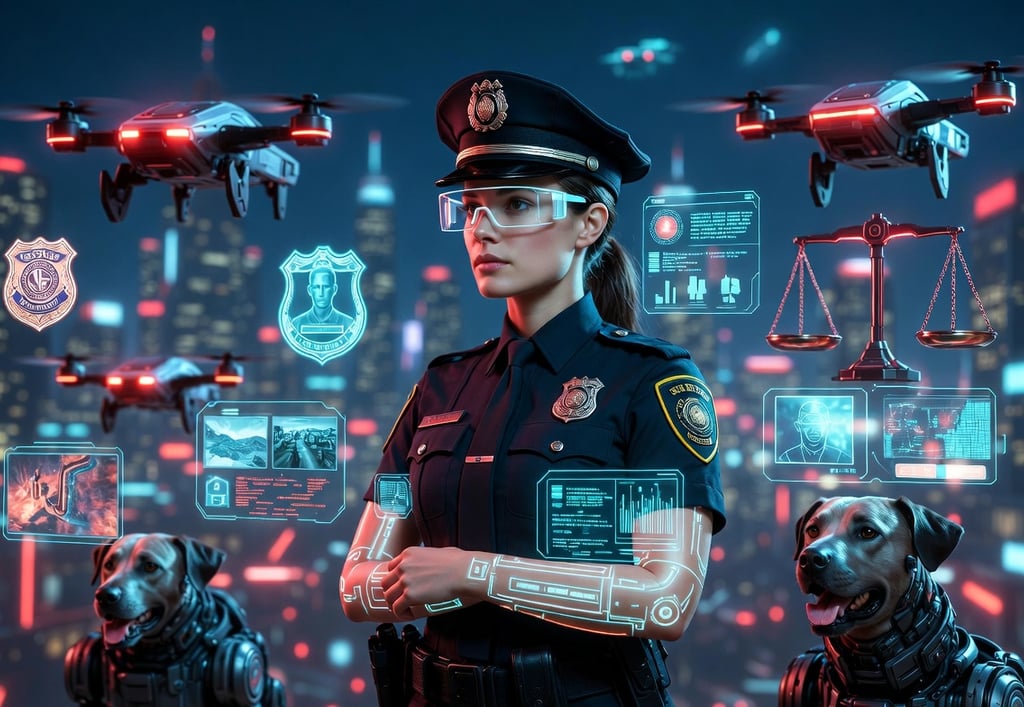
The police officer of 2035 will not look like the one of today. Instead of relying primarily on intuition, paperwork, and reactive patrols, tomorrow’s law enforcement professionals will be augmented by powerful artificial intelligence systems that act as force multipliers for prevention, investigation, response, and justice.
AI is poised to fundamentally reshape policing — making it faster, smarter, safer, and potentially fairer. Here’s how artificial intelligence will help police and law enforcement agencies in the coming decade and beyond.
Predictive Policing 2.0: Preventing Crime Before It Happens
Today’s predictive policing tools analyze historical crime data to suggest hotspots. Future AI systems will be far more sophisticated.
Next-generation AI will integrate real-time data from IoT sensors, traffic cameras, social media sentiment analysis, economic indicators, weather patterns, and even anonymous mental health signals (with strict privacy safeguards). These systems will forecast not just where crime might occur, but who might be at risk of offending or becoming a victim — and why.
Imagine an AI that notices a sudden spike in domestic violence indicators in a neighborhood through anonymous emergency call patterns, increased alcohol sales data, and social media posts expressing distress. Officers could be dispatched for welfare checks or community outreach before an incident escalates. Early intervention programs powered by AI could dramatically reduce violent crime rates.
Real-Time Situational Awareness and Augmented Officers
Future police officers will wear lightweight exosuits or smart uniforms embedded with AI. Augmented reality (AR) visors or contact lenses will overlay critical information directly into their field of view: suspect backgrounds, outstanding warrants, known weapons on scene, building floor plans, and even vital signs of individuals they’re interacting with.
AI-powered body cams will no longer just record — they will analyze in real time. The system could detect aggressive body language, detect concealed weapons using millimeter-wave and thermal imaging, and instantly cross-reference faces against global (yet privacy-controlled) databases. In high-stress situations, AI could provide calm voice prompts to officers: “Subject shows signs of mental health crisis — de-escalation protocol recommended.”
This augmentation will make officers safer and reduce use-of-force incidents by providing better information and decision support.
Autonomous Drones and Robotic First Responders
Drone swarms will become standard in law enforcement. AI-controlled drones can arrive at a scene within minutes, providing live 360° video, thermal imaging, and even delivering medical supplies or non-lethal deterrents like tasers or flashbangs.
Robotic units — think advanced versions of Boston Dynamics’ Spot with police modifications — could handle dangerous situations: entering hostage scenarios, searching for suspects in hazardous environments, or diffusing suspicious packages. These robots will be fully integrated with central AI command systems that coordinate multiple units in real time.
In rural or high-risk areas, AI could autonomously patrol using ground vehicles and aerial drones, alerting human officers only when intervention is truly needed. This extends police presence without increasing manpower costs.
Hyper-Efficient Investigations and Forensics
Solving crimes will become dramatically faster. AI will analyze thousands of hours of surveillance footage in minutes, identifying suspects by gait, clothing, or partial facial features even when they attempt to hide.
Cold cases will be reopened automatically when new DNA, fingerprint, or digital evidence becomes available. Generative AI models will help reconstruct crime scenes in 3D from limited photos and witness statements. Natural language processing will scan millions of pages of case files, interview transcripts, and tip lines to find hidden connections between seemingly unrelated crimes.
AI will also revolutionize digital forensics — rapidly cracking encrypted devices (within legal bounds), tracing cryptocurrency transactions used in criminal enterprises, and detecting deepfake evidence used to create alibis.
Bias Reduction and More Transparent Decision-Making
One of the most promising — and controversial — aspects of AI policing is its potential to reduce human bias. Well-designed AI systems can be trained to focus on behavior and evidence rather than race, gender, or socioeconomic status.
Explainable AI (XAI) frameworks will allow officers and oversight boards to understand exactly why the system flagged a particular individual or location. Every AI-assisted decision could generate an auditable log, creating unprecedented transparency in policing.
However, this requires rigorous oversight. AI systems must be continuously audited for hidden biases in training data. The goal is not to remove human judgment but to support it with more objective, data-driven insights.
Community Engagement and Personalized Policing
AI will enable a shift from “one-size-fits-all” policing to more nuanced community engagement. Chatbots and virtual assistants could handle low-level complaints, provide crime prevention advice, and answer citizen questions 24/7 in multiple languages.
Predictive analytics could help departments allocate resources toward social services and prevention programs in areas showing early risk indicators. Some cities may experiment with “AI community officers” — virtual agents that build long-term relationships with residents through apps and neighborhood platforms.
Enhanced Public Safety Through Smart Cities
In smart cities of the future, AI will create an integrated “nervous system” for urban safety. Traffic systems will automatically detect and respond to accidents or fleeing vehicles. Smart lighting and sensors will identify unusual activity patterns. Emergency services will be coordinated by a central AI that optimizes response times across police, fire, and medical units.
This interconnected approach could significantly reduce response times and prevent cascading emergencies.
Challenges and Ethical Considerations
While the benefits are enormous, the risks cannot be ignored. Mass surveillance powered by AI raises serious privacy concerns. There must be strong legal frameworks governing data retention, consent, and the right to be forgotten.
The potential for authoritarian abuse exists, especially in countries with weaker democratic institutions. Even in democratic nations, “mission creep” — where tools designed for serious crime are gradually applied to minor infractions or political dissent — must be carefully guarded against.
Public trust will depend on transparency, independent oversight, civilian review boards with technical expertise, and clear accountability when AI systems make mistakes.
The Human Element Remains Essential
AI will never fully replace human police officers. Empathy, moral judgment, de-escalation skills, and community relationship-building are inherently human strengths that technology cannot replicate.
The future model is clear: human officers augmented by AI, not replaced by it. The best systems will keep humans in the loop for final decisions while using AI to handle data overload, routine tasks, and dangerous situations.
Conclusion: A Safer, Smarter Future?
When deployed responsibly, AI has the potential to create a world where crime is rarer, responses are faster, officers are safer, and justice is more consistent. Property crime could drop sharply through prevention. Violent crime could be interrupted earlier. Investigations that once took months could be completed in days.
The police of the future will still wear badges and carry the weight of public trust — but they will be supported by an invisible army of intelligent systems working tirelessly behind the scenes.
The question is not whether AI will transform law enforcement. It already is. The real question is whether societies will implement these powerful tools with wisdom, transparency, and a steadfast commitment to civil liberties.
The future of policing can be both more effective and more just — if we get the balance right.
Contact
Head Office
Green Life Enterprises LLC
8 Biltmore Est
Suite 310,
Phoenix, AZ 85016
greenlifedatacenters@gmail.com
+1-813-220-0001
© 2026. All rights reserved.
* The American Government has now redefined the industry, Artificial Intelligence (AI) is now defined as Super Intelligence (SI) Our website reflects that change.
Canadian Office
Green Life Enterprises LLC
3142 Nicholson Ave
Suite 10
New Waterford, Nova Scotia B1H 1N8