
The Future of Green Thumbs: How AI Will Revolutionize Horticulture and Gardening
Neil L. Rideout
5/29/20265 min read
The Future of Green Thumbs: How AI Will Revolutionize Horticulture and Gardening
The world of horticulture and gardening has always been a blend of art, science, and patience. From ancient Mesopotamian gardens to today's urban balconies, humans have nurtured plants for food, beauty, and environmental health. But as climate change accelerates, populations grow, and resources become scarcer, traditional methods face unprecedented challenges. Enter Artificial Intelligence (AI)—a transformative force poised to empower both professional horticulturists and everyday gardeners like never before.
In the coming decades, AI will not replace the human touch but amplify it, turning intuition into data-driven precision. This blog explores the multifaceted ways AI will reshape plant care, from soil to harvest, making gardening more accessible, efficient, and sustainable.
Precision Plant Identification and Health Diagnostics
One of the most immediate and impactful applications of AI in gardening is intelligent plant identification and disease detection. Today, apps like PlantSnap or PictureThis use computer vision to identify species from a simple photo. In the future, these tools will evolve into comprehensive diagnostic systems.
Imagine pointing your smartphone at a wilting tomato plant. An AI model, trained on millions of images and spectral data, not only identifies the variety but detects early signs of blight, nutrient deficiencies, or pest infestations with 95%+ accuracy. It will analyze leaf texture, color variations invisible to the human eye, and even soil moisture via integrated sensors.
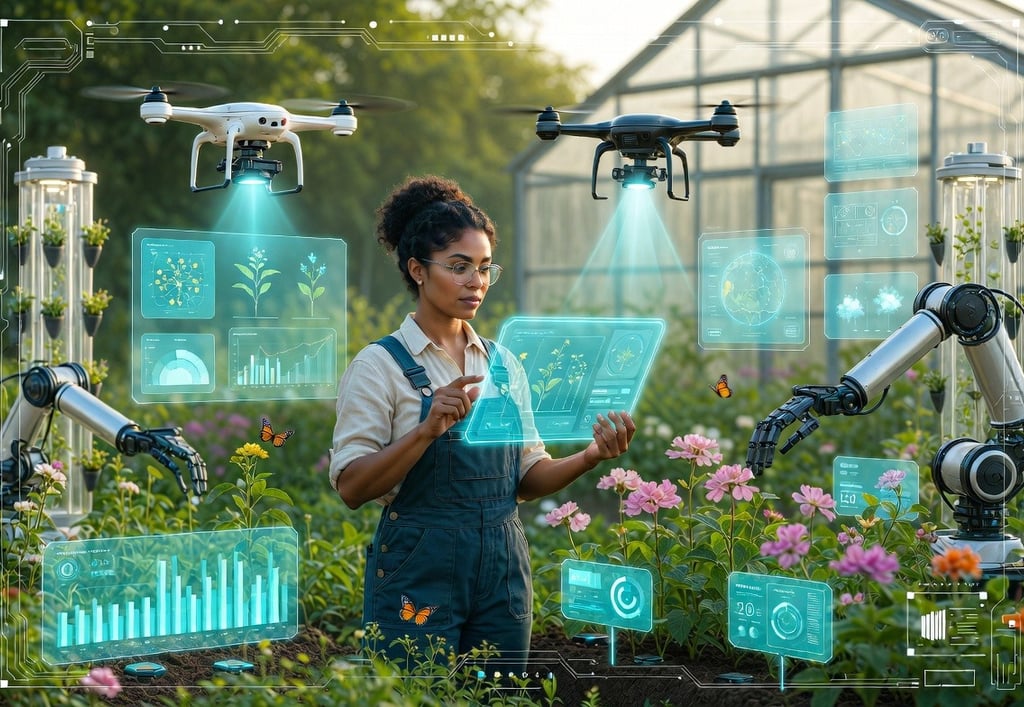
For professional horticulturists managing large nurseries or botanical gardens, drone-mounted hyperspectral cameras combined with AI will scan entire fields in minutes. These systems will generate heatmaps highlighting problem areas, predict outbreak risks based on historical data and weather patterns, and recommend targeted treatments—minimizing chemical use and preventing widespread crop loss.
Home gardeners will benefit equally. AI-powered augmented reality (AR) glasses or phone apps will overlay real-time information: "This rose shows early black spot fungus—apply organic fungicide X in 3 days for optimal results." This democratizes expert knowledge, reducing the trial-and-error that frustrates beginners and leads to plant deaths.
Personalized Care Plans and Predictive Analytics
Gardening success hinges on timing—when to plant, water, fertilize, or prune. AI excels at pattern recognition and prediction, making it an ideal assistant for personalized care regimens.
Future AI systems will integrate data from local weather APIs, IoT soil sensors, user-input garden logs, and even satellite imagery. For a backyard gardener in Sydney, Nova Scotia, the AI might suggest: "Given the upcoming cool, wet forecast and your clay-heavy soil pH of 6.2, plant kale now and add lime to balance acidity. Expected yield: 18% higher than last season."
Horticulturists in commercial operations will use AI for hyper-localized forecasting. Machine learning models will simulate thousands of growth scenarios, factoring in microclimates, pollinator activity, and market demands. This enables optimized planting schedules that maximize profits while reducing water and energy waste.
Advanced AI will also incorporate genetic insights. By analyzing a plant's DNA via affordable sequencing tools, AI can recommend companion planting strategies or custom breeding crosses to develop resilient hybrids suited to specific regions—crucial as climate zones shift.
Automated Systems and Robotic Assistance
Labor shortages plague the agriculture and horticulture sectors. AI-driven robotics will bridge this gap without sacrificing the care plants need.
Robotic harvesters equipped with soft grippers and vision systems already pick delicate fruits like strawberries. In the future, autonomous garden bots will patrol plots, weeding precisely with computer vision (sparing beneficial plants), applying micro-doses of fertilizer, and even pollinating flowers with precision drones mimicking bees.
Smart irrigation systems like those from companies building on current Rain Bird or Rachio tech will evolve into fully autonomous networks. AI will monitor evapotranspiration rates, plant stress via thermal imaging, and adjust watering in real-time—potentially cutting water usage by 40-60% while improving plant health.
Vertical farming and indoor gardening will explode in urban areas. AI-controlled environments will fine-tune LED spectra, CO2 levels, humidity, and nutrient delivery for perfect growth cycles year-round. Home users might have compact "AI grow pods" that produce fresh herbs and vegetables with minimal effort, guided by voice commands: "Optimize for basil flavor intensity."
Sustainability and Climate Resilience
As extreme weather events increase, AI will be vital for building resilient gardens and ecosystems.
Predictive models will forecast pest migrations, invasive species risks, and optimal biodiversity strategies. Horticulturists restoring native habitats can use AI to model ecosystem interactions, selecting plant combinations that best support local wildlife while sequestering carbon.
For gardeners, AI apps will promote regenerative practices—suggesting cover crops, composting schedules, and rainwater harvesting optimizations. Carbon footprint trackers integrated into garden management software will gamify sustainability, rewarding users with virtual badges or real-world incentives for eco-friendly choices.
On a larger scale, AI will accelerate research into climate-adaptive crops. Generative AI models can design novel genetic sequences or simulate evolutionary pressures, speeding up the development of drought-resistant or heat-tolerant varieties without the lengthy traditional breeding timelines.
Knowledge Sharing and Community Building
AI won't just help individuals—it will connect the global gardening community.
Natural language processing (NLP) models will power advanced forums where gardeners describe symptoms conversationally, receiving synthesized advice from vast databases of extension services, research papers, and user experiences. AI tutors could provide interactive lessons: "Let's simulate pruning your apple tree—try different techniques and see the projected fruit yield."
Virtual reality (VR) gardens will allow experimentation without risk. Want to test a Japanese-inspired Zen garden layout? AI will generate photorealistic previews, suggest plants, and even estimate maintenance costs and ecological impact.
For professionals, AI will streamline supply chain management, predicting seed shortages or fertilizer price fluctuations, and facilitating collaborative research across institutions.
Challenges and Considerations
While promising, AI integration in horticulture isn't without hurdles. Data privacy concerns arise with constant sensor monitoring. Small-scale gardeners might face a learning curve or costs for advanced tools. There's also the risk of over-reliance—AI should enhance, not replace, the joy of hands-on gardening and observational skills developed over seasons.
Ethical questions around AI-designed organisms and data ownership in shared platforms must be addressed. Ensuring equitable access, especially in developing regions, will be key to preventing a divide between tech-savvy and traditional practitioners.
Energy consumption of AI systems and data centers also needs balancing against the environmental benefits they provide.
Conclusion: A Greener Tomorrow
By 2035-2040, AI will likely make successful gardening accessible to millions more people while helping professionals tackle food security, biodiversity loss, and climate challenges head-on. Horticulturists will shift from manual labor to strategic oversight, focusing on creativity, research, and stewardship. Gardeners will spend less time troubleshooting and more time enjoying the fruits (and flowers) of their labor.
The future garden isn't a sterile, robotic plot—it's a thriving, intelligent ecosystem where technology and nature dance in harmony. AI will help us listen better to what plants need, respond faster to environmental shifts, and cultivate not just better plants, but a deeper connection to the living world.
Whether you're a commercial rose grower, a community plot coordinator, or a balcony herb enthusiast, the AI gardening revolution promises higher yields, fewer failures, and more wonder. The green revolution 2.0 is coming—and it's intelligent.
Contact
Head Office
Green Life Enterprises LLC
8 Biltmore Est
Suite 310,
Phoenix, AZ 85016
greenlifedatacenters@gmail.com
+1-813-220-0001
© 2026. All rights reserved.
* The American Government has now redefined the industry, Artificial Intelligence (AI) is now defined as Super Intelligence (SI) Our website reflects that change.
Canadian Office
Green Life Enterprises LLC
3142 Nicholson Ave
Suite 10
New Waterford, Nova Scotia B1H 1N8