
The AI Revolution in Space Exploration: Charting Humanity's Path to the Stars
Neil L. Rideout
3/24/20266 min read
The AI Revolution in Space Exploration: Charting Humanity's Path to the Stars
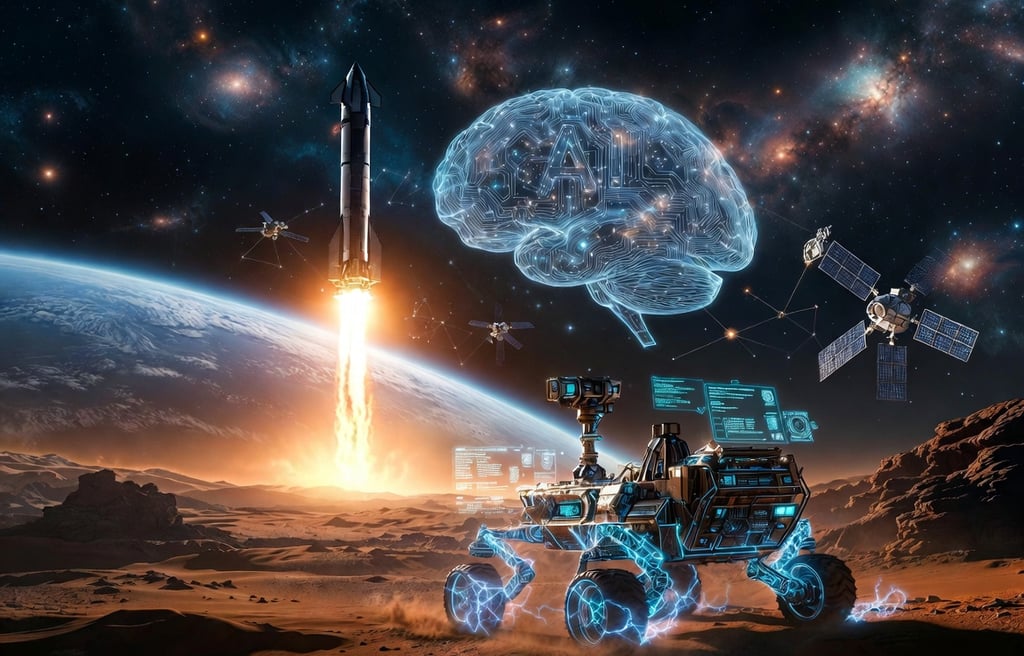
In the vast silence of space, where signals take minutes or hours to travel and humans cannot yet venture unaided, artificial intelligence has become our most reliable co-pilot. Picture this: a rover the size of a small car crawls across the rusty dunes of Mars. A rock formation catches its sensors. Instead of waiting 20 minutes for Earth commands, the rover decides in seconds whether to drill, photograph, or roll on. This is not science fiction—it is the daily reality of NASA's Perseverance rover, powered by AI algorithms that let it navigate treacherous terrain autonomously. As we stand on the cusp of 2026, AI is no longer a supporting actor in space exploration; it is the driving force accelerating discoveries, slashing costs, and pushing the boundaries of what humanity can achieve beyond Earth.
The marriage of AI and space exploration is more than technological synergy. It represents a philosophical leap. For centuries, space has been the ultimate test of human ingenuity—fraught with radiation, extreme temperatures, and communication blackouts. AI thrives precisely where these challenges peak. It processes petabytes of data in real time, predicts failures before they happen, and adapts to the unknown. From orbital mechanics to exoplanet hunting, AI is turning the impossible into routine. This blog post explores how AI is transforming robotic missions, human spaceflight, scientific discovery, and our interstellar future—while confronting the hurdles that remain.
AI-Powered Robotic Pioneers: Rovers and Probes That Think for Themselves
Robotic exploration has always been the vanguard of space travel, but pre-AI missions were painfully slow. Early landers like Viking in the 1970s followed rigid scripts beamed from Earth. Today's machines are different. Perseverance, which touched down in Jezero Crater in 2021, uses the AEGIS (Autonomous Exploration for Gathering Increased Science) system. This AI suite analyzes images on the fly, identifies scientifically promising targets, and prioritizes them without human input. In its first few years, Perseverance collected dozens of rock samples—many selected entirely by AI—laying groundwork for a future sample-return mission.
The European Space Agency's ExoMars Rosalind Franklin rover, slated for launch in the coming years, will take autonomy even further. Its AI navigation software, trained on millions of simulated Martian landscapes, can traverse slopes, avoid sand traps, and even detect subsurface water ice. China's Zhurong rover on Mars and India's Chandrayaan-3 lander on the Moon have demonstrated similar smarts, proving that AI democratizes space exploration beyond superpowers.
Deep-space probes benefit too. NASA's Europa Clipper, en route to Jupiter's icy moon, employs AI for fault protection. Radiation from Jupiter's belts can flip bits in onboard computers; AI models predict and correct these errors in milliseconds. Meanwhile, AI optimizes trajectories. When the James Webb Space Telescope needed a mid-course correction in 2022, machine learning algorithms crunched orbital data faster than any human team, saving fuel and time.
The payoff is staggering. Autonomous operations reduce the need for constant ground control, cutting mission costs by up to 50 percent according to NASA estimates. Rovers cover more ground, collect better data, and survive longer—extending scientific return exponentially. Yet the real magic happens when AI enables entirely new mission architectures. Future swarms of CubeSats, coordinated by AI "hive minds," could map asteroid belts or monitor Earth's climate from orbit in ways no single spacecraft could.
Elevating Human Spaceflight: AI as Astronaut's Trusted Companion
Space is lethal for humans. Microgravity weakens bones, cosmic rays damage DNA, and isolation takes a psychological toll. AI is stepping in as guardian and colleague. On the International Space Station, IBM's Watson and similar systems monitor air quality, predict equipment failures, and even analyze astronaut speech patterns for early signs of stress. Crew members now wear AI-powered smart suits that track vital signs and suggest countermeasures—preventing small issues from becoming mission-ending crises.
Private industry leads the charge here. SpaceX's Dragon and Starship vehicles rely on AI for precision docking with the ISS and autonomous landings. The Falcon 9 booster's pinpoint returns to drone ships? That's AI processing sensor data at blistering speeds, adjusting thrust vectors in real time. Elon Musk's vision of a multi-planetary species depends on this: Starship's upcoming uncrewed Mars flights will use AI to scout landing sites, deploy solar arrays, and begin in-situ resource utilization—turning Martian CO₂ into rocket fuel.
AI also revolutionizes training and operations. Virtual reality simulators powered by generative AI recreate mission scenarios with infinite variations, preparing astronauts for the unexpected. On long-duration missions to the Moon or Mars, AI companions—conversational agents with emotional intelligence—could combat loneliness, offering reminders, entertainment, and even therapy-like support. NASA's ongoing tests with digital twins (virtual replicas of spacecraft and crew) let engineers simulate entire missions on Earth, tweaking variables until success is virtually guaranteed.
The result? Safer flights, longer missions, and more ambitious goals. Artemis II and III, NASA's return to the Moon, integrate AI for everything from habitat construction to resource prospecting. Humans remain in the loop, but AI handles the tedium and danger, freeing explorers to do what they do best: discover.
Supercharging Discovery: AI Turns Data Deluge into Breakthroughs
Space telescopes and observatories generate more data than humans can ever sift through manually. The James Webb Space Telescope alone produces terabytes daily—images of galaxies billions of light-years away, spectra of alien atmospheres. Traditional analysis would take lifetimes. Enter AI.
Machine learning models trained on simulated exoplanet data now sift JWST observations, identifying potential biosignatures like dimethyl sulfide (a possible marker of life) in hours instead of months. Similar algorithms revolutionized the Kepler mission, boosting confirmed exoplanets from hundreds to over 5,500 by spotting faint transit signals buried in noise. Today, AI processes data from the Vera C. Rubin Observatory's Legacy Survey of Space and Time, expected to catalog billions of galaxies and detect thousands of near-Earth asteroids—many spotted for the first time.
Radio astronomy benefits equally. The Square Kilometre Array, coming online in the late 2020s, will generate more data than the entire internet. AI compression and pattern-recognition tools make it manageable, hunting for pulsars, fast radio bursts, and even technosignatures from extraterrestrial civilizations through SETI@home successors.
AI also aids planetary defense. Algorithms analyze asteroid orbits with unprecedented precision, flagging potential impactors years in advance. In 2024–2025 trials, AI successfully rerouted simulated threats, paving the way for real deflection missions like the DART follow-ups.
These tools are not just faster—they're more creative. Generative AI designs novel telescope schedules, optimizes sensor calibrations, and even proposes hypotheses about dark matter from cosmic microwave background data. The synergy is accelerating the pace of discovery: what once took decades now unfolds in years.
Horizons Beyond: AI and the Interstellar Dream
The true frontier lies light-years away. Communication delays of years make real-time control impossible for missions to Proxima Centauri or beyond. AI is the only viable solution. Self-replicating probes—von Neumann machines updated with modern neural networks—could mine asteroids for materials, build copies of themselves, and fan out across the galaxy. Concepts like Breakthrough Starshot envision laser-propelled nanocrafts guided by AI, beaming back data on habitable worlds.
On Mars, AI will manage colonies. Imagine habitats where neural networks control life-support systems, optimize agriculture in regolith greenhouses, and coordinate fleets of autonomous rovers for mining water ice. xAI's mission to understand the universe aligns perfectly here: advanced models could simulate entire ecosystems, predicting how human settlers interact with alien environments before boots touch the ground.
Ethical questions loom large, of course. Should AI decide to abort a mission if it detects a high-probability failure? How do we prevent algorithmic bias in life-detection protocols? And what safeguards ensure AI remains a tool, not an autonomous actor that outpaces human oversight?
Despite these concerns, the trajectory is clear. By 2040, AI could enable crewed missions to the outer solar system and lay the groundwork for multi-generational starships. The computational power of quantum-AI hybrids, now in early development, will tackle the immense simulations needed for warp-drive concepts or antimatter propulsion—turning theoretical physics into engineering blueprints.
Challenges on the Launchpad
No revolution is without friction. Space-hardened AI chips must withstand radiation that corrupts traditional processors. Edge computing—running complex models on spacecraft with limited power—is still evolving. Ethical frameworks lag behind capability: international treaties barely mention AI in space. And public trust matters. A single AI misstep on a high-profile mission could spark backlash.
Yet these are engineering and policy problems, not insurmountable barriers. Investment is pouring in. NASA’s 2025 AI roadmap, ESA’s AI4SPACE initiative, and private ventures from Blue Origin to ispace signal a global commitment.
Conclusion: A Shared Destiny Among the Stars
AI and space exploration are not separate endeavors; they are two sides of humanity’s quest to understand the universe. AI extends our senses, multiplies our reach, and amplifies our curiosity. It turns lone pioneers into a networked civilization spanning worlds. As we gaze at the Milky Way on a clear night, remember: the next giant leap will be taken not just by astronauts, but by silicon minds working in perfect harmony with our own.
The cosmos awaits. With AI as our ally, the final frontier feels closer than ever. Whether you’re a scientist, engineer, student, or dreamer, the invitation is open: join the conversation, support research, and imagine the possibilities. The stars are calling—and for the first time, we have the intelligence to answer.
Contact
Head Office
Green Life Enterprises LLC
8 Biltmore Est
Suite 310,
Phoenix, AZ 85016
greenlifedatacenters@gmail.com
+1-813-220-0001
© 2026. All rights reserved.
* The American Government has now redefined the industry, Artificial Intelligence (AI) is now defined as Super Intelligence (SI) Our website reflects that change.
Canadian Office
Green Life Enterprises LLC
3142 Nicholson Ave
Suite 10
New Waterford, Nova Scotia B1H 1N8