
The AI Revolution in Music: Empowering Creators and Sound Technicians
Neil L. Rideout
5/15/20264 min read
The AI Revolution in Music: Empowering Creators and Sound Technicians
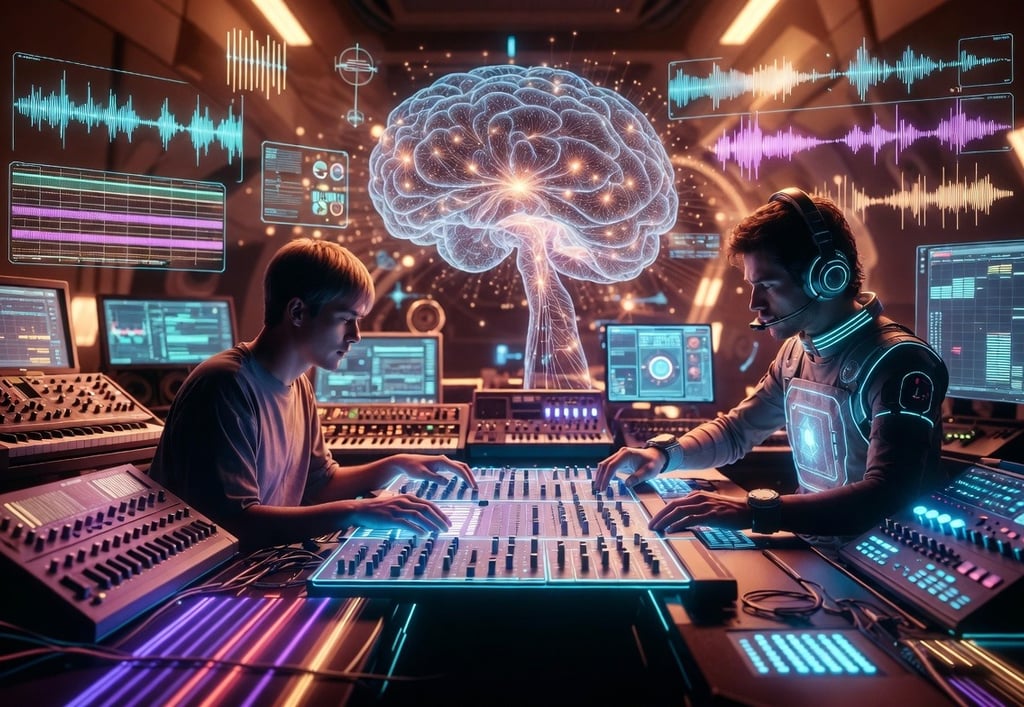
The music industry stands on the brink of its most profound transformation since the advent of digital recording. Artificial intelligence is no longer a futuristic concept—it's a practical, powerful collaborator reshaping how music is conceived, produced, refined, and experienced. For music creators and sound technicians alike, AI tools are democratizing access, accelerating workflows, and unlocking creative possibilities that were unimaginable just a few years ago.
As of 2026, the integration of AI into music production isn't about replacement; it's about augmentation. Producers, songwriters, composers, and audio engineers are leveraging machine learning to handle tedious tasks, suggest innovative ideas, and achieve professional results faster than ever. This blog explores these advancements in detail, highlighting real-world applications, benefits, challenges, and the promising future ahead.
AI for Music Creators: From Idea to Finished Track
Music creation has traditionally been limited by technical skill, time, and resources. AI is breaking down those barriers.
Composition and Songwriting Assistance Tools like Suno, Udio, AIVA, and Soundverse allow creators to generate full songs, melodies, chord progressions, or instrumentals from simple text prompts. A songwriter struggling with a bridge can input "uplifting pop chorus in C major with layered harmonies" and receive multiple variations in seconds.
These generators aren't just for novices. Professional artists use them for rapid prototyping—exploring genres outside their comfort zone or generating backing tracks. Udio stands out for its section-by-section editing and stem exports, enabling seamless integration into a DAW (Digital Audio Workstation). ElevenLabs Music excels in high-fidelity vocal generation with natural instrumentation.
AI also aids lyric writing through pattern recognition from vast datasets, suggesting rhymes, themes, or emotional arcs that align with a track's mood. This doesn't diminish human creativity; it amplifies it by providing starting points and reducing writer's block.
Production and Arrangement In the studio, AI streamlines arrangement. Tools analyze a project's tempo, key, and energy to suggest complementary layers—adding subtle percussion, harmonic extensions, or dynamic builds. LANDR's Layers acts as an "AI co-producer," listening to your music and offering intelligent suggestions.
Generative systems like Mubert or Amper create royalty-free, adaptive music for content creators, while advanced platforms support custom training on an artist's catalog for personalized outputs. This level of customization preserves artistic identity while scaling output.
Mixing, Mastering, and Post-Production Even bedroom producers can achieve radio-ready sound. AI mastering services from LANDR, iZotope Ozone, and Apple's Mastering Assistant analyze tracks for loudness, clarity, EQ balance, and stereo imaging, applying professional-grade processing.
iZotope Neutron uses machine learning for intelligent mixing suggestions, detecting frequency clashes and recommending dynamic EQ or compression. These tools provide a strong first pass, leaving humans to add the artistic final touches.
Marketing and Distribution AI extends beyond creation. Tools analyze streaming data to predict trends, optimize release strategies, and even generate promotional content. Platforms like Orphiq help with release planning tailored to an artist's catalog.
For independent creators, this levels the playing field against major labels.
AI for Sound Technicians: Precision, Restoration, and Efficiency
Sound technicians—mixing engineers, live sound pros, restorers, and post-production specialists—are finding AI indispensable for technical excellence.
Audio Restoration and Cleanup AI shines in noise reduction and repair. Tools from Accentize, Waves Clarity, and LALAL.AI use deep learning to remove background noise, clicks, pops, or even reconstruct missing audio with remarkable fidelity.
Stem separation via LALAL.AI or Moises allows technicians to isolate vocals, drums, bass, and instruments from mixed tracks. This is revolutionary for remixing, archiving old recordings, or salvaging live captures.
Intelligent Mixing and Live Sound In mixing suites, AI plugins provide real-time analysis and automation. They suggest balance adjustments, apply genre-specific presets, and maintain consistency across a project. For live events, AI systems monitor acoustics and adjust EQ, compression, and spatial audio dynamically to optimize for venue and audience.
Room calibration tools use AI to analyze acoustic environments and compensate for reflections or resonances, delivering consistent sound in varied spaces—from home studios to concert halls.
Mastering and Quality Control Beyond basic loudness, AI mastering tools consider reference tracks, genre norms, and platform requirements (e.g., Spotify's normalization). Technicians use them for quick iterations while focusing expertise on creative decisions.
In film and game audio, AI generates Foley effects, spatializes sound for immersive experiences, or matches audio to visual cues automatically.
Workflow and Collaboration AI organizes massive session files, suggests routing templates, and facilitates remote collaboration by predicting edit needs. This reduces administrative burden, letting technicians focus on artistry and client communication.
Key Benefits Across Roles
Democratization and Accessibility: Aspiring creators no longer need expensive gear or years of training for professional results.
Speed and Efficiency: Tasks that took hours now take minutes, enabling higher output and faster iteration.
Creativity Boost: By handling grunt work, AI frees humans for high-level innovation, experimentation, and emotional depth.
Cost Savings: Reduced studio time and fewer specialized hires benefit independents and small operations.
New Opportunities: AI opens niches in AI-assisted performance, personalized listener experiences, and hybrid human-AI artistry.
Surveys show producers enthusiastically adopt AI for restoration, mixing assistance, and mastering, while remaining skeptical of full AI composition—preserving the human element where it matters most.
Challenges and Considerations
AI isn't without hurdles. Copyright concerns around training data persist, prompting ethical AI models trained on licensed material or artist-consented data. Over-reliance risks homogenizing sound if creators don't inject personal flair. Job displacement fears exist, but history suggests technology creates new roles—AI prompt engineers, hybrid producers, and quality curators, among others.
Authenticity remains paramount. Audiences increasingly value "human-made" music as a premium experience. Transparency in AI usage and hybrid workflows will define success.
Technical limitations persist too: AI can struggle with nuanced emotional expression or complex live acoustics without human oversight.
The Future Outlook
By 2030, the AI music market is projected to grow dramatically, with deeper integration into DAWs, real-time collaborative AI, and personalized streaming experiences. Expect artist-driven models that learn individual styles, advanced spatial audio AI, and seamless voice/instrument synthesis.
Music creators and sound technicians who embrace AI as a partner—mastering its strengths while honing irreplaceable human skills like taste, emotion, and storytelling—will thrive. The technology handles the "how"; humans provide the "why."
Conclusion
AI is not the end of music as we know it—it's the beginning of a more vibrant, accessible, and innovative era. For music creators, it means turning inspiration into reality faster. For sound technicians, it means unprecedented precision and creative bandwidth. Together, they form a powerful synergy that elevates the entire industry.
The future belongs to those who blend silicon intelligence with human soul. Whether you're a bedroom beatmaker, a seasoned engineer, or somewhere in between, now is the time to experiment, adapt, and create. The soundtrack of tomorrow is being written today—with a little help from AI.
Contact
Head Office
Green Life Enterprises LLC
8 Biltmore Est
Suite 310,
Phoenix, AZ 85016
greenlifedatacenters@gmail.com
+1-813-220-0001
© 2026. All rights reserved.
* The American Government has now redefined the industry, Artificial Intelligence (AI) is now defined as Super Intelligence (SI) Our website reflects that change.
Canadian Office
Green Life Enterprises LLC
3142 Nicholson Ave
Suite 10
New Waterford, Nova Scotia B1H 1N8