The AI-Blockchain Convergence: How Artificial Intelligence Is Set to Transform Decentralized Technologies
Neil L. Rideout
4/16/20265 min read
The AI-Blockchain Convergence: How Artificial Intelligence Is Set to Transform Decentralized Technologies
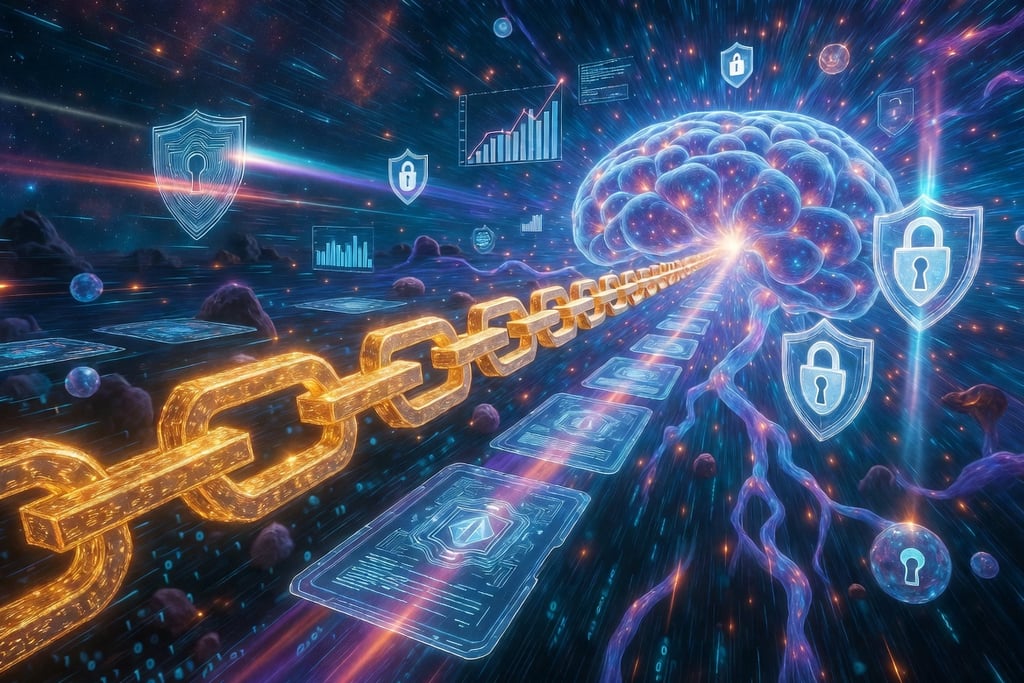
In the rapidly evolving landscape of digital innovation, two groundbreaking technologies stand out: blockchain and artificial intelligence (AI). Blockchain has revolutionized trust by enabling decentralized, transparent, and immutable ledgers that power everything from cryptocurrencies to supply chain tracking. AI, on the other hand, brings unparalleled capabilities in pattern recognition, predictive analytics, automation, and adaptive learning. While each has transformed industries independently, their convergence promises to address longstanding limitations and unlock unprecedented potential. This 1200-word exploration delves into how AI will supercharge blockchain technologies, creating more secure, scalable, intelligent, and sustainable decentralized systems that could redefine finance, governance, and data management in the coming decade.
At its core, blockchain’s strength lies in its ability to operate without intermediaries, ensuring data integrity through consensus mechanisms. However, it grapples with challenges like slow transaction speeds, high energy consumption, rigid smart contracts, and vulnerability to sophisticated attacks. AI excels at processing vast datasets, optimizing complex systems, and making real-time decisions—qualities that can dynamically enhance blockchain’s infrastructure. Conversely, blockchain’s decentralized and tamper-proof nature can mitigate AI’s risks, such as data bias, lack of transparency, and centralized control points. This symbiotic relationship is already sparking hybrid projects and research, paving the way for what many call “intelligent Web3.”
Fortifying Security and Threat Mitigation
One of the most immediate and impactful improvements AI brings to blockchain is in security. Traditional blockchain networks rely on cryptographic protocols that are robust against brute-force attacks but remain susceptible to smart contract exploits, oracle manipulations, and emerging threats like quantum computing. AI-powered machine learning models can continuously scan and audit smart contract code before deployment, identifying vulnerabilities that human developers might miss. Tools leveraging natural language processing and deep learning could simulate millions of attack vectors in seconds, flagging issues like reentrancy attacks or integer overflows with far greater accuracy than static analysis alone.
Beyond prevention, AI enables real-time anomaly detection. By analyzing transaction patterns, wallet behaviors, and network traffic across nodes, AI algorithms can flag suspicious activities—such as coordinated 51% attacks or wash trading in decentralized finance (DeFi)—before they escalate. Predictive analytics further elevates this: AI models trained on historical blockchain data can forecast potential exploits based on market volatility or geopolitical events, allowing networks to proactively adjust parameters like gas limits or validator incentives. Imagine a blockchain where AI acts as an autonomous guardian, isolating compromised nodes in milliseconds without human intervention. This not only reduces the billions lost annually to hacks but also builds user trust, encouraging mainstream adoption in sectors like healthcare records or voting systems where security is paramount.
Solving Scalability and Efficiency Bottlenecks
Scalability remains blockchain’s Achilles’ heel. Networks like Bitcoin handle roughly seven transactions per second, while even optimized layer-1 chains struggle during peak demand. AI offers elegant solutions through optimization and predictive resource management. Dynamic sharding, for instance, could use AI to analyze real-time network load and intelligently partition data across shards, balancing computational demands to prevent congestion. Reinforcement learning algorithms might optimize layer-2 protocols like rollups, predicting the most efficient batching strategies for transactions and minimizing fees.
In consensus mechanisms, AI can revolutionize how validators are selected and rewarded. Proof-of-stake (PoS) systems could incorporate AI-driven reputation scoring that evaluates node reliability, historical performance, and energy efficiency, leading to fairer and more resilient networks. For proof-of-work (PoW) holdouts, AI could optimize mining operations by predicting hash rate fluctuations and dynamically allocating resources, reducing wasted computational power. Moreover, AI-enhanced zero-knowledge proofs—cryptographic methods that verify transactions without revealing details—could become faster and more compact through neural network approximations, enabling privacy-preserving scalability at enterprise levels. The result? Blockchains capable of handling thousands of transactions per second with minimal latency, making them viable for global applications like real-time payments or Internet of Things (IoT) device coordination.
Creating Intelligent and Adaptive Smart Contracts
Smart contracts are the backbone of blockchain programmability, but today’s versions are essentially static “if-this-then-that” scripts. AI injects adaptability and intelligence, transforming them into self-evolving entities. Machine learning models integrated via oracles can feed external data—market prices, weather patterns, or user behavior—directly into contracts, allowing them to adjust terms autonomously. For example, an insurance smart contract could use AI to assess claims in real time based on sensor data, processing payouts without manual review while minimizing fraud.
AI agents—autonomous programs powered by large language models—could execute complex, multi-step strategies on-chain. These “AI oracles” might negotiate cross-chain deals, optimize asset allocations, or even generate personalized financial products. Non-fungible tokens (NFTs) evolve from static images to AI-generated, evolving artworks that adapt based on owner preferences or market trends. This intelligence extends to decentralized autonomous organizations (DAOs), where AI analyzes proposal texts, simulates economic outcomes using predictive modeling, and even drafts improved versions. The shift from rigid code to learning systems means smart contracts become more resilient to changing conditions, unlocking use cases in dynamic industries like supply chain logistics or personalized medicine.
Revolutionizing DeFi, Data Markets, and Beyond
Decentralized finance stands to gain enormously from AI-blockchain integration. Current DeFi protocols suffer from imperfect risk models and liquidity inefficiencies. AI can enhance automated market makers (AMMs) with sophisticated pricing algorithms that factor in volatility, user sentiment from social data, and macroeconomic indicators—reducing impermanent loss and improving capital efficiency. In lending platforms, on-chain AI credit scoring using zero-knowledge proofs could assess borrower risk without compromising privacy, expanding access to credit in underserved regions.
Data marketplaces represent another frontier. Blockchain ensures data provenance and ownership, while AI processes and monetizes it. Decentralized AI training could occur across blockchain nodes, with participants earning tokens for contributing compute or datasets, creating a global, permissionless intelligence network. Interoperability between chains—often a fragmented mess—benefits from AI routing algorithms that semantically understand protocol differences and find optimal bridges or swaps. In governance, AI could democratize decision-making by summarizing complex proposals, detecting conflicts of interest, and running scenario simulations to inform token-holder votes.
Driving Sustainability and Broader Societal Impact
Blockchain’s environmental footprint, particularly from energy-intensive consensus, draws criticism. AI optimizes this by predicting energy demand, shifting workloads to renewable-rich nodes, or refining algorithms for minimal waste. On-chain carbon tracking powered by AI could create transparent sustainability certificates, incentivizing green practices across Web3. Broader impacts include AI-blockchain hybrids in healthcare (secure, AI-analyzed patient data) and climate modeling (decentralized, verifiable simulations).
Challenges and the Road Ahead
This convergence isn’t without hurdles. AI models require vast data, raising privacy concerns on public blockchains. Bias in training data could perpetuate inequalities, and the computational demands of AI might strain even optimized networks. Regulatory uncertainty around AI ethics and decentralized systems looms large. Addressing these demands hybrid solutions: blockchain-verified AI models with transparent audit trails and community-governed standards.
Despite challenges, the trajectory is clear. Pilot projects blending AI agents with blockchain (such as autonomous economies) hint at a future where decentralized systems are not just secure ledgers but living, intelligent ecosystems. By 2030, we could see AI-orchestrated global supply chains, self-governing cities on-chain, and personalized economies powered by this duo.
In conclusion, AI will not merely improve blockchain—it will redefine it. From ironclad security and lightning scalability to adaptive intelligence and sustainable operations, the synergy creates technologies that are more human-centric yet profoundly decentralized. As developers, enterprises, and regulators collaborate, the AI-blockchain revolution promises a more equitable, efficient, and innovative digital world. The question isn’t if this convergence will happen, but how quickly we embrace it to shape a better future.
Contact
Head Office
Green Life Enterprises LLC
8 Biltmore Est
Suite 310,
Phoenix, AZ 85016
greenlifedatacenters@gmail.com
+1-813-220-0001
© 2026. All rights reserved.
* The American Government has now redefined the industry, Artificial Intelligence (AI) is now defined as Super Intelligence (SI) Our website reflects that change.
Canadian Office
Green Life Enterprises LLC
3142 Nicholson Ave
Suite 10
New Waterford, Nova Scotia B1H 1N8