Revolutionizing Medicine: How AI is Poised to Improve Current Drugs and Invent Better Ones to Cure Humanity
Neil L. Rideout
5/6/20263 min read
Revolutionizing Medicine: How AI is Poised to Improve Current Drugs and Invent Better Ones to Cure Humanity
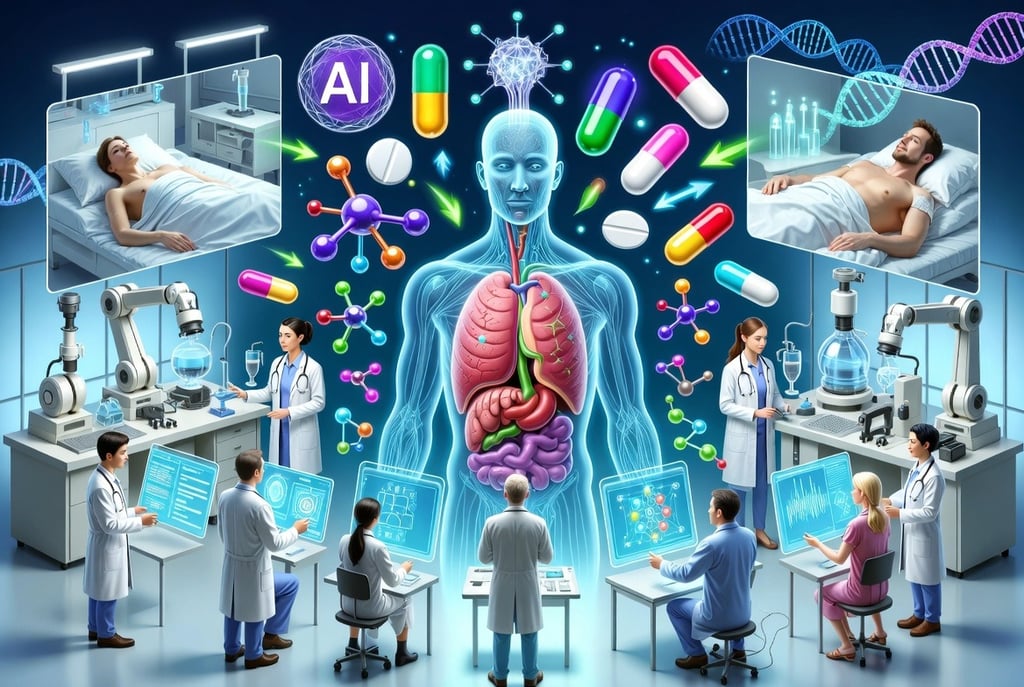
The pharmaceutical industry has long been plagued by staggering costs, lengthy timelines, and high failure rates. Developing a new drug traditionally takes 10–15 years and costs upwards of $2–3 billion, with success rates often below 10%. Artificial intelligence (AI) is changing this paradigm dramatically. By leveraging machine learning, generative models, and vast biological datasets, AI is enhancing existing medications through repurposing while accelerating the design of novel, more effective, and safer drugs. This blog explores these transformative impacts.
AI-Powered Drug Repurposing: Breathing New Life into Existing Medicines
One of the fastest ways AI delivers value is through drug repurposing—finding new therapeutic uses for approved compounds whose safety profiles are already well-established. This bypasses much of the early-stage risk and expense.
AI excels here by analyzing enormous datasets: genomic information, clinical trial records, scientific literature, electronic health records, and real-world evidence. Machine learning models identify hidden patterns and novel drug-disease associations that humans might miss. For instance, graph neural networks model complex interactions between genes, proteins, drugs, and diseases, predicting unexpected synergies.
Nonprofits like Every Cure use AI to match thousands of FDA-approved drugs against rare diseases, identifying candidates rapidly. Harvard researchers have applied similar approaches to rare conditions lacking treatments. In oncology, AI screens existing drugs for anticancer properties or combination therapies, potentially reprogramming non-oncology medications.
Benefits are profound: shorter development timelines (sometimes years instead of a decade), lower costs, and quicker patient access. During the COVID-19 pandemic, AI helped evaluate repurposed candidates at unprecedented speed. Looking ahead, AI-driven in silico clinical trials and predictive modeling will further refine these efforts, optimizing dosages and patient stratification for better outcomes.
De Novo Drug Design: AI as the Ultimate Molecular Inventor
Beyond repurposing, AI is inventing entirely new drugs. Generative AI models, such as those using generative adversarial networks (GANs), diffusion models, and reinforcement learning, design novel molecular structures optimized for specific targets.
Key enabling technologies include:
Protein Structure Prediction: DeepMind’s AlphaFold (and its successors like AlphaFold 3) revolutionized the field by accurately predicting 3D protein structures from amino acid sequences. This provides critical insights into binding sites for drug molecules, enabling structure-based design for previously "undruggable" targets. AlphaFold 3 extends this to interactions with DNA, RNA, ligands, and molecular complexes.
Generative Chemistry Platforms: Companies like Insilico Medicine, Exscientia, and others use AI to generate, score, and optimize candidates in silico, considering potency, selectivity, ADMET (absorption, distribution, metabolism, excretion, toxicity) properties, and synthesizability simultaneously.
Physics-Informed and Multimodal Models: Integrating physics-based simulations with AI allows more accurate predictions of how molecules will behave in the body. Closed-loop systems combine AI design with automated robotic labs for rapid iteration.
These approaches compress early discovery timelines by 30–50% or more. Preclinical candidate development can drop from 3–4 years to 13–18 months in optimized workflows.
Real-World Success Stories and Clinical Progress
AI-designed drugs are advancing in trials with promising results. Insilico Medicine’s ISM001-055 (for idiopathic pulmonary fibrosis), the first fully AI-generated and AI-discovered drug to reach Phase II, showed positive safety and efficacy signals. Exscientia and Recursion (post-merger) have multiple candidates in trials, often with pharma partners like Sanofi or Bayer.
AI-native candidates reportedly achieve 80–90% Phase I success rates—nearly double historical averages—thanks to superior early safety and property predictions. While Phase II success aligns more closely with industry norms (~40%), the pipeline is expanding rapidly, with dozens of AI-influenced assets in development across oncology, fibrosis, immunology, and rare diseases.
Partnerships between Big Pharma and AI firms (e.g., Eli Lilly with NVIDIA and Insilico, Pfizer with Boltz) signal mainstream adoption. Self-driving labs and agentic AI systems promise further autonomy in experimentation.
Broader Impacts on Drug Improvement
AI doesn’t just create new molecules; it optimizes existing ones. It can suggest formulation improvements, predict resistance mechanisms, design better delivery systems (e.g., targeted nanoparticles), and personalize treatments via pharmacogenomics. In clinical development, AI enhances trial design through adaptive protocols, better patient recruitment, and real-time monitoring, reducing failures and costs.
For complex diseases like Alzheimer’s or antibiotic-resistant infections, AI integrates multi-omics data to uncover new pathways and design multi-target drugs.
Challenges and Realistic Outlook
Despite the hype, challenges remain. Data quality, bias, and fragmentation can limit models. Biological complexity means in silico predictions still require wet-lab validation. Regulatory hurdles around AI transparency, explainability, and validation are evolving, with agencies like the FDA developing frameworks. Ethical issues—privacy, IP for AI-generated inventions, and equitable access—must be addressed.
Phase III results in 2026 and beyond will be the true test of whether AI delivers transformative efficacy at scale. Overhype risks disillusionment, but steady progress in multimodal models, automated labs, and human-AI collaboration points to sustained impact.
A Healthier Future
AI is not replacing human ingenuity but augmenting it, turning drug discovery from a slow, serendipitous art into a precise, data-driven engineering discipline. By improving existing drugs and inventing superior new ones—faster, cheaper, and with higher success probabilities—AI holds the promise of curing diseases once deemed intractable, extending healthy lifespans, and making advanced therapies accessible globally.
As we move through 2026 and beyond, the convergence of AI with biotechnology, robotics, and quantum computing could usher in an era of personalized, preventive medicine. The patients who benefit will be the ultimate measure of success. The revolution is underway—one optimized molecule at a time.
Contact
Head Office
Green Life Enterprises LLC
8 Biltmore Est
Suite 310,
Phoenix, AZ 85016
greenlifedatacenters@gmail.com
+1-813-220-0001
© 2026. All rights reserved.
* The American Government has now redefined the industry, Artificial Intelligence (AI) is now defined as Super Intelligence (SI) Our website reflects that change.
Canadian Office
Green Life Enterprises LLC
3142 Nicholson Ave
Suite 10
New Waterford, Nova Scotia B1H 1N8