Revolutionizing Indie Cinema: How AI Empowers Amateur and Independent Filmmakers
Neil L. Rideout
5/26/20265 min read
Revolutionizing Indie Cinema: How AI Empowers Amateur and Independent Filmmakers
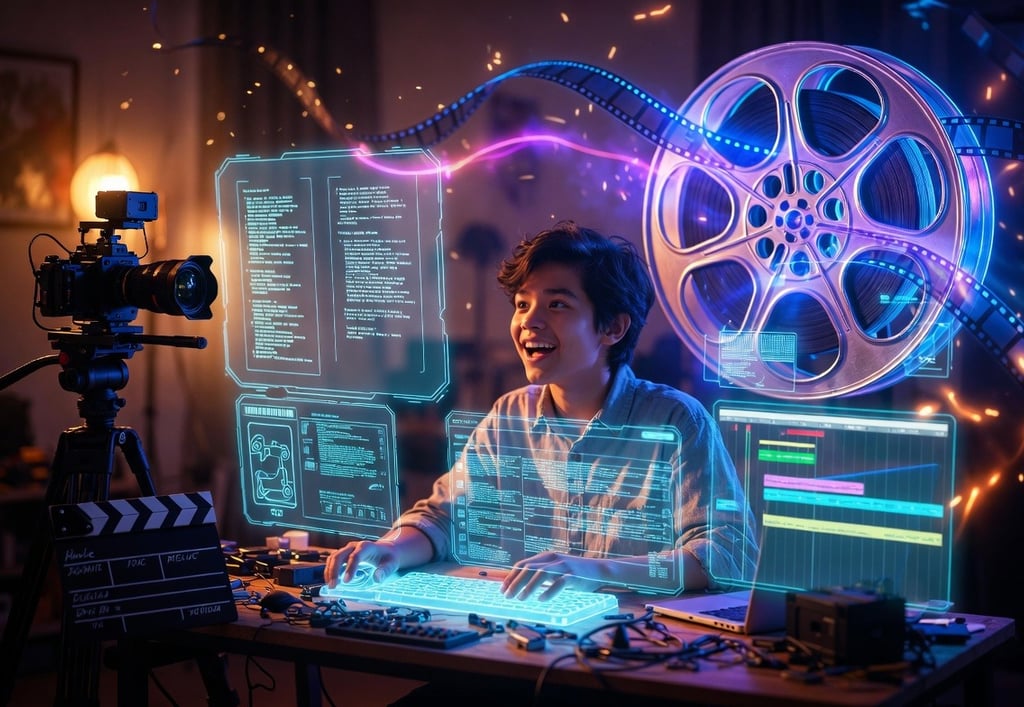
The world of filmmaking has long been gated by massive budgets, expensive equipment, and industry connections. For decades, amateur and independent creators dreamed of telling their stories but were held back by the prohibitive costs of production, post-production, and distribution. Enter artificial intelligence: a democratizing force that's rapidly leveling the playing field. In 2026, AI tools are not just assisting Hollywood blockbusters—they're enabling bedroom filmmakers to produce professional-grade content that rivals studio productions. This blog explores how AI is transforming every stage of the filmmaking process for amateurs and independents, unlocking creativity, slashing costs, and fostering a new golden age of diverse storytelling.
Breaking Down Barriers in Pre-Production
Pre-production has traditionally been one of the most resource-intensive phases. Writing scripts, developing storyboards, and scouting locations required teams of professionals and significant time investments. AI changes this dramatically.
For scriptwriting, tools like advanced language models (successors to GPT architectures and specialized film AIs) can generate drafts, suggest plot twists, refine dialogue, and even ensure cultural authenticity. An amateur filmmaker in Sydney, Nova Scotia, with a compelling idea but limited writing experience can input a basic premise—"a quiet fishing town haunted by climate change memories"—and receive a polished 90-page screenplay in minutes. These AIs learn from vast datasets of successful films, helping creators avoid clichés while amplifying unique voices. More importantly, they iterate quickly. Want to make the protagonist more complex or shift the genre from drama to thriller? The AI adapts instantly, allowing filmmakers to experiment without the fear of writer's block stalling progress for months.
Storyboarding, once requiring artistic talent or hired illustrators, is now accessible through AI image and video generators. Tools can turn text descriptions into detailed visual panels, complete with camera angles, lighting suggestions, and character designs. Independent creators use these to visualize scenes before investing in actual shooting. This not only saves money but helps pitch projects more effectively to potential collaborators or crowdfunding backers. Virtual location scouting via AI-powered 3D environment generators means you can "visit" and modify exotic or impossible sets without leaving your desk. A filmmaker in a small Canadian town can simulate a bustling Tokyo street or a dystopian Mars colony with remarkable realism.
These pre-production efficiencies reduce the traditional need for large teams. Solo or micro-crew operations become viable, empowering marginalized voices—women, people of color, LGBTQ+ creators, and those from rural areas—who have historically been excluded due to networking barriers in major film hubs like Los Angeles or Toronto.
AI on Set: Production Revolution
Shooting a film used to demand costly cameras, lighting rigs, and specialized crew. AI is compressing these requirements. Modern smartphones paired with AI enhancement apps can now produce footage that approaches cinema quality. Real-time AI stabilization, color grading, and noise reduction turn shaky handheld shots into smooth, professional sequences.
Virtual production, popularized by shows like The Mandalorian, is now democratized. AI-driven LED walls and real-time rendering engines allow independents to create immersive environments without green screens or expensive VFX houses. An amateur director can direct actors against AI-generated backgrounds that respond dynamically to camera movement. This technology, once exclusive to big studios, is available through affordable software subscriptions or even open-source alternatives.
Casting is another area seeing massive disruption. AI talent databases and deepfake-adjacent (but ethically controlled) technologies allow filmmakers to audition virtual actors or enhance performances. For character actors with limited availability, AI can generate consistent performances across multiple takes. Voice synthesis tools help dub lines or create unique character voices without hiring expensive talent. While this raises ethical questions around consent and deepfakes, responsible indie creators are using these tools transparently to expand representation—generating diverse characters that might otherwise be impossible due to budget constraints.
Crowdfunding campaigns for indie films are also supercharged by AI. Tools can generate compelling trailers, posters, and social media content tailored to target audiences, increasing funding success rates. An independent filmmaker can prototype their entire visual pitch deck in days rather than weeks.
Post-Production: The Great Equalizer
If pre-production and production benefit from AI, post-production sees perhaps the most dramatic transformation. Editing, sound design, visual effects, and color grading traditionally consumed 60-70% of a film's budget and timeline.
AI editing assistants can analyze hours of footage, suggest optimal cuts, identify emotional beats, and even assemble rough cuts based on script alignment. Software like Adobe's Sensei or specialized indie tools can automatically sync audio, remove background noise, and suggest pacing improvements. For a solo editor working on a laptop, this means turning raw footage into a coherent narrative much faster—critical when you're balancing a day job with filmmaking passion.
Visual effects (VFX) that once required teams of artists and render farms are now accessible. Generative AI can create realistic explosions, creature designs, weather effects, or seamless CGI characters. Tools allow text-to-video generation for complex sequences, enabling amateurs to include epic shots that would have bankrupted previous indie projects. Imagine a low-budget sci-fi film with convincing spaceship battles or a horror short with nightmarish creatures—all generated and refined by AI under human creative direction.
Sound design benefits equally. AI can generate custom soundscapes, Foley effects, and original music scores tailored to the film's mood. Composers with limited formal training can collaborate with AI to produce orchestral pieces or electronic scores. Dialogue enhancement tools fix poor location audio, a common issue for guerrilla-style indie shoots.
Color grading, once an art mastered by few, is automated with AI suggesting cinematic LUTs (lookup tables) that match references from famous films while maintaining a unique style. The result? Films that look and sound polished without the traditional $50,000+ post-production budget.
Marketing, Distribution, and Audience Building
The journey doesn't end at completion. AI helps indie filmmakers cut through the noise in a saturated content landscape. Predictive analytics tools analyze market trends, suggesting optimal release timing and platforms. AI-generated trailers optimized for different social media algorithms can boost visibility on TikTok, YouTube, or Instagram.
Personalized marketing campaigns reach niche audiences more effectively. An AI can craft press releases, festival submissions, and even negotiate distribution deals by analyzing contract language. Streaming platforms' recommendation engines favor content with strong AI-assisted SEO and metadata—giving smart independents an edge.
On the distribution front, AI is enabling direct-to-audience models. Blockchain and AI-powered platforms allow creators to retain more revenue through smart contracts and fan engagement tools. Virtual reality premieres or AI-moderated Q&A sessions expand reach beyond traditional theaters.
Challenges and Responsible Innovation
While the opportunities are immense, AI in filmmaking isn't without challenges. Copyright concerns around training data, potential homogenization of styles, and job displacement for traditional crew roles are valid issues. Amateur and independent filmmakers must prioritize ethical AI use—crediting sources, maintaining human creative oversight, and avoiding harmful deepfakes.
There's also a learning curve. Successful creators will be those who master "prompt engineering" and understand AI limitations rather than treating tools as magic. Over-reliance on AI could lead to generic content, so the best indie films will blend technology with authentic human emotion and cultural specificity.
The Future: A New Renaissance
Looking ahead, AI will continue evolving. Multimodal models will integrate text, video, audio, and even haptics for more immersive creation. Real-time collaborative AI could allow global micro-teams to work seamlessly. As hardware improves, on-device AI processing will make high-end tools available offline in remote locations like rural Nova Scotia.
For amateur and independent filmmakers, this means stories that might never have been told—from unique regional perspectives, experimental narratives, or hyper-personal documentaries—will reach global audiences. Diversity in cinema will flourish as barriers to entry crumble.
The democratization of filmmaking through AI echoes the impact of digital cameras and editing software in the 1990s and 2000s, but on a much larger scale. Just as those technologies birthed the mumblecore movement and YouTube creators, today's AI revolution is poised to unleash unprecedented creativity.
Independent filmmakers no longer need to wait for permission from gatekeepers. With AI as a creative partner, the only limitations are imagination and dedication. Whether you're crafting your first short film on a smartphone or building a feature-length epic from your home office, the tools exist today to make it professional, compelling, and uniquely yours.
The future of cinema isn't just bigger—it's broader, more inclusive, and infinitely more creative. Pick up your camera, fire up those AI tools, and start telling your story. The world is ready to watch.
Contact
Head Office
Green Life Enterprises LLC
8 Biltmore Est
Suite 310,
Phoenix, AZ 85016
greenlifedatacenters@gmail.com
+1-813-220-0001
© 2026. All rights reserved.
* The American Government has now redefined the industry, Artificial Intelligence (AI) is now defined as Super Intelligence (SI) Our website reflects that change.
Canadian Office
Green Life Enterprises LLC
3142 Nicholson Ave
Suite 10
New Waterford, Nova Scotia B1H 1N8