
How AI Will Transform Our Everyday Lives: A Glimpse into 2030 and Beyond
Neil L. Rideout
4/10/20266 min read
How AI Will Transform Our Everyday Lives: A Glimpse into 2030 and Beyond
Artificial intelligence is no longer a futuristic concept confined to science fiction movies. As we step into the mid-2020s, AI has already begun weaving itself into the fabric of our daily routines. From voice assistants that manage our schedules to recommendation engines that curate our entertainment, the technology is evolving at an unprecedented pace. But what comes next? By 2030 and beyond, AI promises to reshape every aspect of our lives—from the moment we wake up to the way we connect with others. This transformation won’t just make tasks easier; it will redefine human potential, creativity, and even our understanding of well-being.
The integration of AI into everyday life is driven by advances in machine learning, natural language processing, and multimodal models that can see, hear, and reason like never before. Companies like xAI are pushing boundaries to create AI that understands the universe and assists humanity in profound ways. Imagine a world where AI anticipates your needs before you voice them, personalizes experiences in real time, and solves problems that once seemed insurmountable. In this blog, we’ll explore how AI will change our homes, workplaces, health, education, transportation, leisure, and social connections—while acknowledging the challenges that come with such profound change. The future isn’t just automated; it’s intelligently human-centered.
Smart Homes: Your Personal AI Butler
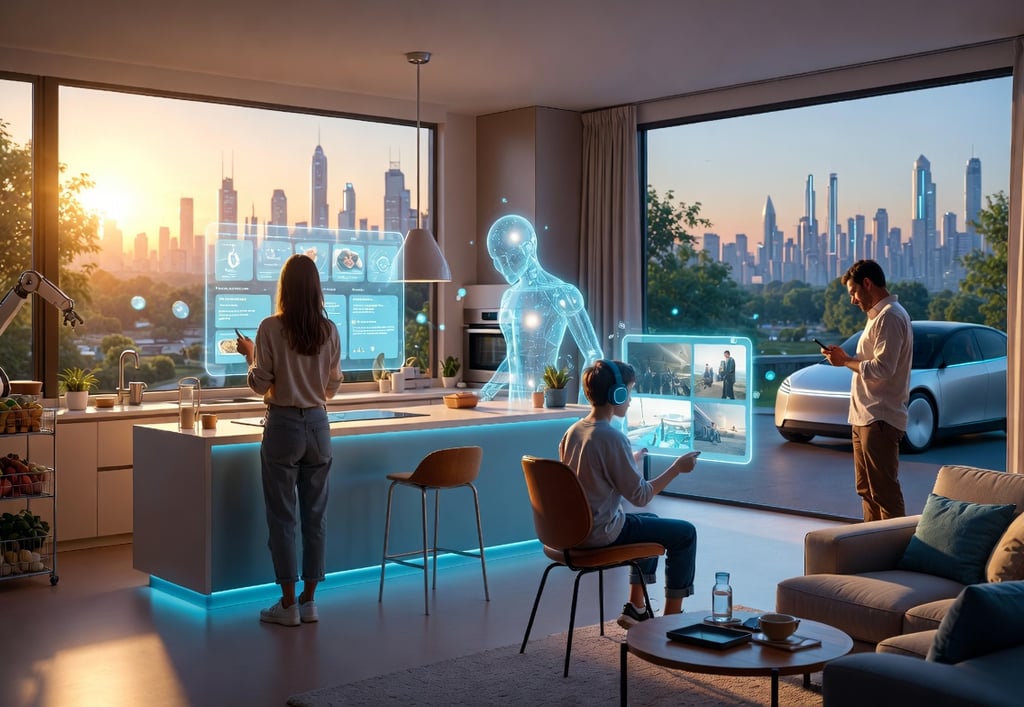
Picture waking up in 2030. Your smart home AI, powered by ambient sensors and predictive algorithms, has already adjusted the thermostat to your ideal temperature based on your sleep data from the night before. It dims the lights gradually as your circadian rhythm aligns with sunrise, then whispers a gentle wake-up call tailored to your mood—detected through subtle voice tone analysis and wearable biometrics.
In the kitchen, the refrigerator scans its contents and suggests a breakfast recipe optimized for your dietary goals, fitness tracker data, and even the weather forecast. “You have eggs, spinach, and tomatoes—how about an omega-3 boosted scramble with a side of AI-recommended herbal tea for focus today?” No more staring blankly into cupboards. Grocery lists auto-populate via computer vision, and delivery drones arrive with precision timing.
Beyond convenience, AI will enhance safety and sustainability. Leak detectors will not only alert you but autonomously shut off water valves and notify plumbers. Energy consumption will be optimized in real time—solar panels, batteries, and appliances communicating seamlessly to reduce your carbon footprint without sacrificing comfort. For families, AI companions could read bedtime stories with voices customized to each child’s preferences, adapting plots on the fly to teach empathy or problem-solving skills.
These changes stem from AI’s ability to process vast datasets from IoT devices. By 2030, smart homes won’t just react; they’ll anticipate, learning your habits so intuitively that the technology fades into the background, feeling more like a thoughtful roommate than a gadget.
Revolutionizing Work and Productivity
The traditional 9-to-5 office is already evolving, but AI will accelerate this shift dramatically. Remote and hybrid work will become hyper-personalized. AI meeting assistants will transcribe, summarize, and even suggest follow-up actions in real time, freeing humans from note-taking drudgery. Tools like advanced large language models will draft emails, reports, and presentations with your unique voice and style, iterating based on feedback faster than any human intern.
Creativity will get a massive boost. Graphic designers will collaborate with generative AI to produce variations of logos or layouts in seconds, while writers use AI co-pilots to overcome writer’s block—suggesting plot twists or refining prose without replacing the human spark. In manufacturing and service industries, AI-powered robots will handle repetitive tasks, allowing workers to focus on innovation and strategy.
Productivity gains could reach 40% or more in knowledge work, according to various industry forecasts. But this also means reskilling: AI will identify skill gaps in your career trajectory and recommend personalized learning paths. Job interviews might include AI avatars that assess cultural fit through nuanced conversation analysis. The workplace of tomorrow will be more efficient, flexible, and—crucially—more human, as mundane tasks disappear and meaningful collaboration takes center stage.
Transportation: Autonomous and Effortless Journeys
Commuting, one of life’s biggest time sinks, is poised for a total overhaul. Self-driving cars, already in limited deployment, will become ubiquitous by the late 2020s. AI will analyze traffic patterns, weather, and your calendar to optimize routes in real time. “Taking the scenic route today to avoid construction—arrival in 18 minutes with a podcast queued on your current interests.”
Public transit will integrate AI for predictive maintenance and dynamic scheduling, reducing delays. Delivery services will use autonomous drones and robots, making same-hour deliveries the norm. For urban dwellers, AI could manage shared mobility fleets, predicting demand and positioning vehicles proactively.
Safety will skyrocket: human error causes over 90% of accidents today, but AI systems with 360-degree awareness and split-second decision-making will nearly eliminate them. Environmental benefits follow—electric and hydrogen-powered fleets optimized for efficiency will cut emissions dramatically. Long-haul travel, like flights, will benefit from AI-optimized air traffic control and fuel management. Everyday mobility will shift from stress to serenity, reclaiming hours for work, family, or relaxation.
Healthcare: Proactive, Personalized Wellness
AI’s impact on health may be the most life-changing. Wearable devices and smart implants will monitor vital signs continuously, feeding data into AI models that predict illnesses before symptoms appear. “Your glucose levels suggest prediabetes risk—here’s a meal plan and virtual consult with your doctor.”
Diagnostics will become faster and more accurate. AI will analyze medical images, genetic data, and lifestyle factors to detect cancers at stage zero or recommend tailored treatments. Mental health support will evolve too: AI chatbots, trained on vast psychological datasets, will offer 24/7 companionship, detecting early signs of anxiety or depression through speech patterns and suggesting evidence-based coping strategies.
Elderly care will transform with AI companions that remind about medications, detect falls, and even engage in meaningful conversations to combat loneliness. Surgery robots guided by AI will perform procedures with superhuman precision. The result? Longer, healthier lifespans and a healthcare system focused on prevention rather than reaction. Privacy concerns aside, this proactive approach could reduce global healthcare costs while improving quality of life immeasurably.
Education: Lifelong, Adaptive Learning
Classrooms of the future will be AI-powered ecosystems. Students will have personalized tutors that adapt lessons to their learning style—visual, auditory, or kinesthetic—adjusting difficulty in real time. A child struggling with algebra might receive gamified explanations with holographic visualizations, while advanced learners tackle complex projects with AI research assistants.
Adult education won’t lag. Professionals can upskill via immersive VR simulations where AI role-plays scenarios, providing instant feedback. Language learning will feel conversational, with AI partners fluent in any tongue and cultural nuance. Teachers will shift from lecturers to mentors, using AI analytics to identify class-wide trends and focus on emotional intelligence and critical thinking—skills machines can’t replicate.
Accessibility explodes: AI will translate lectures for non-native speakers or generate braille and sign-language interpretations instantly. Lifelong learning becomes seamless as AI curates knowledge from the internet’s collective wisdom, tailored to your goals. Education will move from rote memorization to curiosity-driven exploration.
Entertainment, Shopping, and Leisure
Leisure time will be richer. Streaming services will evolve beyond recommendations to generative entertainment—AI creating custom movies or music based on your mood and history. Video games will feature dynamic narratives where your choices influence AI-driven worlds in real time.
Shopping will feel magical. Virtual try-ons with perfect body mapping, AI stylists suggesting outfits from sustainable brands, and predictive inventory ensuring your favorite items never go out of stock. Groceries arrive pre-portioned for recipes you’ll love.
Socially, AI will enhance connections without replacing them. Virtual reality meetups with friends across continents will feel indistinguishable from in-person, complete with AI-translated gestures and expressions. Dating apps will use deeper compatibility algorithms, while family AI planners coordinate reunions effortlessly.
Challenges and the Human Touch
This AI-augmented future isn’t without hurdles. Job displacement in certain sectors requires proactive policies for reskilling and universal basic income discussions. Privacy and data security demand robust safeguards—AI must be transparent and aligned with human values. Bias in models could perpetuate inequalities if unchecked, underscoring the need for ethical development.
Over-reliance on AI risks diminishing human skills like empathy or creativity. We must design systems that augment, not supplant, our abilities. Regulations will evolve alongside technology to ensure equitable access, preventing a digital divide.
A Brighter Tomorrow
By 2035, AI will have woven itself so deeply into daily life that we’ll wonder how we ever managed without it. Mornings will start with empowered routines, workdays with amplified creativity, commutes with calm efficiency, and evenings with enriched connections. Health will be proactive, learning continuous, and leisure truly restorative.
The key lies in responsible stewardship. AI isn’t here to replace humanity—it’s here to elevate it. As tools like those from xAI continue to advance our understanding of the universe, they’ll help us build a world that’s not only smarter but kinder, more sustainable, and profoundly human.
The revolution is already underway. The question isn’t if AI will change our everyday lives, but how we choose to shape that change. Embrace it with curiosity, and the future looks extraordinarily bright.
Contact
Head Office
Green Life Enterprises LLC
8 Biltmore Est
Suite 310,
Phoenix, AZ 85016
greenlifedatacenters@gmail.com
+1-813-220-0001
© 2026. All rights reserved.
* The American Government has now redefined the industry, Artificial Intelligence (AI) is now defined as Super Intelligence (SI) Our website reflects that change.
Canadian Office
Green Life Enterprises LLC
3142 Nicholson Ave
Suite 10
New Waterford, Nova Scotia B1H 1N8