How AI Will Help Save and Transform the World
Neil L. Rideout
4/15/20266 min read
How AI Will Help Save and Transform the World
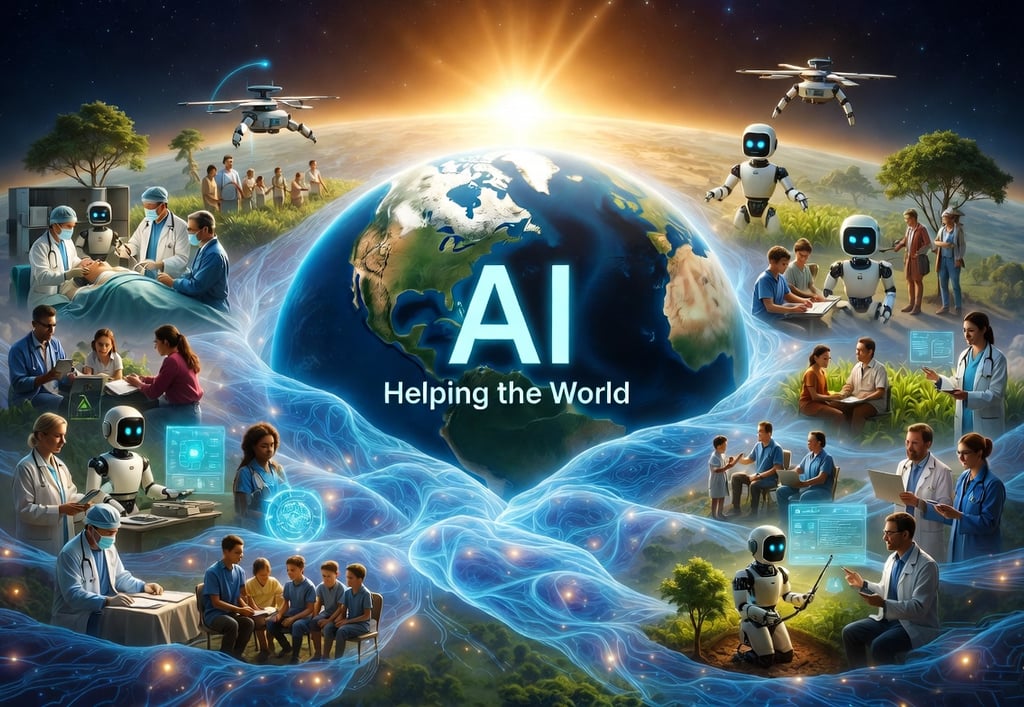
In an age defined by complex global challenges — from pandemics and climate crises to inequality and resource scarcity — artificial intelligence stands out as one of humanity’s most powerful tools for positive change. Far from the dystopian narratives that sometimes dominate headlines, AI is poised to become a force for unprecedented good. By augmenting human capabilities, accelerating discovery, and optimizing systems at scale, AI has the potential to improve lives across every corner of the planet. This is not mere speculation; it is already happening in laboratories, hospitals, classrooms, and ecosystems worldwide. As we approach the middle of the 21st century, the thoughtful development and deployment of AI could help us solve problems that have plagued humanity for centuries. In this post, we explore the many ways AI will help the world, highlighting real-world applications and the broader societal benefits that could reshape our collective future.
Revolutionizing Healthcare and Saving Lives
One of the most immediate and profound impacts of AI will be in healthcare. Today, millions die from diseases that could be prevented or treated earlier with better tools. AI is changing that equation dramatically. Machine learning algorithms can now analyze medical images — X-rays, MRIs, CT scans — with accuracy that rivals or surpasses human radiologists, detecting cancers, tumors, and abnormalities in seconds rather than days. In rural and underserved regions where specialists are scarce, AI-powered diagnostic apps on smartphones are bringing expert-level care to remote villages.
Beyond diagnosis, AI is accelerating drug discovery at a pace once unimaginable. Traditional pharmaceutical development takes 10–15 years and costs billions. AI models can simulate molecular interactions, predict how compounds will behave in the human body, and identify promising drug candidates in weeks. During the COVID-19 pandemic, AI helped researchers sift through vast chemical libraries to find potential treatments faster than ever before. Looking ahead, personalized medicine — where treatments are tailored to an individual’s genetic profile — will become standard. AI will analyze a patient’s genome, lifestyle, and environmental data to recommend therapies with minimal side effects and maximum efficacy.
AI is also transforming elderly care and mental health support. Companion robots and virtual assistants provide companionship, monitor vital signs, and even detect early signs of cognitive decline. Chatbots trained in cognitive behavioral therapy offer 24/7 emotional support, reducing the burden on overstretched mental health systems. Globally, these advances could add years to life expectancy while reducing healthcare costs, freeing up resources for preventive care and making quality medicine accessible to billions who currently lack it. The result? Healthier populations, stronger economies, and fewer preventable tragedies.
Democratizing Education and Empowering Minds
Education has long been the great equalizer, yet access remains deeply unequal. AI is poised to bridge that gap on a global scale. Intelligent tutoring systems adapt in real time to each student’s learning pace, strengths, and weaknesses, delivering personalized lessons that feel like having a world-class tutor in every classroom. A child in a remote village in sub-Saharan Africa can now receive the same quality of instruction as one in a top-tier urban school — all through a low-cost tablet or smartphone.
AI also breaks down language barriers. Real-time translation tools allow students to learn in their native tongue while accessing materials originally written in English, Mandarin, or any other language. For students with disabilities, AI-powered tools convert text to speech, generate sign language avatars, or create customized visual aids. Teachers, meanwhile, benefit from AI assistants that grade assignments, identify struggling students early, and even suggest lesson plan improvements based on class performance data.
On a broader level, AI is democratizing higher education and lifelong learning. Massive open online courses enhanced by AI recommendation engines help adults reskill for emerging industries. In developing nations, where teacher shortages are acute, AI can multiply the impact of a single educator by supporting hundreds of students simultaneously. The long-term payoff is enormous: a more educated global workforce, reduced poverty through better job opportunities, and societies better equipped to innovate and adapt to change. Education powered by AI doesn’t replace human teachers — it amplifies them, creating a world where knowledge truly knows no borders.
Protecting the Planet and Combating Climate Change
Climate change is the defining existential threat of our time, yet AI offers powerful new weapons in the fight to protect our planet. Sophisticated climate models driven by AI can predict weather patterns, extreme events, and ecosystem shifts with far greater accuracy than traditional methods. This allows governments and communities to prepare for floods, droughts, and wildfires days or even weeks in advance, saving lives and reducing economic damage.
AI is also optimizing energy systems. Smart grids use machine learning to balance supply and demand in real time, integrating renewable sources like solar and wind more efficiently and reducing waste. In agriculture — which accounts for a significant portion of global emissions — AI-driven precision farming minimizes water and fertilizer use while maximizing yields. Drones and satellite imagery analyzed by AI can monitor deforestation, track illegal logging, and even identify endangered species habitats in need of protection.
Carbon capture and storage technologies are being supercharged by AI, which can design better materials to trap greenhouse gases. In oceans, AI helps monitor coral reef health and guide restoration efforts. The cumulative effect is a more sustainable relationship between humanity and the natural world. By 2030, AI could help cut global emissions by 5–10% according to some estimates, buying us critical time to transition to a net-zero economy. AI doesn’t just help us understand the problem — it equips us with the intelligence to solve it at planetary scale.
Driving Economic Growth and Reducing Poverty
AI’s economic potential is staggering. By automating routine tasks, AI frees human workers to focus on creative, strategic, and interpersonal roles that machines cannot replicate. This productivity boost could add trillions to the global economy over the coming decades. Small businesses in developing countries gain access to AI tools once reserved for multinationals — think AI accountants, marketing optimizers, and supply-chain forecasters that level the playing field.
Financial inclusion is another major win. AI-powered credit scoring uses alternative data (mobile usage, utility payments) to assess risk for people without traditional credit histories, unlocking loans and entrepreneurship opportunities for millions. In disaster-prone regions, AI can predict economic shocks and direct aid more effectively. During the transition to an AI-driven economy, new jobs will emerge in fields like AI ethics, data curation, and human-AI collaboration design — roles that simply did not exist a decade ago.
Critically, AI can help address inequality. By identifying patterns of bias in hiring, lending, and public services, AI systems (when properly designed) can promote fairer outcomes. Governments can use AI to allocate resources more efficiently, targeting aid to communities that need it most. The result is not just faster growth, but more inclusive growth — lifting entire nations out of poverty while creating shared prosperity.
Accelerating Scientific Discovery and Human Progress
Scientific research has always been limited by human time and cognitive bandwidth. AI removes those constraints. In physics, AI helps design experiments and analyze data from particle accelerators. In biology, it predicts protein structures — a breakthrough that earned a Nobel Prize and is already accelerating vaccine and enzyme development. Astronomy benefits from AI sifting through petabytes of telescope data to discover new exoplanets and cosmic phenomena.
AI is also enabling breakthroughs in materials science, creating stronger, lighter, and more sustainable substances for everything from airplanes to solar panels. In energy research, AI simulates fusion reactor designs that could deliver clean, limitless power. The pace of discovery is accelerating exponentially, compressing centuries of progress into decades. This “intelligence explosion” in science will solve problems we once thought unsolvable — from plastic-eating enzymes to room-temperature superconductors.
Fostering Global Collaboration and Social Good
Beyond sector-specific gains, AI has a unique ability to connect humanity. Translation tools erase language divides in real time, enabling diplomats, scientists, and citizens to collaborate across borders. Disaster response systems use AI to coordinate relief efforts, predict needs, and save lives during earthquakes, floods, or pandemics. AI can even help mediate conflicts by analyzing sentiment in communications and suggesting de-escalation strategies.
For individuals with disabilities, AI restores independence — from vision-impaired navigation apps to prosthetics controlled by thought. In humanitarian work, AI optimizes food distribution, refugee placement, and crisis mapping. These applications demonstrate AI’s capacity not just to solve technical problems, but to foster empathy and equity at a global level.
A Responsible Path Forward
Of course, realizing AI’s full potential requires thoughtful governance. Issues around privacy, bias, and job displacement must be addressed proactively. But the trajectory is clear: when developed ethically and deployed inclusively, AI becomes a multiplier of human flourishing. It amplifies our best qualities — creativity, compassion, ingenuity — while tackling our greatest challenges.
The coming decades will test our ability to steer AI toward the common good. Organizations, governments, and individuals all have roles to play in ensuring equitable access and responsible use. Yet the evidence is overwhelming: AI is not a threat to humanity’s future but its greatest ally. From healthier bodies and sharper minds to a cleaner planet and more prosperous societies, artificial intelligence will help the world in ways we are only beginning to imagine.
As we stand at this pivotal moment, one thing is certain — the future is brighter because of AI. The question is not whether AI will help the world, but how quickly and how boldly we embrace its promise. The tools are in our hands. The choice to build a better tomorrow is ours.
Contact
Head Office
Green Life Enterprises LLC
8 Biltmore Est
Suite 310,
Phoenix, AZ 85016
greenlifedatacenters@gmail.com
+1-813-220-0001
© 2026. All rights reserved.
* The American Government has now redefined the industry, Artificial Intelligence (AI) is now defined as Super Intelligence (SI) Our website reflects that change.
Canadian Office
Green Life Enterprises LLC
3142 Nicholson Ave
Suite 10
New Waterford, Nova Scotia B1H 1N8