
How AI Will Change Artists and Entertainment: The Dawn of a New Creative Era
Neil L. Rideout
4/20/20265 min read
How AI Will Change Artists and Entertainment: The Dawn of a New Creative Era
The entertainment industry has always been a mirror to human imagination, reflecting our deepest emotions, stories, and cultural shifts. From the brushstrokes of Renaissance painters to the blockbuster films that dominate global box offices, artists have been the architects of wonder. But as we stand on the cusp of 2026, artificial intelligence is no longer a distant sci-fi concept—it is reshaping the very foundations of creativity. AI is not just a tool; it is becoming a collaborator, a catalyst, and, in some cases, a disruptor. This transformation promises to democratize art, amplify entertainment experiences, and challenge what it means to be “creative.” In this 1,200-word exploration, we dive into how AI is poised to redefine artists’ roles and revolutionize the entertainment landscape.
Let’s begin with the visual arts, where AI’s impact is already palpable. Tools like generative adversarial networks (GANs) and diffusion models—think Midjourney, DALL-E, and Stable Diffusion—have turned text prompts into stunning imagery in seconds. What once took a professional illustrator weeks can now be prototyped instantly. For independent artists, this lowers barriers to entry dramatically. A solo creator in a small studio can generate concept art, iterate on designs, and even produce high-resolution prints without a massive team or budget. Galleries and museums are already exhibiting AI-assisted works, sparking debates about authorship. Is the artist the prompter, the algorithm, or the symbiotic duo?
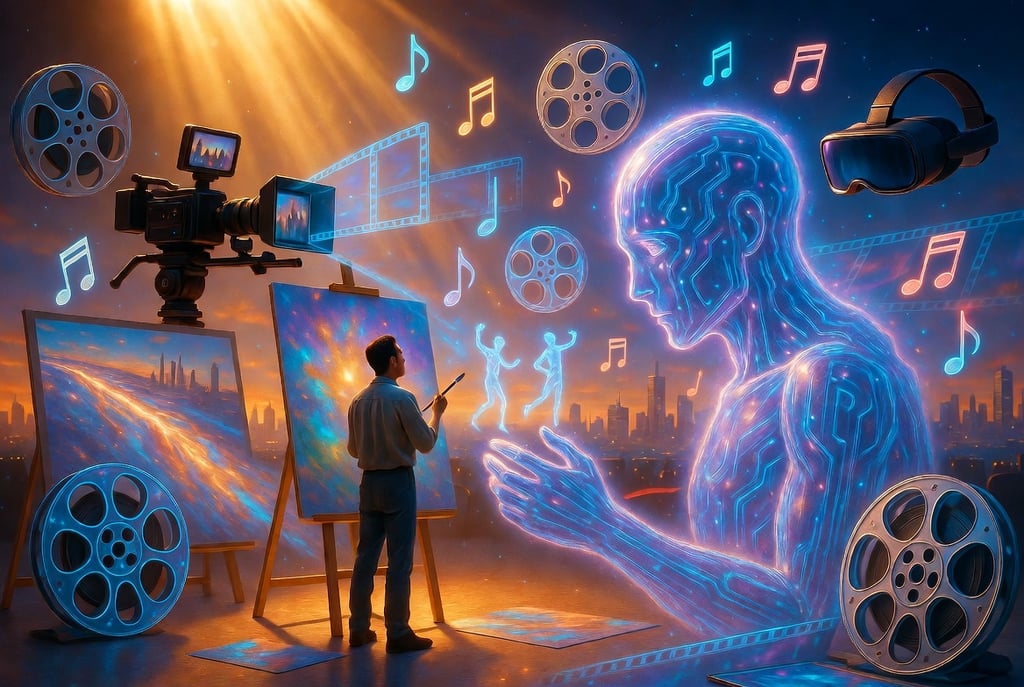
Yet this shift is double-edged. Traditional illustrators and concept artists in film, gaming, and advertising fear obsolescence. Stock image libraries are flooded with AI-generated content, undercutting prices and forcing human creators to pivot toward curation, editing, and personalization. The real opportunity lies in hybrid workflows: artists who master AI as an extension of their palette will thrive. Imagine a painter using AI to generate infinite variations of a landscape, then applying hand-finished details that infuse soul and imperfection—qualities algorithms still struggle to replicate authentically. AI excels at speed and scale but lacks lived experience, cultural nuance, and emotional depth. The artists who succeed will be those who direct AI’s output with vision, turning it from a replacement into a powerful co-pilot.
Music and the performing arts are undergoing a parallel revolution. AI composition tools such as AIVA, Suno, and Udio can generate full tracks—from orchestral scores to pop hooks—based on genre, mood, or even lyrics. Musicians are already releasing AI-assisted albums, while streaming platforms experiment with personalized soundtracks that adapt to listeners’ heart rates or daily routines. In live performance, virtual idols like Hatsune Miku have paved the way for AI-driven holograms and deepfake avatars that tour globally without logistical nightmares. Emerging artists can now bypass expensive studio time; a bedroom producer with a laptop can create radio-ready demos overnight.
This democratization is exhilarating, yet it raises questions about originality and royalties. When an AI model is trained on millions of copyrighted songs, who owns the output? Lawsuits against companies like OpenAI and Stability AI highlight the tension. For established musicians, AI offers new revenue streams—licensing their style to train custom models or collaborating on experimental projects. Emerging talent benefits most: songwriters can focus on lyrics and emotion while AI handles complex arrangements. The future of music may be hyper-personalized concerts where AI generates setlists in real time based on audience energy, or interactive operas where viewers influence the score via app. Human performers will remain irreplaceable for the raw connection of live energy, but AI will expand the stage, creating hybrid spectacles that blend flesh-and-blood talent with digital augmentation.
Nowhere is AI’s influence more transformative than in film, television, and broader entertainment. Hollywood is already using AI for script analysis, pre-visualization, and even generating entire scenes. Tools like Runway ML and Sora can produce short video clips from text descriptions, accelerating pre-production and reducing costs that often bankrupt indie projects. Directors can test multiple story endings or visualize impossible CGI sequences before committing millions. Voice synthesis and deepfake technology allow deceased actors to appear in new roles with consent protocols, while AI-driven editing software can cut a feature film in hours instead of months.
Entertainment consumption itself is evolving toward personalization at scale. Streaming giants are deploying recommendation engines that don’t just suggest content—they generate it. Netflix-style platforms could soon offer “choose-your-own-adventure” movies where AI tailors plots, characters, and endings to individual viewers’ preferences, history, and even real-time emotional feedback from facial recognition. Video games are leaping forward with procedural generation: entire worlds built by AI that respond dynamically to player choices, creating infinite replayability. Virtual reality and augmented reality experiences, powered by AI companions, will blur the line between audience and participant. Imagine stepping into a live-action role in your favorite franchise, with AI NPCs remembering your past decisions across sessions.
These advancements promise abundance. Blockbuster budgets could shrink as AI handles VFX, animation, and even marketing assets. Global storytelling becomes more inclusive—creators from underrepresented regions can produce high-quality content without Hollywood gatekeepers. Yet the entertainment industry must grapple with profound challenges. Job displacement is real: visual effects artists, background actors, and junior writers face automation risks. The Writers Guild of America strikes of recent years underscored fears that AI-generated scripts could dilute human storytelling. Ethical dilemmas abound: deepfakes threaten misinformation and consent; algorithmic bias can perpetuate stereotypes if training data lacks diversity; and the “uncanny valley” effect risks alienating audiences seeking genuine human connection.
Copyright and intellectual property loom largest. Current legal frameworks strain under AI’s ability to remix vast datasets. Will fair use expand to cover training data? Should artists receive royalties when their style is emulated? Policymakers and industry leaders are scrambling for solutions, from watermarking AI content to blockchain-based provenance tracking. Transparency will be key—labeling AI-generated elements so consumers can choose authentic human work when desired.
Despite these hurdles, the opportunities for artists and the entertainment ecosystem are immense. AI frees creators from drudgery, allowing focus on high-level vision, emotional resonance, and innovation. New job categories will emerge: prompt engineers, AI ethics consultants, synthetic media curators, and hybrid performance directors. Education systems are already adapting, teaching young artists not just traditional skills but AI literacy and critical thinking. Entertainment companies that embrace this shift will lead the next wave of cultural export, from AI-powered interactive theater in Broadway to personalized K-pop experiences reaching billions.
Looking ahead, the relationship between humans and AI in creativity will likely settle into symbiosis rather than competition. Just as photography didn’t kill painting but birthed new movements like Impressionism, AI will spawn genres we can scarcely imagine today—perhaps “neuro-art” responsive to brainwaves or “quantum narratives” that evolve across parallel realities. The essence of entertainment—evoking laughter, tears, awe, and reflection—remains profoundly human. AI amplifies reach and variety but cannot replace the spark of lived experience that makes art matter.
In conclusion, AI is not arriving to eclipse artists and entertainment; it is igniting a renaissance. By democratizing tools, personalizing experiences, and expanding creative possibilities, it invites every dreamer to participate. The winners will be those who adapt: artists who wield AI as a brush, storytellers who infuse algorithms with soul, and industries that balance innovation with ethics. As we navigate this transformation, one truth endures—human creativity, augmented by intelligence both artificial and emotional, will continue to captivate, inspire, and unite us. The stage is set. The spotlight is brighter than ever. The only question is: how will you step into the light?
Contact
Head Office
Green Life Enterprises LLC
8 Biltmore Est
Suite 310,
Phoenix, AZ 85016
greenlifedatacenters@gmail.com
+1-813-220-0001
© 2026. All rights reserved.
* The American Government has now redefined the industry, Artificial Intelligence (AI) is now defined as Super Intelligence (SI) Our website reflects that change.
Canadian Office
Green Life Enterprises LLC
3142 Nicholson Ave
Suite 10
New Waterford, Nova Scotia B1H 1N8