
How AI is Transforming Lives: The Future of Prosthetics for Physically Handicapped People
Neil L. Rideout
4/29/20265 min read
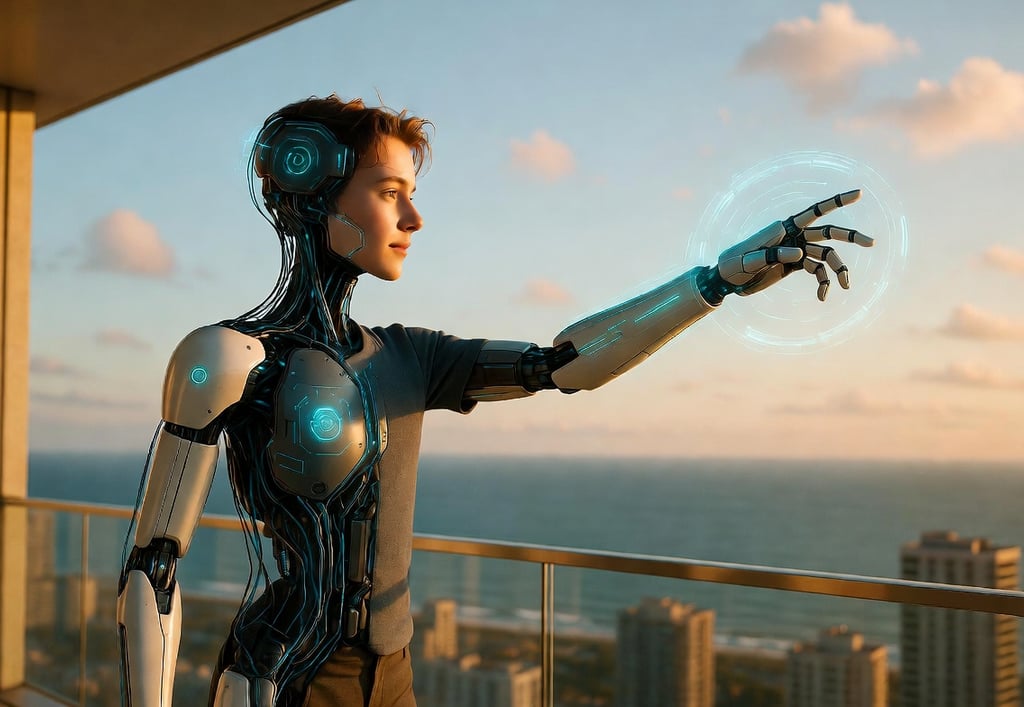
How AI is Transforming Lives: The Future of Prosthetics for Physically Handicapped People
In a world where technology increasingly blurs the line between human capability and machine intelligence, artificial intelligence (AI) stands out as one of the most promising tools for empowering people with physical disabilities. For millions living with limb loss or mobility impairments, AI-powered advancements in artificial limbs—often called bionic prosthetics—are not just restoring function; they are redefining what is possible.
From intuitive control systems that respond to thoughts to adaptive limbs that learn and evolve with their user, AI is ushering in a new era of independence, dignity, and opportunity for physically handicapped individuals. This blog explores how AI is revolutionizing prosthetics, the key technological breakthroughs driving this change, real-world impacts on daily life, and what the future holds.
The Burden of Physical Disability and Traditional Limitations
Limb loss or congenital limb differences affect approximately 185 million people worldwide. Traditional prosthetics, while life-changing, have long come with significant limitations. Many older models are heavy, uncomfortable, and require manual adjustments. They often lack the fine motor control needed for delicate tasks like writing, typing, or grasping fragile objects. Users frequently experience “phantom limb” pain and must expend significant mental and physical energy to operate basic functions.
For lower-limb amputees, walking on uneven terrain, climbing stairs, or simply maintaining balance can be exhausting and risky. These challenges contribute to higher rates of depression, social isolation, and unemployment among people with physical disabilities. The gap between human biological limbs and conventional prosthetics has historically felt insurmountable—until artificial intelligence began closing it rapidly.
How AI is Revolutionizing Artificial Limbs
Artificial intelligence is transforming prosthetics through several groundbreaking approaches:
1. Neural Interfaces and Brain-Computer Control
One of the most exciting developments is the integration of AI with brain-computer interfaces (BCIs). Companies and research institutions are developing systems that allow users to control prosthetic limbs using nothing more than their thoughts. AI algorithms decode neural signals from the brain or residual muscles, translating intention into precise movement almost instantaneously.
For example, advanced myoelectric prosthetics now use machine learning to interpret subtle muscle signals (electromyography or EMG) with far greater accuracy than earlier generations. AI models trained on vast datasets can distinguish between dozens of grip patterns—pinch, power grip, tripod grasp—and even adapt to the user’s unique movement style over time.
Recent advancements have pushed this further with implantable neural interfaces that provide bidirectional communication: the prosthetic sends sensory feedback back to the brain, allowing users to “feel” pressure, temperature, and texture through their artificial limb. This closes the sensory loop that traditional prosthetics completely lack.
2. Adaptive Learning and Personalization
Unlike static mechanical limbs, AI-powered prosthetics are dynamic learners. Using reinforcement learning and deep neural networks, these devices analyze gait patterns, environmental conditions, and user behavior in real time. If a user walks on sand, grass, or a slippery floor, the AI automatically adjusts joint stiffness, ankle angle, and power output to maintain stability and efficiency.
This adaptability dramatically reduces the cognitive load on the user. Instead of consciously thinking about every step, the prosthetic anticipates needs and responds intuitively. Over weeks and months, the AI refines its model of the individual, creating a truly personalized experience that improves with use—just like a biological limb adapts through practice.
3. Computer Vision and Environmental Awareness
Modern bionic limbs increasingly incorporate cameras and AI-powered computer vision. These systems can recognize objects in the user’s environment and suggest or automatically execute appropriate grip patterns. Picking up a coffee cup, turning a doorknob, or using cutlery becomes more natural when the AI understands context.
For visually impaired users with limb differences, AI can combine prosthetic control with obstacle detection and navigation assistance, creating multi-sensory solutions that enhance overall mobility and safety.
4. Lightweight Materials and Energy Efficiency
AI contributes indirectly by optimizing design. Generative AI algorithms help engineers create lighter, stronger prosthetic structures using advanced materials like carbon fiber composites and titanium alloys. Machine learning also optimizes battery usage and motor control, extending wear time and reducing the frequency of recharging—critical factors for user adoption and comfort.
Real-World Impact: Stories of Empowerment
The human stories behind these technologies are profoundly moving. Consider a young engineer in Sydney who lost an arm in an industrial accident. With a new AI-controlled bionic arm featuring neural pattern recognition, he returned to work within months, capable of precise soldering and typing at near-normal speeds. The AI learned his preferred movements and reduced fatigue dramatically.
Or take the case of athletes. Paralympic runners and climbers are breaking records with AI-optimized running blades and climbing prosthetics that adjust stiffness based on terrain and fatigue levels. These advancements are not only restoring function but enabling superhuman performance in specific domains.
Children born with limb differences benefit enormously too. Pediatric prosthetics that grow and adapt with the child—thanks to AI monitoring growth patterns and usage—reduce the need for frequent replacements and help young users develop natural movement habits early.
For elderly amputees, AI-powered balance assistance and fall-prevention algorithms are literally life-saving, reducing the fear of mobility and helping seniors maintain independence longer.
Current Leading Technologies and Research
Several organizations are at the forefront of this revolution:
Össur and Ottobock have released AI-enhanced knee and ankle systems that use machine learning to adapt to thousands of gait variations per day.
DEKA Arm (often called the “Luke Arm”) integrates advanced AI for fluid, multi-articulated movement.
Research labs at institutions like MIT, Stanford, and Johns Hopkins are pioneering thought-controlled prosthetics with sensory feedback.
Companies like Neuralink, Synchron, and others working on brain-computer interfaces promise even tighter integration between human intention and machine action.
In 2025–2026, we’re seeing rapid iteration: prosthetics with 20+ degrees of freedom, sub-100ms response times, and increasingly natural sensory restoration. Costs are gradually decreasing as AI development tools become more accessible and manufacturing scales.
Challenges and Ethical Considerations
Despite the promise, significant hurdles remain. High-end AI prosthetics can cost tens or even hundreds of thousands of dollars, limiting access primarily to wealthier individuals or those with excellent insurance. There is also a need for better long-term clinical data on durability, psychological adaptation, and potential over-reliance on technology.
Data privacy is another critical issue. Neural interface systems collect highly sensitive brain and muscle signal data. Robust protections and ethical frameworks are essential to prevent misuse.
Training AI models requires diverse datasets. Ensuring that algorithms work equally well across different ages, body types, cultural movement patterns, and amputation levels is an ongoing challenge that researchers must address through inclusive design practices.
The Road Ahead: A More Inclusive Future
Looking forward to 2030 and beyond, AI will likely make advanced prosthetics more affordable, more intuitive, and more widely available. We can expect:
Fully integrated neuro-prosthetics that feel like natural extensions of the body
Cloud-connected limbs that receive over-the-air updates improving performance
AI companions that monitor health, detect early signs of socket issues or skin breakdown, and suggest adjustments
Hybrid biological-technological solutions, potentially combining regenerative medicine with intelligent prosthetics
Greater emphasis on emotional and psychological support through AI-driven rehabilitation programs
The ultimate goal is not merely to replace lost function but to enhance quality of life so profoundly that disability becomes less defining. AI has the potential to level the playing field, allowing physically handicapped individuals to pursue careers in fine arts, surgery, sports, technology, and any field they choose.
Conclusion: Technology as a Force for Human Dignity
AI-powered advancements in artificial limbs represent far more than impressive engineering—they embody hope, resilience, and the best of human ingenuity applied to human suffering. By restoring autonomy and expanding capability, these technologies are helping millions reclaim their independence and participate fully in society.
As AI continues to evolve at an exponential pace, the gap between biological and artificial limbs will narrow further. The future is one where a missing limb no longer dictates the boundaries of a person’s potential.
For physically handicapped individuals and their loved ones, this is not science fiction. It is the emerging reality—one step, one grasp, one thought-controlled movement at a time.
The integration of artificial intelligence into prosthetics reminds us of technology’s highest calling: not to replace humanity, but to amplify it.
Contact
Head Office
Green Life Enterprises LLC
8 Biltmore Est
Suite 310,
Phoenix, AZ 85016
greenlifedatacenters@gmail.com
+1-813-220-0001
© 2026. All rights reserved.
* The American Government has now redefined the industry, Artificial Intelligence (AI) is now defined as Super Intelligence (SI) Our website reflects that change.
Canadian Office
Green Life Enterprises LLC
3142 Nicholson Ave
Suite 10
New Waterford, Nova Scotia B1H 1N8