
How AI is Revolutionizing the Tourism Industry: The Future of Travel
Neil L. Rideout
5/4/20265 min read
How AI is Revolutionizing the Tourism Industry: The Future of Travel
The tourism industry, one of the world's largest economic sectors, is on the cusp of a profound transformation driven by artificial intelligence. In 2025, global tourism is rebounding strongly post-pandemic, contributing trillions to the global economy and supporting hundreds of millions of jobs. Yet challenges like overtourism, personalization gaps, sustainability pressures, and operational inefficiencies persist. AI is emerging as the game-changing force that addresses these issues while unlocking new levels of efficiency, delight, and responsibility.
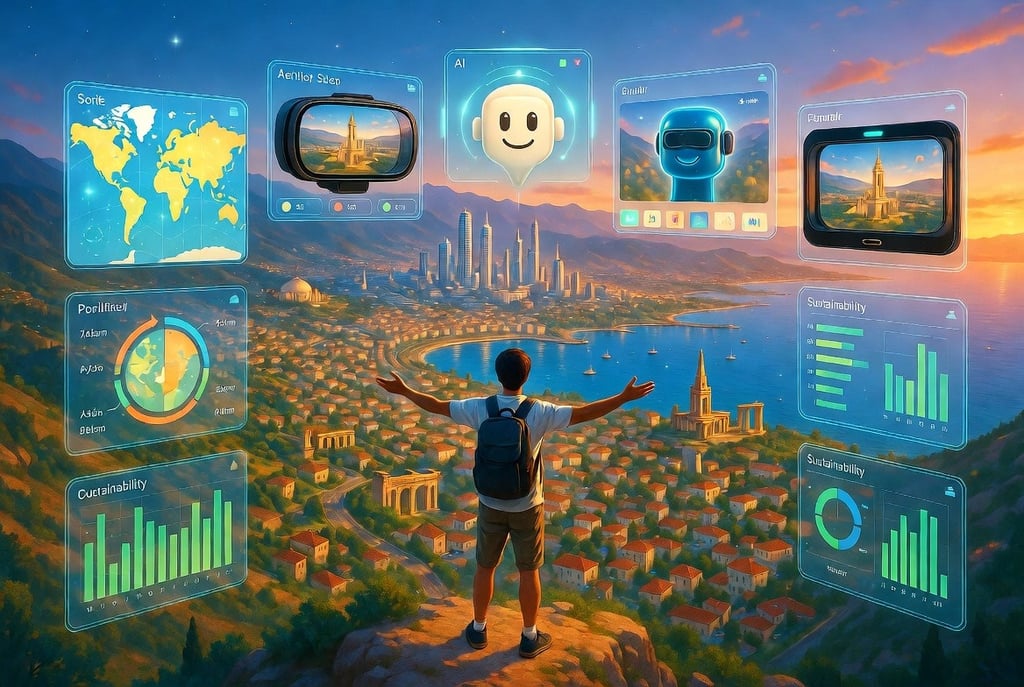
From hyper-personalized itineraries to predictive crowd management and immersive virtual previews, AI is reshaping how we discover, book, experience, and remember travel. This isn't science fiction—it's happening now, and its impact will only accelerate. Here's a deep dive into how AI will improve tourism across the entire value chain.
Hyper-Personalized Travel Planning and Recommendations
One of the most immediate and visible improvements is in travel planning. Traditional recommendation engines based on broad demographics are giving way to sophisticated AI systems that analyze vast datasets—including past trips, browsing behavior, social media activity, weather preferences, budget constraints, and even real-time biometric data from wearables.
Imagine an AI travel assistant that knows you love quiet hiking trails at sunrise, craft coffee shops with local history, and sustainable accommodations. Platforms like TripAdvisor, Booking.com, and emerging startups are already deploying machine learning models that deliver "your perfect trip" rather than generic packages. These systems improve over time through reinforcement learning, learning from your feedback and similar travelers.
Natural Language Processing (NLP) allows users to converse naturally: "Plan a 7-day trip to Japan for my family of four who loves anime and food, with a budget of $8,000." The AI generates optimized itineraries, suggests hidden gems, and adjusts in real-time for flight delays or weather changes. This level of personalization boosts satisfaction and reduces decision fatigue, leading to higher conversion rates for travel companies and fewer last-minute cancellations.
Intelligent Booking and Dynamic Pricing
AI is streamlining the booking process while optimizing revenue. Dynamic pricing algorithms, already used by airlines and hotels, are becoming more sophisticated. They factor in real-time demand, competitor pricing, local events, and even sentiment analysis from social media to adjust prices minute-by-minute.
Predictive analytics help destinations and businesses forecast demand with remarkable accuracy. Hotels can optimize occupancy, restaurants can staff appropriately, and tour operators can scale offerings. For travelers, AI reduces costs by suggesting the best booking windows or alternative dates/routes that save money without sacrificing experience.
Fraud detection has also improved dramatically. AI systems analyze booking patterns to flag suspicious activity, protecting both companies and customers.
24/7 Customer Service and Seamless Support
Gone are the days of waiting on hold for a customer service agent. AI-powered chatbots and virtual assistants, powered by large language models, handle the majority of inquiries instantly in multiple languages. These aren't rigid rule-based bots anymore—they understand context, emotion, and nuance.
During a trip, an AI concierge on your phone can recommend nearby restaurants based on your dietary needs and current location, translate menus in real-time, or help rebook a missed connection. Computer vision integrated into apps allows travelers to point their camera at a landmark for instant information or navigation.
Post-trip, AI analyzes feedback automatically, helping companies identify trends and improve offerings faster than ever. This leads to higher Net Promoter Scores (NPS) and loyalty.
Smart Destinations and Sustainable Tourism
Overtourism has strained many popular sites. AI is helping manage this through predictive crowd analytics. Cameras and sensors combined with machine learning forecast visitor flows, enabling dynamic pricing for attractions, timed entry slots, or recommendations for less crowded alternatives.
In Barcelona or Venice, AI systems already help distribute tourists more evenly. Destination Management Organizations (DMOs) use AI to promote lesser-known areas, balancing economic benefits while preserving cultural and environmental integrity.
Sustainability is another major win. AI optimizes routes for lower carbon emissions, suggests eco-friendly accommodations and activities, and even monitors environmental impact in real-time. For example, AI can analyze satellite imagery and sensor data to track coral reef health or deforestation near tourist areas, informing better policies. Airlines use AI for fuel-efficient flight paths, while hotels optimize energy usage through smart building management.
Immersive Experiences: VR, AR, and the Metaverse
AI is blurring the lines between physical and digital travel. Virtual Reality (VR) powered by AI allows travelers to preview destinations realistically before booking—walk through a hotel room, hike a trail, or explore a museum exhibit from home. This reduces uncertainty and "buyer's remorse."
Augmented Reality (AR) enhances on-site experiences. Point your phone at the Colosseum and see historical reconstructions or gladiator battles overlaid in real-time. AI generates personalized narratives based on your interests.
For those unable to travel physically—due to health, cost, or mobility—AI-driven virtual tourism opens the world. High-fidelity digital twins of destinations, powered by generative AI, create meaningful experiences that still support local economies through virtual souvenirs or donations.
Safety, Security, and Health
AI significantly enhances traveler safety. Real-time risk assessment tools analyze news, weather, health data, and social sentiment to provide up-to-date advisories. Facial recognition and biometric systems speed up airport security while improving accuracy.
During the pandemic, AI contact tracing and health monitoring proved valuable. Future systems will predict outbreaks or environmental hazards more effectively. Lost luggage? AI tracking combined with computer vision helps reunite items faster.
For solo travelers or families, AI companions monitor location (with consent) and alert in emergencies.
Operational Efficiency for Tourism Businesses
Behind the scenes, AI is a massive productivity booster. Small tour operators can automate scheduling, inventory, and marketing. Generative AI creates compelling descriptions, social media content, and even personalized videos.
Supply chain optimization helps restaurants and hotels predict demand for ingredients, reducing waste. Predictive maintenance on aircraft, buses, and attractions minimizes downtime.
HR departments use AI for better matching of seasonal staff, while revenue management systems maximize profitability.
Challenges and the Road Ahead
Despite the benefits, AI in tourism isn't without risks. Data privacy is paramount—travelers share sensitive information, and robust protection is essential. Algorithmic bias could lead to unfair recommendations or discrimination. Job displacement in customer-facing roles is a concern, though AI often creates new opportunities in tech, data analysis, and experience design.
Ethical considerations around "over-optimization" (turning travel into a frictionless but soulless experience) and the digital divide (ensuring benefits reach smaller businesses and developing destinations) must be addressed. Regulations around AI transparency and accountability will play a key role.
The most successful players will blend AI with human touch—using technology to free staff for meaningful guest interactions rather than replacing them entirely.
Conclusion: A More Accessible, Sustainable, and Magical Future
AI won't just improve tourism; it will democratize it. More personalized, affordable, sustainable, and safer travel experiences will become available to a broader global audience. Destinations that embrace AI thoughtfully will thrive, while those that resist may fall behind.
As we move toward 2030 and beyond, the fusion of AI with other technologies like 5G, IoT, and quantum computing promises even more breakthroughs. The future traveler might enjoy AI-curated serendipity—deliberately leaving room for delightful discoveries while having intelligent support in the background.
Tourism has always been about connection—between people and places, cultures and stories. AI, at its best, enhances these connections rather than replacing them. The industry isn't just adopting technology; it's evolving into something smarter, greener, and more human-centered.
The journey has just begun. Pack your curiosity—the AI-powered world of travel awaits.
Contact
Head Office
Green Life Enterprises LLC
8 Biltmore Est
Suite 310,
Phoenix, AZ 85016
greenlifedatacenters@gmail.com
+1-813-220-0001
© 2026. All rights reserved.
* The American Government has now redefined the industry, Artificial Intelligence (AI) is now defined as Super Intelligence (SI) Our website reflects that change.
Canadian Office
Green Life Enterprises LLC
3142 Nicholson Ave
Suite 10
New Waterford, Nova Scotia B1H 1N8