
How AI is Revolutionizing the Locating, Exploration, and Extraction of Oil, Gas, and Clean Coal
Neil L. Rideout
5/13/20264 min read
How AI is Revolutionizing the Locating, Exploration, and Extraction of Oil, Gas, and Clean Coal
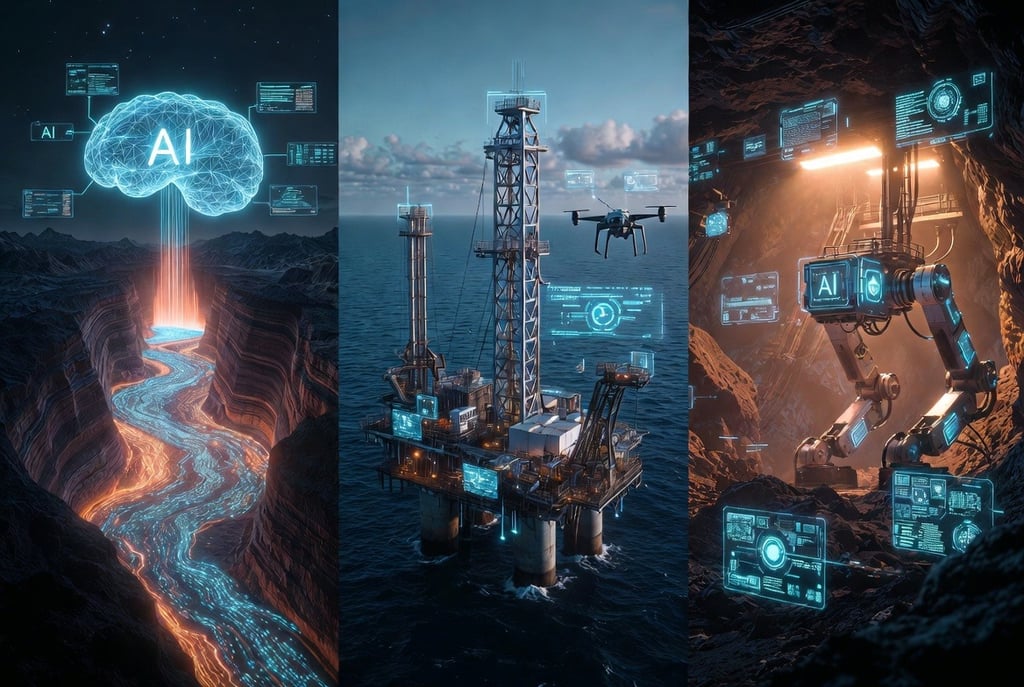
Artificial Intelligence (AI) is no longer a futuristic concept in the energy sector—it's a transformative force actively reshaping how we locate, explore, and extract hydrocarbons like oil, natural gas, and even cleaner forms of coal. As global energy demand continues to rise alongside the push for efficiency and reduced environmental impact, AI offers tools to make operations smarter, safer, cheaper, and more sustainable. From processing vast seismic datasets in hours instead of months to optimizing drilling in real-time and enhancing safety in coal mines, AI is unlocking new potential across the value chain.
AI in Locating and Exploration: Precision from Data Deluge
Traditional oil and gas exploration has always been high-risk and high-cost, often likened to finding a needle in a haystack beneath the Earth's surface. Geologists and geophysicists relied heavily on manual interpretation of seismic data—massive 3D volumes generated by sending sound waves into the ground and recording reflections. This process could take months or years, with significant uncertainty leading to expensive dry wells.
AI, particularly machine learning (ML) and deep learning models like convolutional neural networks (CNNs), is changing this dramatically. These systems can analyze terabytes of seismic data overnight, identifying subtle patterns, faults, horizons, and hydrocarbon indicators that human interpreters might miss. For instance, ML models trained on historical well data and geological datasets can predict oil-bearing structures with far greater accuracy, reducing dry-hole risks.
Companies like BP and Shell are deploying AI for seismic interpretation. In one notable case, AI reduced the need for extensive seismic imaging, potentially identifying deep-sea resources in days rather than months using just 1-3% of traditional data volumes. Full-waveform inversion and AI-driven multi-attribute analysis further enhance resolution, allowing explorers to map complex subsurface structures more precisely.
For unconventional resources like shale gas, AI integrates diverse data sources—well logs, core samples, and satellite imagery—to build sophisticated reservoir models. Predictive analytics help estimate reserve sizes and extraction feasibility early on. This data-driven approach not only speeds up exploration but also lowers costs, making marginal fields viable.
Optimizing Drilling and Extraction for Oil and Gas
Once a site is located, the real work begins. Drilling is one of the most expensive and risky phases in upstream operations. AI-powered systems now provide real-time optimization and automation. Drilling advisors monitor parameters like torque, vibration, mud properties, and downhole pressure, automatically adjusting operations to minimize non-productive time (NPT). Reports indicate 10-15% reductions in drilling time and lower risks of incidents like blowouts.
Predictive maintenance is another game-changer. IoT sensors on rigs, pumps, compressors, and pipelines feed data into AI models that forecast failures weeks or months in advance. This has prevented millions in downtime costs for offshore platforms and extended asset lifespans. Digital twins—virtual replicas of physical assets—simulate reservoir behavior, predict depletion, and optimize enhanced oil recovery (EOR) techniques.
AI also enhances production optimization. Intelligent agents adjust flow rates, pressure, and injection strategies dynamically. In shale plays, AI helps optimize hydraulic fracturing by analyzing microseismic data to map fracture networks more effectively, improving recovery rates. Overall, these technologies are helping operators squeeze more from existing fields—potentially unlocking trillions of additional barrels globally through better analogue matching and recovery factor benchmarking.
Safety and environmental benefits are notable too. AI reduces human exposure to hazardous environments via autonomous drones and robots for inspections. It also aids in methane detection and emissions monitoring, supporting regulatory compliance and sustainability goals.
AI and the Future of Clean Coal
While oil and gas dominate headlines, coal—particularly "clean coal" initiatives—remains vital in many economies, especially for baseload power and industrial uses. AI is modernizing coal mining, making it safer, more efficient, and less environmentally damaging.
In leading operations, particularly in China, AI enables precision mining. Autonomous systems, guided by AI and 5G networks, control tunneling, drilling, and material transport. Drones inspect shafts rapidly, while robots handle repairs in hazardous areas. At advanced mines, one worker can oversee massive output—processing over 1,000 tonnes daily—with AI optimizing coal washing and quality control through real-time sensor analysis.
AI excels in safety-critical areas. Predictive models analyze geological data, gas levels, roof pressure, and other variables to forecast disasters like outbursts, fires, water ingress, or collapses with high accuracy. This shifts mining from reactive to proactive risk management. For clean coal, AI improves beneficiation processes—separating impurities more effectively—and supports carbon capture integration by optimizing plant operations.
In the U.S. and elsewhere, AI is being applied to critical mineral recovery from coal seams and waste, turning former liabilities into resources for the energy transition. Machine learning helps map and quantify these deposits efficiently.
Challenges and the Road Ahead
Despite the promise, challenges remain. High-quality, labeled data is essential for training effective models, yet much subsurface data is proprietary or inconsistent. Integration with legacy systems requires investment, and there's a skills gap—geoscientists now need data science fluency. Ethical considerations around job displacement and the environmental footprint of AI itself (data centers' energy use) must be addressed.
Regulatory hurdles and cybersecurity risks in operational technology (OT) environments also demand attention. However, the ROI is compelling: reduced exploration risks, lower operational costs (often 10-20% savings), higher recovery rates, and improved safety records.
Looking forward, AI agents could autonomously manage entire segments of operations, from exploration planning to real-time extraction adjustments. Multimodal AI combining seismic, satellite, and sensor data will create even more holistic insights. As the industry balances energy security with decarbonization, AI will be key to responsible resource development—extending the life of assets while minimizing impacts.
Conclusion
AI is not just augmenting the oil, gas, and coal sectors; it's redefining them. By accelerating discovery, optimizing extraction, and enhancing safety, it ensures these vital resources can be produced more efficiently amid growing global needs. For "clean coal," it offers pathways to higher standards of environmental performance. The companies that embrace AI-first strategies will lead the next era of energy production—more innovative, resilient, and sustainable.
The energy transition isn't about abandoning hydrocarbons overnight but about extracting and using them intelligently. AI provides the intelligence layer to make that possible.
Contact
Head Office
Green Life Enterprises LLC
8 Biltmore Est
Suite 310,
Phoenix, AZ 85016
greenlifedatacenters@gmail.com
+1-813-220-0001
© 2026. All rights reserved.
* The American Government has now redefined the industry, Artificial Intelligence (AI) is now defined as Super Intelligence (SI) Our website reflects that change.
Canadian Office
Green Life Enterprises LLC
3142 Nicholson Ave
Suite 10
New Waterford, Nova Scotia B1H 1N8