
How AI is Revolutionizing Space Travel: From Autonomous Rovers to Interplanetary Colonies
Neil L. Rideout
5/8/20264 min read
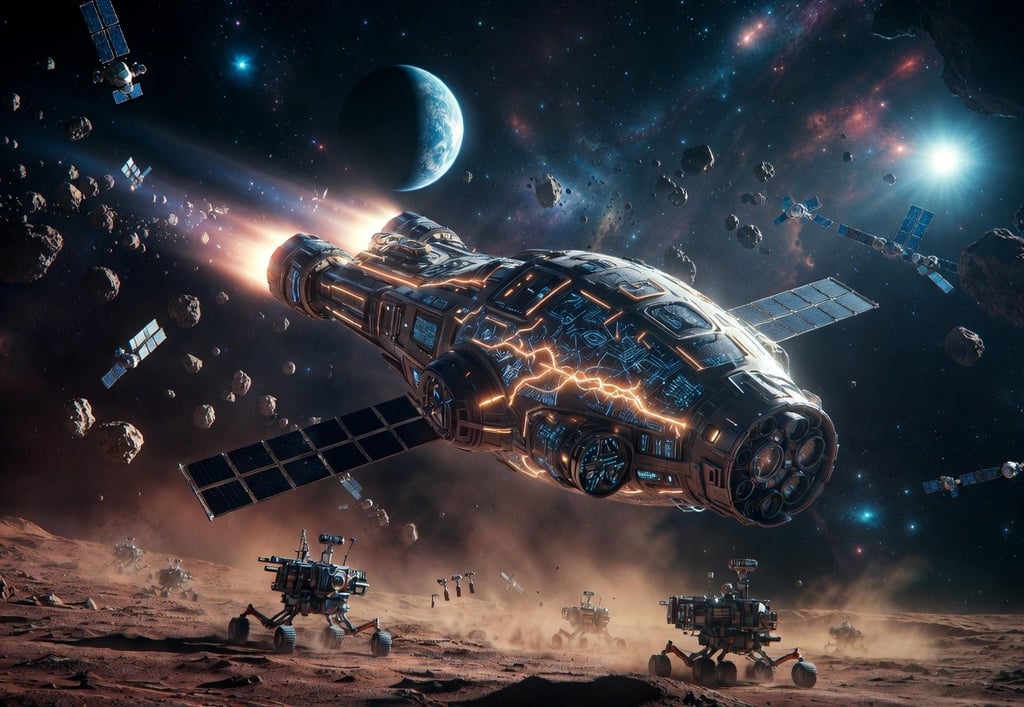
How AI is Revolutionizing Space Travel: From Autonomous Rovers to Interplanetary Colonies
Space travel has always captured humanity's imagination, but the vast distances, communication delays, and hostile environments of space have long limited our ambitions. Today, artificial intelligence (AI) is changing that. By enabling autonomy, optimizing operations, processing massive datasets, and supporting human explorers, AI is turning science fiction into reality. From NASA's Perseverance rover to future Mars colonies, AI is becoming the indispensable co-pilot for humanity's journey beyond Earth.
Autonomous Navigation and Exploration
One of the most immediate impacts of AI is in spacecraft and rover navigation. Communication delays make real-time control impossible for distant missions. A signal from Mars to Earth can take up to 20 minutes one way. AI solves this by allowing vehicles to make decisions onboard.
NASA's Perseverance rover on Mars demonstrates this powerfully. Roughly 88% of its driving is autonomous. It uses cameras and AI-powered systems like Enhanced AutoNav and Machine Learning Navigation (MLNav) to analyze terrain, detect hazards, and plot safe paths in real time. The AEGIS system further enables autonomous scientific data collection, identifying promising targets without waiting for Earth commands.
The Ingenuity Mars Helicopter also relied on AI for autonomous flights across challenging terrain. Future missions will expand this capability. ESA's Rosalind Franklin rover will use AI to navigate Martian landscapes, select scientific targets, and adapt to obstacles independently. Terrain-relative navigation, already used in landings, allows spacecraft to avoid hazards during descent—critical for landing in scientifically rich but risky areas.
In deep space, AI will enable entirely new mission profiles. Probes to icy moons of Jupiter and Saturn or beyond will operate with high autonomy, making real-time decisions based on sensor data. Reinforcement learning and computer vision allow spacecraft to "learn" from environments and improve performance over time.
Space Debris and Collision Avoidance
As satellite numbers explode—projected to reach 100,000 by 2030—managing orbital traffic becomes vital. AI excels at predicting and preventing collisions.
ESA and others are developing AI systems that autonomously assess collision risks, decide on maneuvers, and execute them. Machine learning models analyze tracking data to identify threats faster and more accurately than traditional methods. Some concepts even involve onboard AI that coordinates with other satellites in real time.
This reduces reliance on ground teams and minimizes unnecessary fuel-burning maneuvers. In the future, swarms of AI-managed satellites could maintain safe orbits dynamically, protecting valuable assets and reducing space debris creation.
Mission Planning, Operations, and Data Analysis
AI transforms how missions are planned and run. NASA's ASPEN (Automated Scheduling and Planning Environment) optimizes rover activities, adjusting schedules for resource constraints and unexpected events. AI monitors spacecraft health, predicts failures, and suggests or automates repairs.
The real game-changer is data handling. Space missions generate enormous volumes of information. AI sifts through satellite imagery, telescope data, and sensor readings to find patterns humans might miss. It has already helped discover exoplanets in Kepler and TESS mission data. Onboard "edge AI" processes data directly on spacecraft, prioritizing transmissions and reducing bandwidth needs—essential for deep space where delays are long.
This capability accelerates scientific discovery. Rovers can decide which rocks to analyze with lasers or drills. Telescopes can focus on anomalous signals. AI-driven simulations also improve training for astronauts, creating hyper-realistic virtual environments.
Life Support, Habitats, and Human Exploration
For crewed missions, especially long-duration ones to the Moon or Mars, AI will be lifesaving. Communication lags and isolation demand smart systems.
AI can manage Environmental Control and Life Support Systems (ECLSS), monitoring oxygen, temperature, humidity, water recycling, and radiation levels. It detects anomalies early and adjusts automatically. Predictive maintenance keeps habitats functioning reliably.
In medical scenarios, AI assists with diagnosis, treatment planning, and even robotic surgery. Psychological support tools could monitor astronaut mental health through voice, behavior, or biometrics.
Robotic "artificial astronauts" or advanced AI companions could handle dangerous tasks, scout ahead, or build infrastructure. Swarms of AI-powered robots are envisioned for constructing habitats using in-situ resources (like 3D-printing with Martian regolith).
The Road to Colonization
Looking further ahead, AI is central to sustainable space colonies. Autonomous systems will handle resource extraction (e.g., asteroid mining or ice harvesting on the Moon/Mars), energy production, agriculture in controlled environments, and waste recycling.
AI-optimized logistics will manage supply chains across interplanetary distances. Multi-agent AI systems could coordinate fleets of spacecraft, rovers, and drones. For permanent settlements, AI will evolve into a central "brain" overseeing operations, learning from experiences, and optimizing for long-term survival.
Economic projections are optimistic: the AI space exploration market could grow dramatically, reaching tens of billions by the 2030s, driven by autonomy and data applications.
Challenges and Considerations
Despite the promise, hurdles remain. Radiation can corrupt AI hardware and data. Power and computing constraints in space limit model complexity (though edge computing and efficient algorithms help). Reliability is paramount—AI systems must be verifiable and safe, especially for crewed missions.
Ethical and governance questions arise too: Who is responsible for AI decisions in space? How do we prevent autonomous systems from creating more debris? International cooperation will be key as activity increases.
A New Era of Discovery
AI is not replacing human ingenuity in space travel; it is amplifying it. It handles the repetitive, dangerous, and data-intensive tasks, freeing humans to focus on creativity, leadership, and breakthrough science. With AI, we can explore farther, faster, and safer than ever before.
As we stand on the cusp of returning to the Moon, venturing to Mars, and building a multi-planetary future, one thing is clear: AI will be our most powerful ally in unlocking the cosmos. The stars are calling—and thanks to artificial intelligence, humanity is better equipped than ever to answer.
Contact
Head Office
Green Life Enterprises LLC
8 Biltmore Est
Suite 310,
Phoenix, AZ 85016
greenlifedatacenters@gmail.com
+1-813-220-0001
© 2026. All rights reserved.
* The American Government has now redefined the industry, Artificial Intelligence (AI) is now defined as Super Intelligence (SI) Our website reflects that change.
Canadian Office
Green Life Enterprises LLC
3142 Nicholson Ave
Suite 10
New Waterford, Nova Scotia B1H 1N8