
How AI is Revolutionizing Optometry and Ophthalmology: Enhancing Human Vision for a Brighter Future
Neil L. Rideout
5/19/20264 min read
How AI is Revolutionizing Optometry and Ophthalmology: Enhancing Human Vision for a Brighter Future
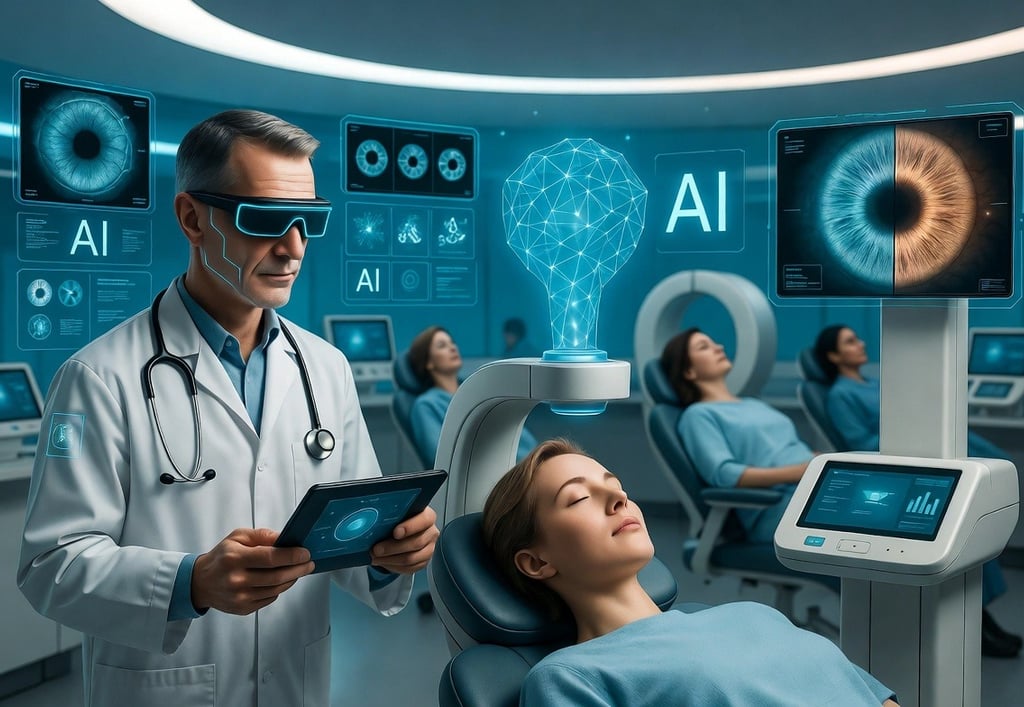
Artificial intelligence (AI) is transforming healthcare, and eye care stands out as one of its most promising frontiers. Optometrists and ophthalmologists—professionals dedicated to preserving and improving human vision—are leveraging AI to detect diseases earlier, personalize treatments, streamline workflows, and achieve better patient outcomes than ever before. From analyzing retinal images in seconds to predicting myopia progression in children, AI augments human expertise rather than replacing it, allowing doctors to focus on what matters most: compassionate, individualized care.
Early Detection and Diagnosis: Catching Problems Before They Blur Lives
One of AI’s most significant contributions is in diagnostic imaging. Conditions like diabetic retinopathy (DR), age-related macular degeneration (AMD), and glaucoma often develop silently, with vision loss occurring before patients notice symptoms. Traditional screening relies on specialists reviewing images, which can be time-consuming and limited by access in underserved areas.
AI-powered systems excel here. Tools like IDx-DR, the first FDA-approved autonomous AI diagnostic device, analyze retinal photos to detect more-than-mild diabetic retinopathy with high accuracy, enabling point-of-care screening even by non-specialists. Similar platforms, such as EyeArt, deliver real-time results for DR screening. Deep learning algorithms process fundus photographs and Optical Coherence Tomography (OCT) scans, identifying subtle patterns invisible to the human eye—such as microaneurysms, hemorrhages, or early optic nerve changes.
In glaucoma detection, AI analyzes structural changes in the optic nerve head and retinal nerve fiber layer from OCT data, predicting progression risk with impressive accuracy (often exceeding 85-90% in validation studies). For AMD, models classify drusen, geographic atrophy, and neovascular changes, helping prioritize patients for anti-VEGF injections that preserve central vision.
These capabilities expand access dramatically. In rural or low-resource settings, AI enables primary care providers or optometrists to screen populations at scale, referring complex cases to specialists. Studies show AI reduces screening time dramatically while maintaining or surpassing expert-level performance, freeing doctors for treatment and patient education.
Personalized Vision Correction and Refractive Solutions
AI is moving beyond disease detection into everyday refractive care. Traditional prescriptions rely on subjective refraction, but AI integrates objective data from autorefractors, corneal topography, wavefront aberrometry, and even lifestyle factors for hyper-personalized outcomes.
AI algorithms analyze vast datasets to predict how a patient’s eyes will respond to corrections, optimizing glasses, contact lenses, or orthokeratology prescriptions. In myopia management—critical as global rates rise—AI models predict five-year risk of high myopia in children, guiding interventions like low-dose atropine or specialized lenses to slow progression.
For surgical vision correction, AI enhances LASIK and other refractive procedures. Machine learning models improve patient selection by assessing ectasia risk (e.g., keratoconus), calculate optimal ablation profiles, and predict postoperative healing. Next-generation systems use real-time biometric feedback and AI-guided lasers for unprecedented precision, reducing side effects like halos or dry eye.
Intraocular lens (IOL) calculations for cataract surgery also benefit. AI-enhanced formulas (e.g., those incorporating Hill-RBF or Kane methods with machine learning) achieve higher predictability, leading to better uncorrected visual acuity post-surgery.
Treatment Planning, Monitoring, and Surgical Precision
AI supports ongoing management. In retina clinics, algorithms monitor disease activity via serial OCT scans, predicting treatment needs and reducing unnecessary injections for conditions like wet AMD. For glaucoma, progression analysis integrates visual fields, OCT, and intraocular pressure data into risk models that guide therapy escalation.
Surgically, AI assists in planning and execution. Robotic systems with AI guidance improve precision in vitreoretinal procedures, while augmented reality overlays in surgical microscopes provide real-time anatomical insights. AI also optimizes strabismus surgery planning by simulating muscle adjustments.
Administrative burdens decrease too. AI scribes transcribe consultations, generate notes, and handle documentation, reducing physician burnout. Chatbots and virtual assistants manage scheduling, patient queries, and follow-ups, improving practice efficiency.
Teleoptometry and Global Reach
AI-powered telehealth platforms let patients capture retinal images via smartphone adapters or portable devices. Cloud-based AI analyzes them instantly, enabling remote diagnosis and monitoring. This is revolutionary for aging populations, diabetic patients, and remote communities, bridging gaps in specialist access.
Challenges and Ethical Considerations
Despite the promise, challenges remain. AI models require diverse, high-quality training data to avoid bias—performance can vary across ethnicities or camera types. Regulatory approval, integration into workflows, cost, and data privacy are ongoing hurdles. Over-reliance on AI could erode clinical skills or the doctor-patient relationship if not managed thoughtfully.
Optometrists and ophthalmologists emphasize AI as a supportive tool. Surveys show professionals are optimistic, viewing it as enhancing accuracy, efficiency, and access while they retain final clinical judgment and empathetic care.
Transparency, continuous validation, and robust training are essential. Regulatory bodies like the FDA continue to evolve frameworks for AI as a medical device.
The Future: Predictive, Preventive, and Personalized Vision Care
Looking ahead, multimodal AI will integrate imaging, genetics, wearables (e.g., smart contact lenses), and electronic health records for holistic predictions. AI could forecast individual responses to therapies, enabling truly preventive care—intervening before vision loss begins.
Research explores AI for keratoconus progression, pediatric amblyopia monitoring, and even linking retinal biomarkers to systemic conditions like cardiovascular disease or dementia (oculomics).
In education, AI simulations and virtual reality will train the next generation of eye care professionals with vast case libraries.
Conclusion: A Clearer Vision for Humanity
AI is not diminishing the role of optometrists and eye doctors—it is amplifying their impact. By handling repetitive analytical tasks with superhuman speed and consistency, AI lets professionals spend more time on complex cases, patient relationships, and innovative care.
For patients, this means earlier interventions, fewer vision-threatening complications, more accurate prescriptions, safer surgeries, and better overall quality of life. Millions worldwide could retain or regain sharper vision thanks to these advancements.
As technology evolves, collaboration between AI developers, clinicians, ethicists, and regulators will ensure responsible implementation. The future of eye care is bright: one where human expertise and artificial intelligence work in tandem to protect the precious gift of sight.
Contact
Head Office
Green Life Enterprises LLC
8 Biltmore Est
Suite 310,
Phoenix, AZ 85016
greenlifedatacenters@gmail.com
+1-813-220-0001
© 2026. All rights reserved.
* The American Government has now redefined the industry, Artificial Intelligence (AI) is now defined as Super Intelligence (SI) Our website reflects that change.
Canadian Office
Green Life Enterprises LLC
3142 Nicholson Ave
Suite 10
New Waterford, Nova Scotia B1H 1N8