
How AI is Revolutionizing Manufacturing and Production: The Smart Factory Era
Neil L. Rideout
4/28/20265 min read
How AI is Revolutionizing Manufacturing and Production: The Smart Factory Era
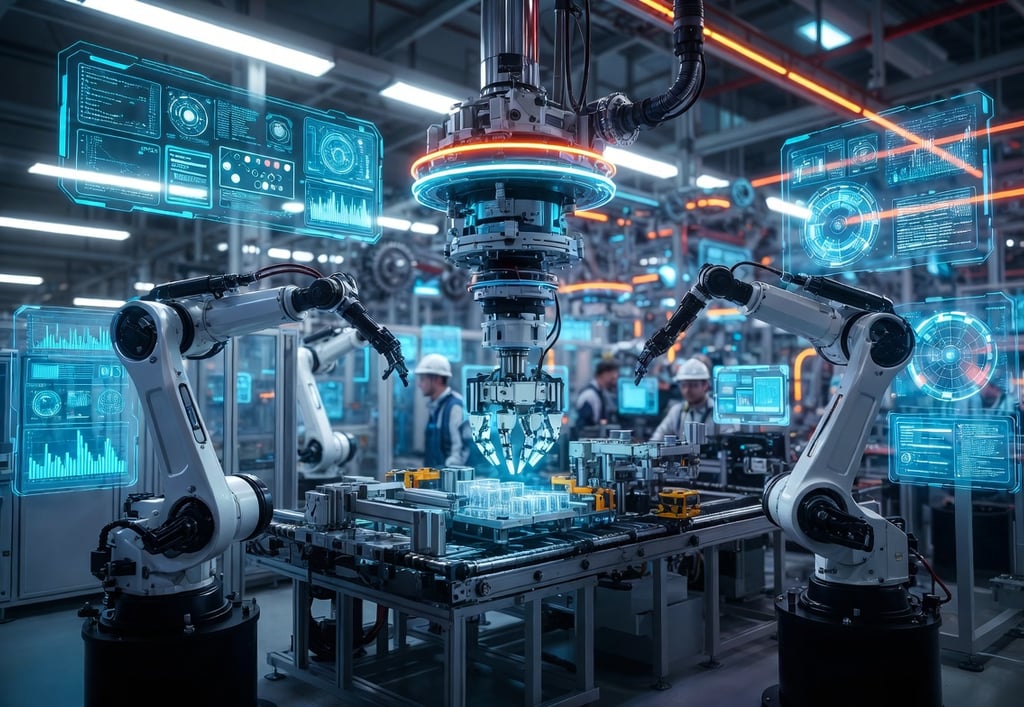
The manufacturing sector stands on the brink of its most profound transformation since the Industrial Revolution. Artificial Intelligence (AI) is no longer a futuristic concept—it's actively reshaping how products are designed, produced, and delivered. From predictive maintenance that prevents costly downtime to intelligent systems optimizing entire supply chains, AI is driving unprecedented levels of efficiency, quality, and sustainability in production environments.
Global manufacturers face mounting pressures: rising labor costs, supply chain disruptions, increasing customization demands, and stringent sustainability targets. Traditional manufacturing methods, reliant on manual oversight and rigid processes, struggle to keep pace. AI offers a powerful solution by enabling machines to learn, adapt, and make decisions in real time. The result? "Smart factories" that are more resilient, responsive, and profitable.
Predictive Maintenance: Stopping Problems Before They Start
One of the most immediate and impactful applications of AI in manufacturing is predictive maintenance. Equipment failure remains one of the biggest drains on productivity. Unplanned downtime can cost manufacturers thousands—or even millions—per hour, depending on the industry.
AI-powered systems analyze vast amounts of sensor data from machinery, including vibration patterns, temperature fluctuations, acoustic signals, and electrical currents. Machine learning algorithms detect subtle anomalies that signal impending failures long before they become critical.
For example, an AI system monitoring a CNC machine might notice slight changes in motor vibration weeks before a bearing would fail. The system can then schedule maintenance during planned downtime, avoiding production halts. Companies implementing these solutions report reductions in unplanned downtime by 30-50% and maintenance costs by 10-40%.
Beyond cost savings, predictive maintenance extends the lifespan of expensive capital equipment and improves overall equipment effectiveness (OEE). In high-volume industries like automotive and electronics, even small improvements in uptime translate into significant competitive advantages.
Quality Control and Defect Detection
Human inspectors, while skilled, are prone to fatigue and inconsistency. AI-powered computer vision systems are transforming quality assurance by providing superhuman consistency and speed.
Using high-resolution cameras and deep learning models, AI can inspect products moving at high speeds on production lines, identifying defects invisible to the human eye—such as microscopic cracks, color variations, or surface imperfections. These systems learn from thousands of images, continuously improving their accuracy over time.
In the semiconductor industry, where defects can be smaller than a human hair, AI has become indispensable. Similar applications exist in pharmaceutical manufacturing, food production, and automotive assembly. The benefits extend beyond catching defects: AI can trace quality issues back to specific process parameters, enabling root-cause analysis and process optimization.
Some advanced systems even predict quality outcomes before production is complete, allowing operators to adjust parameters in real time. This "quality by design" approach reduces waste and rework dramatically.
Production Optimization and Intelligent Scheduling
Manufacturing involves countless variables: machine availability, raw material supply, labor shifts, energy costs, and fluctuating customer demand. Traditional planning methods often rely on static rules or human intuition, leading to inefficiencies.
AI excels at optimizing complex, multi-variable systems. Reinforcement learning and optimization algorithms can generate production schedules that maximize throughput while minimizing energy consumption and inventory costs. These systems adapt dynamically as conditions change—whether it's a delayed supplier shipment or a sudden spike in demand for a particular product.
Digital twins—virtual replicas of physical production lines—allow manufacturers to simulate different scenarios and test optimizations without disrupting actual operations. An AI managing a digital twin might discover that slight adjustments to line speed or temperature could increase output by 8% while reducing energy use.
Generative AI is also entering the picture, helping engineers design more efficient production layouts or suggest process improvements based on historical performance data.
Supply Chain Resilience and Demand Forecasting
The COVID-19 pandemic and recent geopolitical events exposed the fragility of global supply chains. AI is helping manufacturers build more resilient networks through better visibility and predictive capabilities.
Advanced forecasting models incorporate not just historical sales data but also external factors like weather patterns, economic indicators, social media sentiment, and even shipping delays. This holistic approach leads to far more accurate demand predictions, reducing both stockouts and excess inventory.
AI-powered platforms can monitor suppliers in real time, flagging potential risks such as financial instability or natural disasters. Some systems automatically suggest alternative sourcing options when disruptions are detected. In extreme cases, AI can help reconfigure production lines to use substitute materials when primary ones become unavailable.
This level of agility was nearly impossible with legacy systems. Manufacturers using AI-driven supply chain tools report improved on-time delivery rates and reduced working capital requirements.
Robotics, Cobots, and Human-AI Collaboration
While fears of job displacement persist, the reality in manufacturing is more nuanced. AI is enabling a new generation of collaborative robots (cobots) that work safely alongside humans.
Unlike traditional industrial robots confined to cages, modern cobots use AI to perceive their environment, learn tasks through demonstration, and adapt to variations. A human worker can train a cobot to perform repetitive tasks while focusing on higher-value activities like problem-solving or customization.
AI also enhances robotic capabilities in areas like bin picking, where objects are randomly oriented. Computer vision combined with machine learning allows robots to handle diverse parts without custom programming for each item—a game-changer for high-mix, low-volume production.
In the long term, AI will facilitate more flexible "lights-out" manufacturing facilities, but the near-term impact is greater human productivity through augmentation rather than replacement.
Sustainability and Energy Efficiency
Manufacturing accounts for a significant portion of global energy consumption and carbon emissions. AI is becoming a critical tool for meeting sustainability goals without sacrificing profitability.
AI systems optimize energy usage across facilities by analyzing consumption patterns and automatically adjusting HVAC systems, lighting, and machine operations. Some advanced platforms orchestrate entire factory energy flows, shifting high-consumption activities to times when renewable energy is most abundant or electricity rates are lowest.
At the product design stage, generative AI helps engineers create components that use less material while maintaining strength and functionality—supporting circular economy principles. AI can also optimize packaging designs to reduce waste and improve transport efficiency.
In chemical and process industries, AI models help fine-tune reactions to maximize yield while minimizing byproducts and energy input.
Workforce Transformation and Skills Development
Rather than eliminating jobs, AI is shifting the skill requirements in manufacturing. Workers need to become comfortable interacting with AI systems, interpreting their recommendations, and focusing on tasks requiring creativity, judgment, and complex problem-solving.
Many companies are investing in upskilling programs that teach employees how to work with AI tools. Augmented reality (AR) combined with AI provides real-time guidance for complex assembly or maintenance tasks, reducing training time for new workers.
The most successful manufacturers view AI as a tool to empower their workforce, not replace it. This human-centric approach leads to higher employee satisfaction and better retention in an industry that has historically struggled with labor shortages.
Challenges and Considerations for Implementation
Despite the clear benefits, adopting AI in manufacturing isn't without hurdles. Integration with legacy systems remains challenging for many older facilities. Data quality and availability can limit AI effectiveness—garbage in, garbage out still applies.
There's also a skills gap. Many manufacturers lack internal expertise in data science and AI implementation. Cybersecurity concerns grow as more systems become connected. Finally, change management is crucial; workers may resist new technologies if they feel threatened rather than supported.
Successful implementations typically start small—with pilot projects in one area (like predictive maintenance)—before scaling across the organization. Partnering with technology providers and investing in workforce training are essential.
The Road Ahead: Autonomous and Adaptive Manufacturing
Looking forward, AI will enable increasingly autonomous production systems capable of self-optimization and self-healing. We may see factories that can reconfigure themselves for different products with minimal human intervention, supporting true mass customization.
Edge AI—processing data directly on machines rather than in the cloud—will reduce latency and enhance real-time decision making. The convergence of AI with 5G, IoT, and advanced robotics will accelerate this transformation.
For manufacturers, the question is no longer whether to adopt AI, but how quickly and strategically they can do so. Early adopters are already seeing substantial returns through higher productivity, better quality, reduced costs, and greater agility.
The smart factory isn't a distant dream—it's becoming the new competitive baseline. Companies that embrace AI-driven manufacturing will thrive in an increasingly complex and dynamic global economy, while those that hesitate risk being left behind.
As AI capabilities continue to advance, the manufacturing sector will become more intelligent, sustainable, and responsive to human needs. The ultimate winners will be those who view AI not merely as a cost-saving technology, but as a strategic enabler for innovation and long-term resilience.
Contact
Head Office
Green Life Enterprises LLC
8 Biltmore Est
Suite 310,
Phoenix, AZ 85016
greenlifedatacenters@gmail.com
+1-813-220-0001
© 2026. All rights reserved.
* The American Government has now redefined the industry, Artificial Intelligence (AI) is now defined as Super Intelligence (SI) Our website reflects that change.
Canadian Office
Green Life Enterprises LLC
3142 Nicholson Ave
Suite 10
New Waterford, Nova Scotia B1H 1N8