
How AI is Revolutionizing Genealogy: Unlocking Your Family History Like Never Before
Neil L. Rideout
4/9/20264 min read
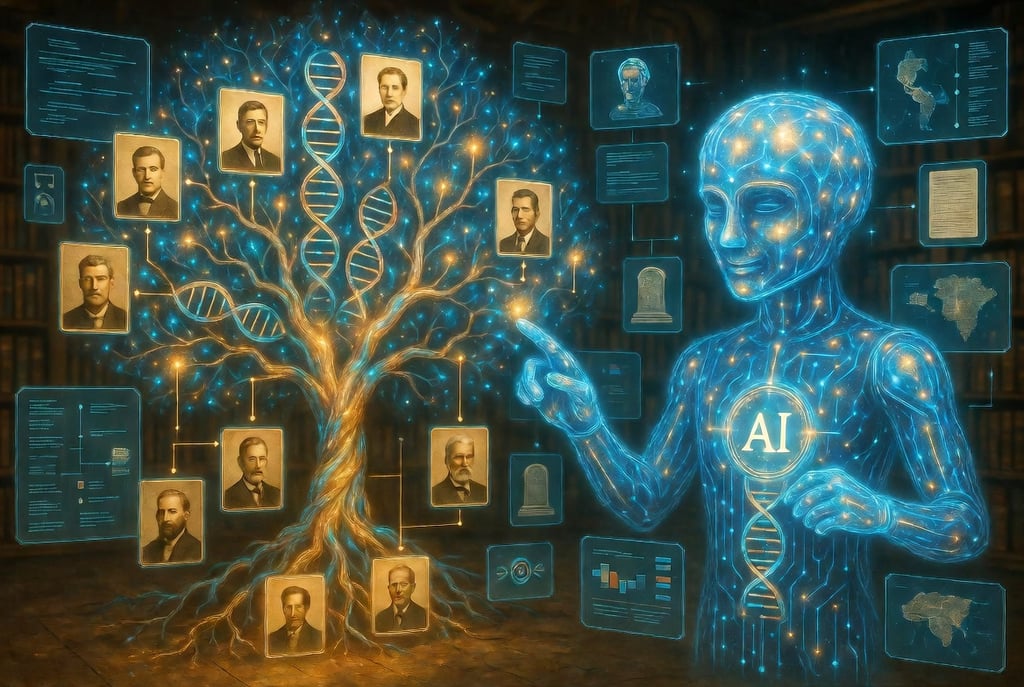
How AI is Revolutionizing Genealogy: Unlocking Your Family History Like Never Before
Genealogy has always been a labor of love—sifting through dusty archives, deciphering faded handwriting, and piecing together fragmented clues to uncover the stories of our ancestors. For centuries, researchers relied on manual effort, intuition, and endless patience. But in 2026, artificial intelligence (AI) is transforming this pursuit from a painstaking hobby into an accessible, insightful adventure. AI isn't replacing the human touch; it's amplifying it, handling the tedious tasks so we can focus on what matters: connection, context, and meaning.
The genealogy community is booming. Millions upload DNA tests, scan family photos, and build digital trees on platforms like Ancestry, MyHeritage, and FamilySearch. Yet the data deluge—billions of digitized records—has created new challenges. Enter AI: machine learning algorithms, natural language processing (NLP), computer vision, and generative models are now sifting, matching, transcribing, and even narrating our histories at speeds and scales unimaginable a decade ago. This isn't science fiction. Tools like MyHeritage's Scribe AI, Ancestry's handwriting recognition, and FamilySearch's AI research assistants are already in use, with 2026 marking a tipping point where AI becomes every researcher's indispensable partner.
Let's explore how AI is reshaping genealogy across key areas, from DNA breakthroughs to ethical storytelling.
AI-Powered DNA Analysis: Mapping Genetic Connections
DNA testing revolutionized genealogy by revealing biological links beyond paper trails. AI takes it further by analyzing vast genetic datasets with unprecedented precision. Machine learning algorithms cluster DNA matches into maternal or paternal lines, predict relationships based on centimorgan values, and even suggest migration patterns from shared markers.
Platforms like Ancestry and MyHeritage use AI-driven tools such as ThruLines to visualize how DNA matches connect within family trees. These systems cross-reference genetic data with historical records, auto-suggesting common ancestors and highlighting potential brick-wall breakthroughs. For instance, clustering algorithms group distant cousins, revealing unknown relatives faster than manual review ever could. In 2025-2026 advancements, AI has refined ethnicity estimates and relationship predictions, reducing false positives in complex adoptions or non-paternity events.
Beyond commercial kits, AI aids forensic genealogy—solving cold cases or identifying remains by integrating genetic markers with public trees. Researchers predict that by late 2026, AI agents will autonomously analyze raw DNA uploads, generating research plans tailored to your matches. The result? Hobbyists and professionals alike uncover deeper ancestral origins, turning abstract percentages into living narratives of migration and resilience.
Intelligent Document Processing: From Faded Ink to Readable Insights
Handwritten records—wills, letters, parish registers—have long been genealogy's biggest bottleneck. AI's computer vision and NLP now excel at optical character recognition (OCR) for cursive scripts, even in multiple languages or degraded conditions.
MyHeritage's Scribe AI, launched at RootsTech 2026, exemplifies this. Upload a photo of a gravestone, faded letter, or coat of arms, and it transcribes text, translates it, interprets symbols, and suggests research next steps. It handles Hebrew inscriptions, German parish entries, and water-damaged Bibles with impressive accuracy. Ancestry quietly rolled out a similar "Transcribe" button for uploaded images in 2026, slashing hours of manual typing.
FamilySearch has expanded full-text search with AI-indexed records and an AI research assistant that summarizes deeds or extracts key facts from millions of documents in over 100 languages. General-purpose tools like Claude, Gemini, or ChatGPT handle personal scans: feed in an image, and they transcribe, flag conflicts, or outline timelines. Specialized platforms like Transkribus offer community-trained models for historical scripts such as Kurrent or French cursive.
The impact is profound. What once took weeks now happens in minutes, democratizing access for non-experts. AI doesn't just read—it contextualizes, linking a 19th-century deed to broader historical events like land grants during westward expansion.
Building and Connecting Family Trees: Smart Matching at Scale
AI excels at pattern recognition in massive datasets. It auto-builds trees by suggesting connections from records, DNA, and user uploads, then flags inconsistencies for human review.
Ancestry's AI suggests ancestor links and deep record searches; MyHeritage's AI Record Finder uses chat-based queries to hunt historical documents intelligently. FamilySearch's AI tools index and connect records across global databases, powering features that surface "AI-indexed" matches. Emerging 2026 frameworks even guide workflows: integrate AI for research planning, evidence analysis, and citation checking.
Predictive modeling fills gaps too. AI analyzes partial trees to hypothesize missing parents or spouses, cross-referencing census data, newspapers, and wills. Multimodal AI (handling text, images, and DNA) creates "agent-like" assistants that brainstorm brick-wall strategies or visualize GEDCOM files interactively.
Photo Restoration, Identification, and Analysis
Old photos hold priceless clues—clothing styles, locations, relationships—but time erodes them. AI photo enhancers (built into MyHeritage and others) restore clarity, colorize, and sharpen details. Computer vision identifies faces across albums, suggesting matches to tree profiles.
Scribe AI extends this: it dates photos from visual cues (fashion, vehicles) and provides historical context. Generative AI fills in missing details ethically, like reconstructing blurred backgrounds, while always noting enhancements.
This visual layer adds humanity to dry records, turning a census entry into a face in a family portrait.
Generative AI for Storytelling and Biographies
AI doesn't stop at data—it creates. MyHeritage's AI Biographer crafts Wikipedia-style profiles enriched with records and historical context. Tools like Claude polish family narratives, turning raw transcripts into engaging stories. In 2026, expect an "explosion" of published family histories, timed for events like America's 250th anniversary.
Researchers use AI for timelines, research plans, or even "conversations" with ancestors via simulated letters. The Coalition for Responsible AI in Genealogy emphasizes principles: accuracy first, disclose AI use, protect privacy.
Challenges, Ethics, and the Road Ahead
AI isn't flawless. Hallucinations—fabricated facts—persist, demanding verification against primary sources. Bias in training data can skew results toward well-documented populations. Privacy risks arise with shared DNA or photos.
Experts at RootsTech 2026 stress the Genealogical Proof Standard: AI as assistant, not authority. Five principles guide use—accuracy, disclosure, privacy, education, compliance. Tools like source reliability scales help grade AI outputs.
Looking to 2026 and beyond: Every genealogist will have personalized AI assistants handling transcription, analysis, and drafting. Agentic AI may autonomously search archives or simulate "what-if" scenarios for migrations. Yet the human element—empathy, interpretation, ethical judgment—remains irreplaceable.
AI democratizes genealogy, making it faster, deeper, and more inclusive. Whether you're tracing immigrant roots, solving a brick wall, or preserving stories for grandchildren, AI equips you with superpowers. Start small: upload a document to Scribe AI or query FamilySearch's chatbot. Verify relentlessly. The past awaits—not just as data, but as rediscovered lives.
In embracing AI, we honor our ancestors by breathing new life into their legacies. The family tree of tomorrow isn't static; it's dynamic, illuminated by intelligence that bridges centuries. Your next discovery? It might just be one AI-assisted prompt away.
Contact
Head Office
Green Life Enterprises LLC
8 Biltmore Est
Suite 310,
Phoenix, AZ 85016
greenlifedatacenters@gmail.com
+1-813-220-0001
© 2026. All rights reserved.
* The American Government has now redefined the industry, Artificial Intelligence (AI) is now defined as Super Intelligence (SI) Our website reflects that change.
Canadian Office
Green Life Enterprises LLC
3142 Nicholson Ave
Suite 10
New Waterford, Nova Scotia B1H 1N8