
How AI is Revolutionizing Food Production: Feeding a Growing Planet Sustainably
Neil L. Rideout
4/22/20265 min read
How AI is Revolutionizing Food Production: Feeding a Growing Planet Sustainably
In an era where the global population is projected to surpass 9.7 billion by 2050, food production faces unprecedented pressure. Climate change, extreme weather, soil degradation, and resource scarcity threaten traditional farming methods, while food insecurity already affects hundreds of millions worldwide. Yet amid these challenges, artificial intelligence (AI) emerges as a powerful ally. By harnessing data, predictive analytics, automation, and machine learning, AI is transforming every stage of the food system—from planting seeds to delivering meals. Far from replacing farmers, AI empowers them with precision tools that boost yields, cut waste, enhance sustainability, and ensure safer, more nutritious food for all. This blog explores how AI is reshaping food production, backed by real-world applications and promising data, and why it represents one of the most hopeful paths toward global food security.
Precision Agriculture: Smarter Fields, Fewer Inputs
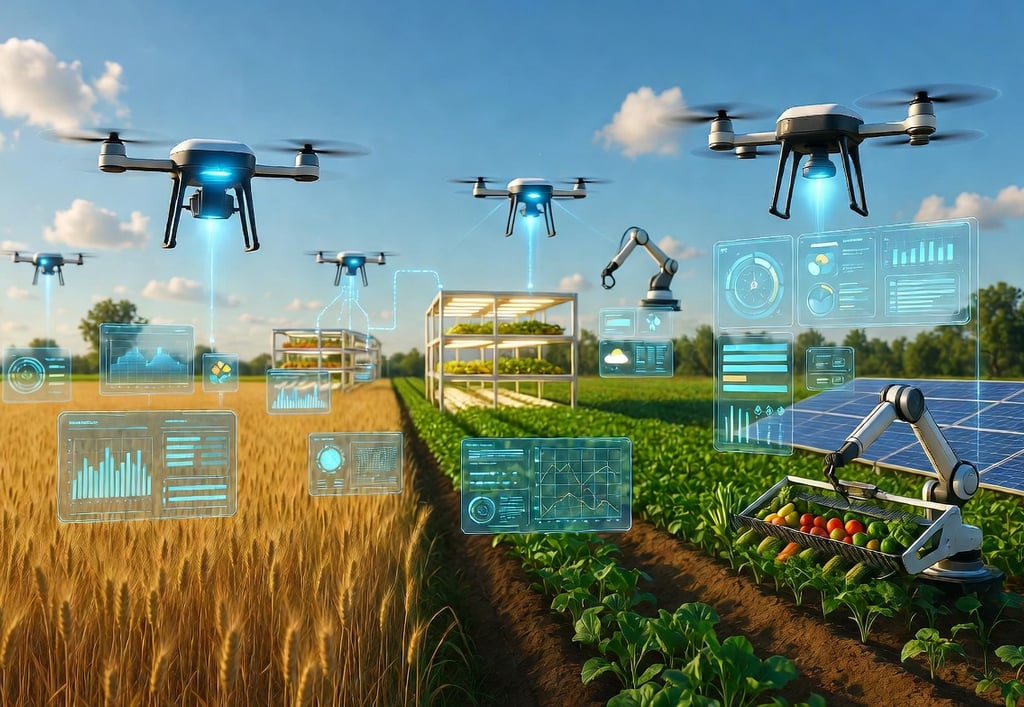
At the heart of AI’s impact is precision agriculture, which uses sensors, drones, satellites, and IoT devices to treat every inch of farmland as unique rather than uniform. Traditional farming often applies water, fertilizer, and pesticides across entire fields based on averages. AI changes that by analyzing real-time data on soil moisture, nutrient levels, weather patterns, and crop health to deliver targeted interventions.
Drones equipped with multispectral cameras fly over fields, capturing images that AI algorithms process instantly. These systems detect early signs of stress—such as nitrogen deficiency or water scarcity—long before they’re visible to the human eye. Farmers receive actionable insights via mobile apps: “Irrigate this 2-acre zone by 15% less today.” The results are dramatic. Studies show AI-driven precision tools can increase crop yields by 15–20% while reducing required investments by 25–30% and improving overall efficiency by 20–25%.
Resource optimization is equally transformative. AI models forecast weather with remarkable accuracy and integrate satellite imagery to optimize irrigation schedules, potentially slashing water usage by up to 30% in drought-prone areas. Fertilizer application becomes hyper-precise, minimizing runoff that pollutes waterways. In livestock farming, AI monitors animal health through wearable sensors and cameras, predicting disease outbreaks and optimizing feed formulas for better growth with less waste.
Companies like those deploying FarmWise robotic weeders use machine learning to identify and remove weeds mechanically, dramatically cutting herbicide use. The environmental payoff is clear: lower chemical dependency protects biodiversity and reduces the carbon footprint of agriculture, which accounts for roughly 30% of global greenhouse gas emissions from agrifood systems.
Crop Monitoring, Pest Control, and Yield Prediction: Proactive Protection
Pests and diseases destroy up to 40% of global harvests annually, but AI turns defense into prevention. Computer vision and deep learning models trained on thousands of plant images can identify specific pathogens or insect infestations in seconds. A farmer snaps a photo on their phone, and the AI app diagnoses the issue and recommends the minimal treatment needed—often spot-spraying instead of blanket applications.
Predictive analytics takes this further. By crunching historical yield data, soil profiles, climate trends, and even market forecasts, AI models generate accurate crop yield predictions weeks or months in advance. These forecasts help farmers decide planting dates, variety selection, and harvest timing. In one approach, AI reduced forecasting errors by 20–50% compared to traditional methods, enabling better inventory planning and reducing overproduction.
Yield prediction also supports resilience against climate volatility. AI simulates “what-if” scenarios—drought, heatwaves, or heavy rains—and suggests adaptive strategies like switching to drought-resistant varieties bred with AI-assisted genomics. This is especially vital for smallholder farmers in vulnerable regions, where early warnings can mean the difference between food security and crisis.
On the processing side, AI-powered robotics handle repetitive tasks like sorting, grading, and packaging with superhuman consistency. Machine vision systems scan produce for defects, ensuring only high-quality items reach shelves while diverting imperfect but edible items to secondary markets or processing—further cutting waste.
Optimizing the Supply Chain: From Farm Gate to Dinner Plate
AI’s influence extends far beyond the field into the complex global food supply chain. Perishable goods spoil quickly, and inefficiencies lead to massive waste—roughly one-third of all food produced worldwide. AI-driven demand forecasting analyzes sales data, social trends, weather, and even holidays to predict consumer needs with pinpoint accuracy. Grocery chains and processors can adjust orders in real time, preventing overstocking and stockouts.
Logistics benefit enormously too. AI optimizes delivery routes, consolidates shipments, and monitors temperature-controlled trucks via IoT sensors. If a refrigerated container shows signs of warming, the system reroutes or alerts operators instantly. Predictive maintenance on processing equipment uses vibration and thermal data to flag failures before they occur, minimizing downtime and energy waste.
In manufacturing, AI streamlines production lines. Automated systems adjust recipes dynamically based on ingredient quality or availability, while computer vision ensures food safety by detecting contaminants that human inspectors might miss. The result? Reduced recalls, lower energy consumption, and fresher products on shelves. One analysis highlights how AI in supply chain optimization can shrink inventory needs by up to 30% while enhancing traceability from farm to fork—critical for recalls and building consumer trust.
Sustainability gains compound here. AI helps minimize food waste at every link, lowering methane emissions from landfills and reducing the need for resource-intensive replanting. Smart packaging integrated with AI sensors can even predict spoilage and adjust storage conditions automatically, extending shelf life without additives.
Challenges, Ethics, and the Road Ahead
Despite the promise, AI adoption in food production isn’t without hurdles. High initial costs for sensors and training data can exclude small farms unless shared platforms or subsidies step in. Data privacy concerns arise when sensitive farm information is shared across cloud systems. There’s also the risk of over-reliance on technology—farmers must retain core skills and local knowledge.
Ethical questions persist too: Who owns the data generated by AI on farms? How do we ensure algorithms don’t inadvertently favor large agribusinesses over family operations? Transparency in AI decision-making (“explainable AI”) will be key to building trust.
Looking forward to 2026 and beyond, trends point to even deeper integration. Agentic AI—systems that autonomously reason and act—will handle complex tasks like optimizing entire supply networks or recommending climate-resilient crop rotations. Vertical farming and controlled-environment agriculture, powered by AI climate controls, will bring production closer to urban centers, slashing transport emissions. Personalized nutrition, where AI analyzes individual health data to suggest tailored foods, could close the loop from production to consumption.
The numbers are encouraging: AI could help close yield gaps in developing regions, where food insecurity is most acute, while cutting agriculture’s environmental footprint. With strategic investment, collaboration between tech companies, governments, and farmers, AI offers a scalable solution to feed billions without exhausting the planet.
Conclusion: A Smarter, Greener Plate for Everyone
AI won’t magically solve hunger or climate change overnight, but it provides the precision, foresight, and efficiency our food systems desperately need. By making farming more productive with fewer resources, reducing waste across the chain, and enabling rapid adaptation to environmental shifts, AI is paving the way for a resilient, sustainable food future. Farmers become data-savvy stewards; consumers enjoy safer, more affordable, and nutritious food; and the planet benefits from lighter ecological demands.
The revolution is already underway—in drone-filled fields, AI-optimized factories, and smart supply networks. As we embrace these tools thoughtfully, we move closer to a world where no one goes hungry and agriculture works in harmony with nature. The future of food isn’t just about growing more—it’s about growing smarter. And AI is the key.
Contact
Head Office
Green Life Enterprises LLC
8 Biltmore Est
Suite 310,
Phoenix, AZ 85016
greenlifedatacenters@gmail.com
+1-813-220-0001
© 2026. All rights reserved.
* The American Government has now redefined the industry, Artificial Intelligence (AI) is now defined as Super Intelligence (SI) Our website reflects that change.
Canadian Office
Green Life Enterprises LLC
3142 Nicholson Ave
Suite 10
New Waterford, Nova Scotia B1H 1N8