
How AI is Revolutionizing Archaeology: Uncovering Hidden Chapters of Human History
Neil L. Rideout
4/14/20265 min read
How AI is Revolutionizing Archaeology: Uncovering Hidden Chapters of Human History
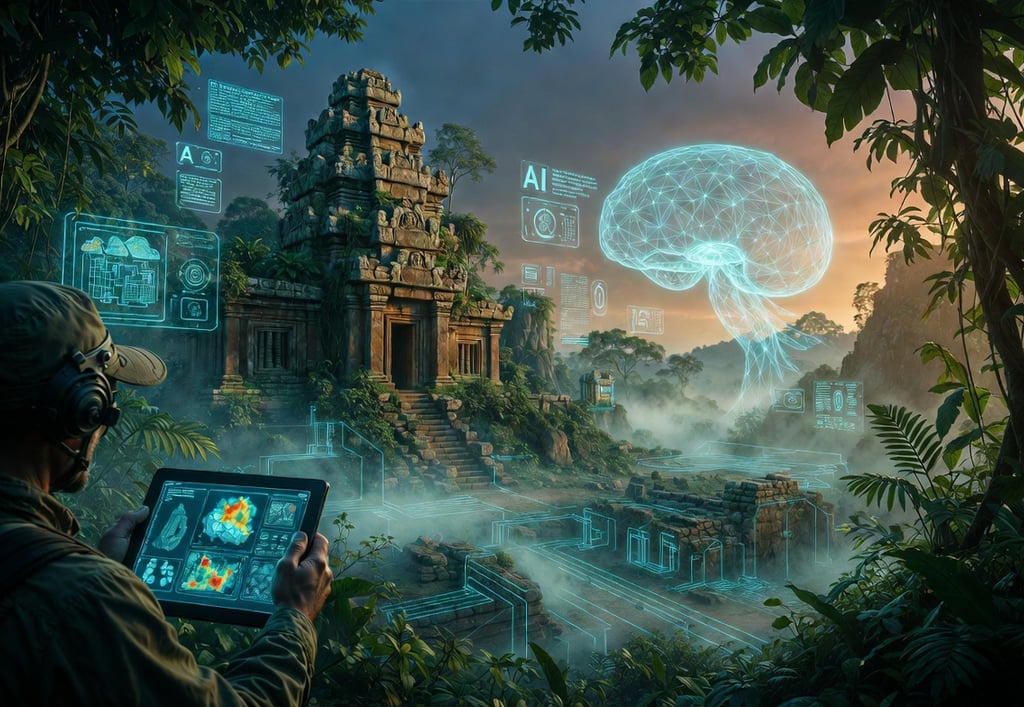
Imagine standing in a dense jungle, where centuries of overgrowth have swallowed entire cities. For decades, archaeologists relied on luck, manual surveys, and limited funding to peel back those layers. Today, artificial intelligence is changing the game—turning what once took lifetimes into discoveries that unfold in months. AI isn’t replacing the trowel or the expert eye; it’s amplifying them, revealing lost civilizations, decoding forgotten languages, and piecing together artifacts with precision that humans alone could never achieve. In 2026, this fusion of technology and tradition is rewriting our understanding of the past at an unprecedented pace.
As we mark another year of AI breakthroughs, the impact on archaeology is profound. From satellite imagery that spots buried structures invisible to the naked eye to neural networks that virtually “unroll” charred ancient scrolls, AI is helping us peer deeper into history than ever before. This isn’t science fiction—it’s happening now, across continents, and it’s democratizing access to our shared human story. In this post, we explore exactly how AI is assisting archaeologists, the real-world discoveries it’s enabling, the challenges it faces, and what the future holds for this exciting partnership.
Detecting Lost Sites: AI as the Ultimate Surveyor
One of the biggest hurdles in archaeology has always been scale. The Earth is vast, and potential sites number in the millions—many hidden under forests, deserts, or modern developments. Traditional ground surveys are slow and expensive. Enter AI-powered remote sensing.
Machine learning algorithms now analyze massive datasets from satellites, drones, and LiDAR (Light Detection and Ranging) scans. These tools detect subtle anomalies: changes in soil moisture, vegetation patterns, or elevation that signal human activity from centuries ago. For instance, in the Maya Lowlands, AI has helped identify previously unknown ruins beneath thick jungle canopies by processing aerial surveys at speeds no human team could match.
In Peru’s Nazca Desert, AI recently doubled the known number of geoglyphs—those enigmatic giant figures etched into the earth—by scanning high-resolution imagery for patterns too faint for the human eye. Similarly, in the Mesopotamian floodplains, deep-learning models trained on satellite data achieved around 80% accuracy in spotting potential archaeological sites, guiding teams to high-probability areas and saving countless hours of fruitless digging.
Predictive modeling takes this further. By feeding historical data, climate records, and terrain features into AI systems, archaeologists can forecast where undiscovered sites are most likely to exist. A 2025 OpenAI-backed challenge in the Amazon used these techniques to pinpoint 67 promising patches for future exploration, potentially preserving ancient settlements before climate change or deforestation erases them.
The result? Non-invasive prospection that respects fragile sites while accelerating discovery. AI doesn’t “find” the past on its own—it prioritizes where humans should look next.
Decoding Ancient Texts: From Fragments to Narratives
Many of history’s greatest secrets lie in unreadable inscriptions, crumbling tablets, or carbonized scrolls. AI is cracking these codes with remarkable success.
Consider the Vesuvius Challenge: AI systems have virtually unrolled and read portions of 2,000-year-old Herculaneum scrolls that were too fragile to open physically. Neural networks reconstruct ink patterns from CT scans, revealing philosophical texts once thought lost forever.
In Greece, the AI model “Ithaca” has transformed epigraphy—the study of inscriptions. It restores damaged texts, dates them within a 30-year window, and even attributes them geographically with up to 70% accuracy when paired with human experts (a huge leap from the 25% solo human baseline). This has already refined our understanding of Athenian history and opened doors to deciphering other ancient scripts like Linear B or cuneiform.
AI excels at pattern recognition across languages and eras. It analyzes vast corpora of known texts to predict missing words or contextualize fragments, helping linguists and historians collaborate across borders. The outcome isn’t just more readable artifacts—it’s richer stories about daily life, governance, trade, and belief systems that reshape textbooks.
Analyzing and Reconstructing Artifacts: Precision Meets Creativity
Once sites are located and texts decoded, the artifacts themselves tell the next chapter. Here, computer vision and generative AI shine.
Convolutional neural networks (CNNs) classify pottery shards, tools, and decorative motifs with over 90% precision in some studies—far faster than manual cataloging. In 2026 museum projects, models fuse images with contextual descriptions to identify ceramic origins or cultural affiliations, turning chaotic storage rooms into organized knowledge bases.
For damaged or incomplete objects, generative adversarial networks (GANs) reconstruct missing pieces. Roman coins, shattered statues, and fragmented frescoes can be virtually restored in 2D or 3D, giving conservators a blueprint for physical repairs or immersive digital exhibits. One project used GANs to enhance degraded artifacts until they were nearly indistinguishable from pristine originals.
Robotics adds another layer: AI-guided systems in Pompeii carefully piece together delicate artworks, minimizing human handling and risk. These tools preserve cultural heritage while making it accessible—think virtual reality tours where anyone can “handle” a reconstructed ancient tool.
Preservation, Prediction, and Public Engagement
AI isn’t just about discovery; it’s about safeguarding the past for the future. Digital twins—virtual replicas of sites—use AI to model degradation from climate change, tourism, or erosion, allowing proactive conservation.
Predictive analytics also flag risks to at-risk heritage, such as coastal shell rings threatened by rising seas. Meanwhile, interactive applications like AI-powered “archaeogames” let the public explore Neolithic life through realistic 3D environments and conversational AI characters grounded in real data.
Projects like Microsoft AI for Earth, Planet Labs, and CyArk demonstrate global scale: satellite fleets combined with AI uncover buried landscapes, while 3D scanning preserves sites digitally for generations.
Real-World Impact: Rewriting History Books
These advances are already bearing fruit. In India, AI and satellite tech highlighted emerging leadership in digital archaeology at major seminars. In Scandinavia, AI helps build embodied learning experiences. Globally, the technology is uncovering everything from 4,000-year-old hunting sites in Michigan to hidden glyphs in Peru.
By processing datasets too large for humans, AI reveals patterns—migration routes, trade networks, societal collapses—that connect isolated finds into coherent histories. It’s making archaeology more inclusive, too: citizen-science apps let volunteers contribute to AI training from their phones, crowdsourcing discoveries worldwide.
Challenges and Ethical Considerations
AI isn’t a magic wand. Models can produce false positives, inherit biases from training data, or overlook cultural context without expert oversight. Data quality, accessibility (especially in the Global South), and the risk of over-reliance remain hurdles. Archaeologists emphasize a “human-AI collaboration” workflow: AI proposes, humans verify and refine.
Ethical questions loom large—ownership of digital discoveries, protection of sacred sites from looting enabled by precise mapping, and ensuring AI benefits local communities rather than extractive research. Responsible use demands transparency, multidisciplinary teams, and open datasets.
The Future: A New Golden Age of Discovery
Looking ahead to 2027 and beyond, AI will integrate even more deeply: multimodal models combining text, imagery, and environmental data; real-time field assistants via augmented reality; and “neural archaeology” that introspectively improves itself.
The result? Faster, greener, more ethical exploration of our past. AI won’t erase the romance of the dig—it will multiply the wonder, ensuring that hidden histories surface before they’re lost forever.
Archaeology has always been about curiosity and connection. With AI as our ally, we’re not just digging deeper; we’re understanding humanity more completely. Whether you’re a researcher, student, or history buff, the tools to participate are more accessible than ever.
Contact
Head Office
Green Life Enterprises LLC
8 Biltmore Est
Suite 310,
Phoenix, AZ 85016
greenlifedatacenters@gmail.com
+1-813-220-0001
© 2026. All rights reserved.
* The American Government has now redefined the industry, Artificial Intelligence (AI) is now defined as Super Intelligence (SI) Our website reflects that change.
Canadian Office
Green Life Enterprises LLC
3142 Nicholson Ave
Suite 10
New Waterford, Nova Scotia B1H 1N8