How AI is Becoming Earth's Cosmic Shield: Protecting Our Planet from Asteroids, Comets, Meteorites, and Space Debris
Neil L. Rideout
6/3/20264 min read
How AI is Becoming Earth's Cosmic Shield: Protecting Our Planet from Asteroids, Comets, Meteorites, and Space Debris
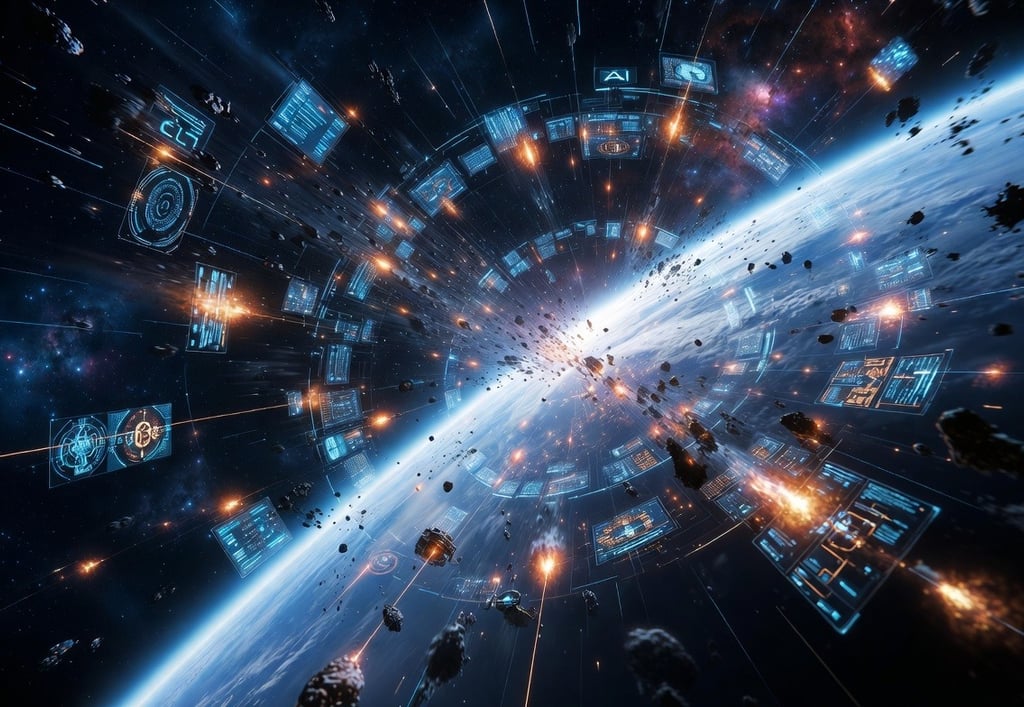
In the vast expanse of space, Earth is constantly under threat from celestial objects. Asteroids, comets, meteorites, and the growing cloud of human-made space debris orbit our planet, some on collision courses that could cause catastrophic damage. While Hollywood dramatizes these events, the risk is real—though manageable with advancing technology. Artificial Intelligence (AI) is emerging as a critical tool in planetary defense, enhancing detection, prediction, tracking, and mitigation strategies. This blog explores how AI is helping safeguard Earth from these cosmic hazards.
The Growing Threat from Space
Our solar system is a busy place. Near-Earth Objects (NEOs) include asteroids and comets whose orbits bring them close to Earth. NASA defines Potentially Hazardous Asteroids (PHAs) as those larger than about 140 meters with orbits that come within 0.05 astronomical units of Earth's path. A collision with a large asteroid could trigger mass extinctions, tsunamis, and climate disruptions, as evidenced by the Chicxulub impact 66 million years ago that wiped out the dinosaurs.
Smaller meteorites and space debris pose different risks. Debris from satellites, rocket stages, and collisions—now numbering in the millions of pieces—threatens operational spacecraft and the International Space Station. Even tiny fragments traveling at hypervelocity can cause significant damage. Comets, being icy and unpredictable, add another layer of complexity due to their high speeds and long orbital periods.
Historically, detection relied on ground-based telescopes like those in the Catalina Sky Survey or Pan-STARRS. However, the sheer volume of data from modern observatories overwhelms human analysts. Enter AI: machine learning models can process petabytes of astronomical imagery far faster and more accurately than humans alone.
AI-Powered Detection and Discovery
One of AI's primary contributions is in early detection. Telescopes generate massive datasets nightly. Traditional methods use manual vetting, but AI classifiers excel here. Researchers have developed machine learning techniques, such as gradient-boosting machines, random forests, and neural networks, to sift through the Near-Earth Object Confirmation Page (NEOCP). These models achieve around 95% precision in distinguishing NEOs from non-NEOs, reducing false positives by over 80% while missing very few real threats.
Vision Transformers and deep learning architectures analyze trailed images of fast-moving objects in real time. Projects like NEODetect use AI for accelerated processing of astronomical images, enabling quicker identification of small NEOs and debris. Edge AI on satellites, such as Ubotica's CogniSAT-XE2 with ESA collaborations, performs onboard computer vision to detect debris at low signal-to-noise ratios, reducing data transmission needs and enabling faster responses.
For space debris specifically, AI enhances radar and optical sensor data processing. Deep learning models detect small objects (1-20 cm) that traditional systems struggle with. NASA's AI-powered tracking systems and ESA's autonomous detection satellites exemplify this shift. AI algorithms improve pattern recognition, trajectory estimation, and collision risk assessment for satellites.
Predictive Modeling and Risk Assessment
Once detected, predicting an object's path is crucial. Orbital mechanics involve complex gravitational interactions, but AI accelerates simulations. Neural networks estimate Minimum Orbit Intersection Distance (MOID) more efficiently. Machine learning models trained on historical data classify NEOs as hazardous or non-hazardous based on size, composition, velocity, and trajectory.
AI simulates millions of scenarios rapidly. The Frontier Development Lab (FDL) used machine learning to generate over 800,000 simulated orbits for deflection planning—an exponential improvement over manual methods. This helps prioritize threats and optimize follow-up observations.
For comets and meteorites, AI integrates data from multiple sources (telescopes, radars, space weather sensors) for probabilistic forecasting. Real-time anomaly detection flags sudden changes, like outgassing in comets that alters trajectories.
AI in Deflection and Mitigation Strategies
Detection alone isn't enough; we need action. NASA's Double Asteroid Redirection Test (DART) in 2022 demonstrated kinetic impactor technology by slamming into Dimorphos, successfully altering its orbit around Didymos. AI played roles in autonomous navigation via SMART Nav and DRACO camera systems, enabling precise targeting without real-time human control.
Future missions will leverage AI more deeply. AI-guided systems optimize impact parameters, predict post-collision outcomes, and minimize unintended debris. Research proposes multi-layered AI defenses combining kinetic impactors, electric propulsion, and even ground-based lasers. Deep learning predicts trajectories and adapts deflection forces in real time.
Gravity tractors—spacecraft that hover near an asteroid using gravitational pull over long periods—benefit from AI-optimized flight paths and station-keeping. For larger threats, nuclear options or swarm robotics could be AI-coordinated. Simulations using AI help test thousands of variables, ensuring the best strategy for a given NEO's composition and spin.
Space debris mitigation also relies on AI. Autonomous satellites use AI for collision avoidance maneuvers. Companies develop AI-driven tracking that warns operators in advance, preventing cascade collisions (Kessler Syndrome). Onboard GPGPUs process video and signals for real-time navigation around debris fields.
International Collaboration and Future Horizons
Planetary defense requires global cooperation. Organizations like NASA's Planetary Defense Coordination Office, ESA, and China's Deep Space Exploration Laboratory integrate AI into shared frameworks. AI facilitates data fusion across international observatories, creating a unified early-warning system.
Challenges remain: small, dark objects are hard to spot; AI models need diverse training data to avoid biases; and ethical questions arise around deflection decisions that might affect other nations. However, advancements in quantum computing and multimodal AI (combining visual, radar, and spectroscopic data) promise breakthroughs.
By 2030, missions like NEO Surveyor will use infrared detectors aided by AI for better inner-solar-system scanning. Edge AI on constellations of defense satellites could provide continuous monitoring and rapid response capabilities.
Conclusion: A Smarter, Safer Planet
AI is transforming humanity from passive observers of cosmic threats into active guardians. From sifting telescope data to piloting deflection missions and managing orbital traffic, AI augments our capabilities where human limitations fall short—speed, scale, and precision.
While no single technology eliminates all risks, the synergy of AI with robust space infrastructure offers hope. Continued investment in research, open data sharing, and ethical frameworks will ensure these tools protect not just one nation, but our shared home. As we expand into space, AI will be indispensable in keeping Earth safe from the dangers above.
The next time you gaze at the night sky, remember: behind the stars, intelligent algorithms are watching, predicting, and preparing. With AI as our cosmic ally, humanity stands a far better chance against the universe's occasional curveballs.
Contact
Head Office
Green Life Enterprises LLC
8 Biltmore Est
Suite 310,
Phoenix, AZ 85016
greenlifedatacenters@gmail.com
+1-813-220-0001
© 2026. All rights reserved.
* The American Government has now redefined the industry, Artificial Intelligence (AI) is now defined as Super Intelligence (SI) Our website reflects that change.
Canadian Office
Green Life Enterprises LLC
3142 Nicholson Ave
Suite 10
New Waterford, Nova Scotia B1H 1N8