
How AI Empowers Young Entrepreneurs: A Game-Changer for High School Students Under 18
Neil L. Rideout
5/22/20265 min read
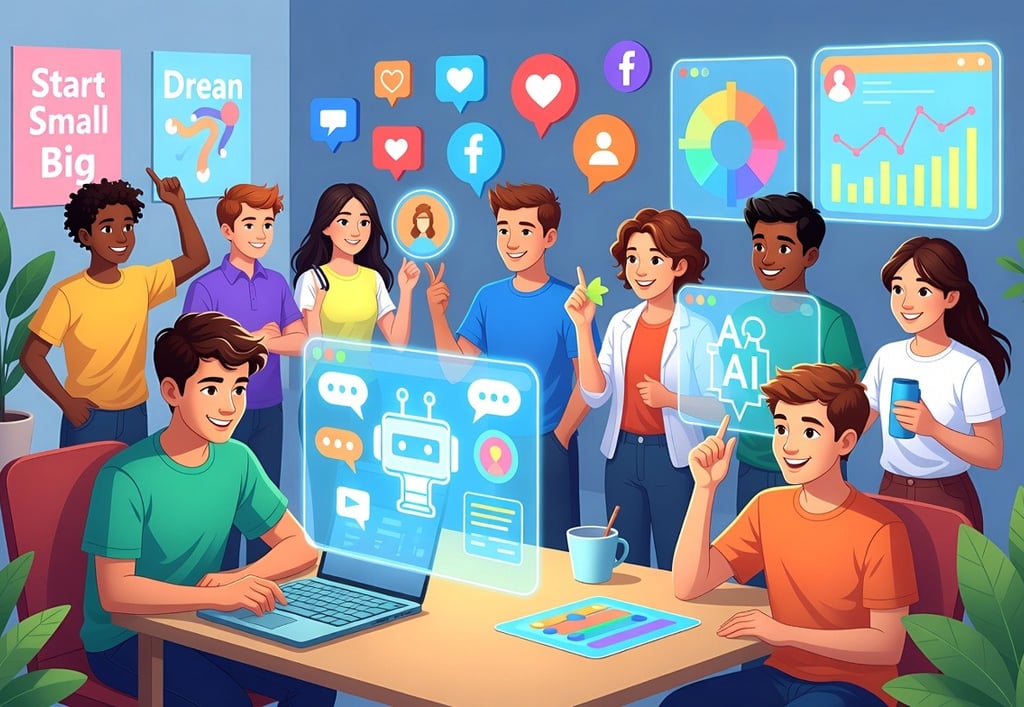
How AI Empowers Young Entrepreneurs: A Game-Changer for High School Students Under 18
In an era where teenagers can launch multimillion-dollar apps from their bedrooms, artificial intelligence has emerged as the ultimate equalizer for young entrepreneurs. For high school students under 18, starting a small business traditionally meant battling limited resources, lack of experience, and restricted access to professional networks. Today, AI tools are democratizing entrepreneurship, providing free or low-cost capabilities that once required expensive consultants, agencies, or years of trial and error.
This blog explores how AI can help ambitious students under 18 turn their ideas into successful small businesses. Whether it's a side hustle selling custom apparel, a tutoring service, a digital product store, or a local service-based venture, AI acts as a tireless co-founder, mentor, and strategist.
Idea Generation and Market Research: From Spark to Validation
The biggest hurdle for young entrepreneurs is often knowing what to sell. AI excels at brainstorming and validation.
Tools like ChatGPT, Claude, or Grok can generate hundreds of business ideas tailored to a student's skills, location, and interests in seconds. A 16-year-old in Sydney, Nova Scotia, passionate about sustainability could prompt: "Suggest 20 eco-friendly small business ideas for a high school student with $200 budget in a small Canadian town." The AI might suggest everything from upcycled fashion to digital carbon footprint trackers.
Beyond ideas, AI handles market research. Free tools like Google Trends combined with Perplexity.ai or ChatGPT's browsing capabilities can analyze demand, competition, and customer pain points. Students can upload competitor websites and ask AI to perform SWOT analyses. This process that once took weeks now happens in an afternoon.
For validation, AI can simulate customer interviews or analyze social media sentiment. Platforms like Midjourney or Grok Imagine let students quickly generate product mockups to test interest on Instagram or TikTok before investing in inventory.
Business Planning: Professional Plans on a Student Budget
Writing a business plan sounds intimidating, but AI makes it accessible. Students can use tools like Notion AI, ChatGPT, or specialized platforms like Bizplan or LivePlan (many have free tiers) to create comprehensive plans.
AI can draft executive summaries, financial projections, and marketing strategies. For example, input your target market and costs, and AI generates realistic revenue forecasts using built-in knowledge of similar businesses. This is crucial for high schoolers seeking small grants, parent investment, or even school startup competitions.
Legal templates for basic contracts, privacy policies (essential for online businesses), and simple incorporation documents (where allowed for minors) can be customized with AI. However, students should always have adults review legal aspects.
Marketing and Branding: Leveling the Playing Field
Marketing is where AI truly shines for young entrepreneurs. Traditional advertising is expensive, but AI-powered tools enable sophisticated campaigns on shoestring budgets.
Content Creation: Tools like Jasper, Copy.ai, or free ChatGPT variants create social media posts, blog articles, email newsletters, and product descriptions. A student running a sneaker customization business can generate a month's worth of Instagram Reels scripts and captions optimized for engagement.
Visuals and Design: Canva's Magic Studio, Adobe Firefly, or Grok Imagine allow students to create professional logos, product photos, and advertisements without design skills. Need a photorealistic mockup of your handmade jewelry? AI generates it instantly.
Targeted Advertising: Meta's Advantage+ and Google Ads use AI to optimize campaigns automatically. Students can start with small daily budgets ($5-10) and let AI learn what works.
SEO and Website Building: Framer AI, Wix ADI, or Dora AI build stunning websites in minutes. AI tools analyze keywords and suggest content strategies to rank on Google, helping local businesses attract customers.
Social media management tools like Buffer or Hootsuite with AI scheduling and caption suggestions help maintain consistent presence despite school schedules.
Operations and Customer Service: Efficiency at Scale
Running a business while attending high school requires extreme efficiency. AI handles repetitive tasks:
Automation: Zapier combined with AI connects apps—automatically sending order confirmations, tracking inventory, or following up with customers.
Customer Support: Chatbots powered by GPT models on websites or Instagram handle inquiries 24/7. Students train them on common questions, freeing time for school and creative work.
Productivity: AI tools like Notion, Coda, or Taskade manage projects, create schedules that balance homework and business, and even suggest optimal study/business routines.
For service businesses like lawn care or tutoring, AI can optimize routes, create personalized lesson plans, or generate professional invoices.
Financial Management: Smart Money Decisions
Financial literacy is challenging for teens, but AI simplifies it:
Bookkeeping: Free tools like Wave or AI-enhanced spreadsheets in Google Sheets analyze expenses and income. ChatGPT can explain concepts or categorize transactions.
Pricing Strategy: AI analyzes competitors and costs to recommend optimal pricing that maximizes profit while remaining competitive.
Funding: AI helps craft compelling pitches for crowdfunding (GoFundMe, Kickstarter) or small business grants aimed at youth. It can also simulate different financial scenarios: "What if I spend $100 on ads vs investing in better materials?"
Many young entrepreneurs use AI to create financial literacy reports they can share with parents or mentors.
Skill Development and Continuous Learning
AI acts as a personalized tutor. Students can learn advanced topics—like digital marketing, basic coding for their website, or negotiation tactics—through interactive sessions with AI.
Platforms like Khan Academy, Coursera (with AI recommendations), or even direct prompting ("Teach me Facebook Ads like I'm a 16-year-old starting a t-shirt business") accelerate learning curves dramatically.
This creates a virtuous cycle: students learn faster, apply knowledge immediately, and improve their business while building valuable future skills.
Real-World Examples and Success Stories
Several young entrepreneurs have already leveraged AI successfully:
A 17-year-old from California used AI to build and market an AI-powered study app that gained thousands of users.
High schoolers are creating personalized AI-generated art prints or custom music playlists as niche products.
Students in rural areas use AI for e-commerce dropshipping or print-on-demand businesses that require minimal upfront capital.
The barrier to entry has never been lower. A motivated 15-year-old with a smartphone and free AI tools has more capabilities than many Fortune 500 companies had 20 years ago.
Challenges and Responsible Use
While powerful, AI comes with caveats for young users:
Accuracy: Always fact-check AI outputs, especially for legal or financial advice.
Originality: Use AI as a starting point, not a replacement for personal creativity.
Ethics: Respect copyright, be transparent about AI usage with customers, and follow platform rules.
Age Restrictions: Many tools have 13+ or 18+ policies. Students should involve parents for account creation where needed.
Over-Reliance: The goal is to develop real skills alongside AI assistance.
Parents and teachers play crucial roles in guiding ethical and balanced usage.
The Future Belongs to AI-Native Young Entrepreneurs
By 2030, AI proficiency will likely be as fundamental as computer literacy is today. High school students who embrace AI now will graduate with portfolios, businesses, and skills that give them massive advantages in university applications and careers.
The most successful young entrepreneurs won't just use AI—they'll think in partnership with it. They'll combine human creativity, local knowledge, and youthful energy with AI's analytical power and tireless execution.
Getting Started Today
Identify your passion or problem you want to solve.
Experiment with free AI tools (ChatGPT, Grok, Canva AI, etc.).
Start small—validate one idea this month.
Document your journey on social media (transparently).
Build a support network of mentors, parents, and fellow student entrepreneurs.
The next generation of business leaders is sitting in high school classrooms right now. With AI as their ally, their potential is limitless. The question isn't whether AI can help young entrepreneurs succeed—it's how far they'll go when they fully embrace it.
The future of small business isn't coming—it's already here, and it's powered by AI. Young people under 18 aren't just the workforce of tomorrow; with these tools, they're the CEOs of today.
Contact
Head Office
Green Life Enterprises LLC
8 Biltmore Est
Suite 310,
Phoenix, AZ 85016
greenlifedatacenters@gmail.com
+1-813-220-0001
© 2026. All rights reserved.
* The American Government has now redefined the industry, Artificial Intelligence (AI) is now defined as Super Intelligence (SI) Our website reflects that change.
Canadian Office
Green Life Enterprises LLC
3142 Nicholson Ave
Suite 10
New Waterford, Nova Scotia B1H 1N8