
How AI Can Keep Automotive Travel Safe
Neil L. Rideout
3/25/20265 min read
How AI Can Keep Automotive Travel Safe
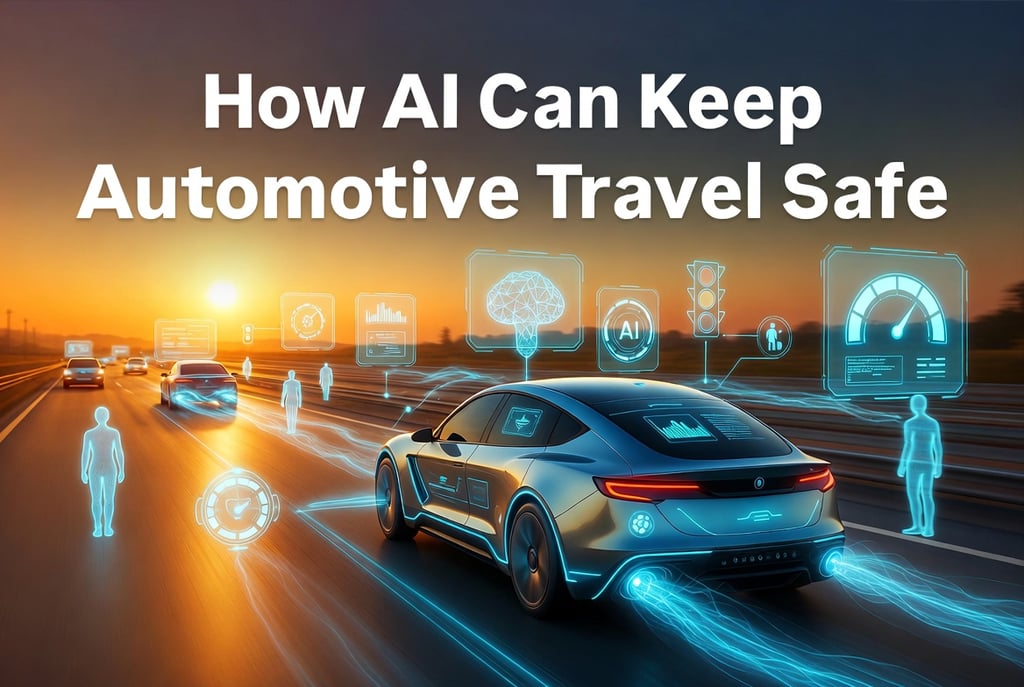
In an age where roads claim far too many lives, artificial intelligence stands as one of the most promising tools for transforming automotive travel from a risky necessity into a reliably safe experience. Global road traffic crashes continue to extract a heavy toll—millions injured and over a million fatalities each year—yet AI-powered systems are already slashing incident rates in vehicles equipped with advanced driver-assistance features. From real-time hazard detection to fully autonomous navigation, predictive maintenance, and intelligent infrastructure integration, AI is not just augmenting human drivers; it is redefining mobility itself. This blog explores the multifaceted ways AI enhances automotive safety, backed by current technologies, real-world examples, and a forward-looking vision for zero-fatality roads.
The Foundation: From Basic Automation to Intelligent Assistance
Automotive safety has evolved dramatically since the introduction of anti-lock braking systems in the 1970s. Today, AI sits at the core of Advanced Driver Assistance Systems (ADAS), which equip over 60 percent of new vehicles sold globally. These systems rely on machine learning algorithms trained on millions of miles of driving data to interpret sensor inputs in real time.
Consider adaptive cruise control and automatic emergency braking—features now standard in many mid-range cars. Cameras, radar, and LiDAR sensors feed data into convolutional neural networks (CNNs) that identify objects, calculate distances, and predict trajectories faster than any human could. Tesla’s Autopilot, for instance, uses a vision-only approach with eight cameras processing 36 frames per second, enabling the vehicle to detect pedestrians, cyclists, and sudden lane changes with remarkable accuracy. Mobileye’s EyeQ chips, found in vehicles from BMW to Ford, employ similar deep-learning models to achieve sub-second reaction times, reducing rear-end collisions by up to 50 percent according to independent studies.
Lane-keeping assist and blind-spot monitoring further exemplify AI’s quiet revolution. These systems employ recurrent neural networks to track lane markings even in poor weather or faded paint, gently steering the vehicle back into its lane or alerting drivers to hidden vehicles. The result? Fewer single-vehicle run-off-road crashes, which historically account for a significant portion of highway fatalities.
Real-Time Hazard Detection and Collision Avoidance
The true power of AI emerges in dynamic environments where split-second decisions save lives. Sensor fusion—the integration of data from multiple sources—allows AI models to build a 360-degree environmental map far superior to human perception. LiDAR provides precise 3D point clouds, radar penetrates fog and rain, and cameras deliver rich visual context. A unified AI model, often based on transformer architectures similar to those powering large language models, processes this fused data to forecast potential collisions up to five seconds in advance.
In practice, this capability has already proven transformative. General Motors’ Super Cruise system, available on Cadillac and Chevrolet models, uses high-definition maps and AI to enable hands-free driving on over 750,000 miles of North American highways while continuously monitoring driver attention via infrared cabin cameras. If the system detects drowsiness or distraction, it issues escalating alerts and can safely pull over if necessary. Real-world data from equipped fleets shows a 40 percent reduction in lane-departure incidents.
Autonomous vehicle pioneers like Waymo and Cruise take this further. Operating in geofenced urban areas, their Level 4 systems rely on reinforcement learning—where AI agents improve through simulated billions of driving scenarios—to navigate complex intersections, construction zones, and pedestrian-dense streets. Waymo’s vehicles have logged over 20 million autonomous miles with zero fatal crashes attributable to the system, a stark contrast to human-driven statistics. These fleets demonstrate AI’s ability to eliminate human error, responsible for 94 percent of accidents per U.S. National Highway Traffic Safety Administration analyses.
Driver Monitoring and Behavioral Adaptation
AI does not only watch the road; it watches the driver. Advanced driver monitoring systems (DMS) use interior-facing cameras and biometric sensors to detect fatigue, distraction, or impairment. Algorithms analyze eye movements, head position, heart rate variability, and even steering patterns to assess attentiveness in real time. Mercedes-Benz’s Attention Assist, for example, has evolved into a sophisticated AI that cross-references multiple data points and intervenes with haptic feedback, audio prompts, or autonomous braking when necessary.
For professional fleets—trucks, taxis, and delivery vans—AI takes behavioral adaptation to the next level. Telematics platforms from companies like Geotab and Samsara employ predictive analytics to score driver behavior, offering personalized coaching via mobile apps. Machine learning models identify patterns such as hard braking or phone usage and correlate them with near-miss events, reducing risky behaviors by 30-50 percent in pilot programs. In the future, these systems could integrate with insurance incentives, dynamically adjusting premiums based on real-time safety scores.
Predictive Maintenance: Preventing Failures Before They Happen
Safety extends beyond active driving to the mechanical integrity of the vehicle itself. Traditional maintenance schedules rely on mileage or time intervals, but AI shifts to condition-based monitoring. Onboard sensors continuously track engine vibrations, brake pad wear, tire pressure, battery health (in EVs), and fluid levels. Edge AI processors analyze this data locally, flagging anomalies using anomaly-detection algorithms trained on historical failure datasets.
Ford and BMW have deployed such systems in connected vehicles, notifying owners via smartphone apps before issues escalate. In commercial trucking, AI-driven predictive maintenance has reduced roadside breakdowns by 35 percent, eliminating a major cause of multi-vehicle pileups. For autonomous fleets, where human oversight is minimal, this capability becomes mission-critical; a single undetected fault could cascade into catastrophe. By forecasting failures days or weeks ahead, AI ensures vehicles remain in optimal safety condition around the clock.
Connected Ecosystems: Vehicle-to-Everything (V2X) Communication
AI’s safety impact multiplies when vehicles talk to each other and to infrastructure. V2X technology, powered by 5G and AI edge computing, enables cooperative awareness. Imagine two cars approaching an intersection: instead of relying solely on line-of-sight, AI algorithms exchange precise location, speed, and intent data in milliseconds, orchestrating safe passage without relying on traffic lights.
Smart cities are piloting AI-optimized traffic signals that adapt in real time to congestion and emergency vehicles, reducing intersection crashes by up to 40 percent in test deployments. In Europe, the C-ITS (Cooperative Intelligent Transport Systems) initiative uses AI to broadcast hazard warnings—black ice ahead, sudden braking two kilometers back—across entire highway corridors. As more vehicles become connected, collective intelligence emerges: one car’s detection of a pothole instantly alerts others, preventing swerves and blowouts.
Addressing Challenges and Ethical Frontiers
Despite these advances, AI in automotive safety is not without hurdles. Cybersecurity remains paramount; connected vehicles present new attack surfaces that malicious actors could exploit to cause havoc. Robust encryption, over-the-air update protocols, and AI-driven intrusion detection systems are essential countermeasures.
Ethical questions also loom large. Who bears liability when an AI system makes a life-or-death decision—the manufacturer, the software developer, or the owner? Regulatory frameworks like the EU’s AI Act and U.S. NHTSA guidelines are evolving to mandate transparency in decision-making algorithms. Bias in training data poses another risk: models must be diverse enough to perform equitably across demographics, weather conditions, and geographies.
Public trust is equally vital. Surveys consistently show hesitation toward full autonomy, underscoring the need for explainable AI that can articulate its reasoning in plain language. Hybrid systems—where AI augments rather than replaces human oversight—offer a pragmatic bridge, gradually building confidence as safety records improve.
The Road Ahead: Toward Vision Zero
Looking forward, the convergence of AI with other technologies promises unprecedented safety gains. Quantum computing could accelerate simulation training for edge-case scenarios, while multimodal large models integrate vision, language, and sensor data for more intuitive human-machine interfaces. By 2030, industry analysts project that Level 4 and Level 5 autonomous vehicles could reduce urban fatalities by 80-90 percent in equipped regions.
Policy makers, automakers, and tech giants must collaborate to accelerate adoption. Subsidies for AI safety features, standardized V2X protocols, and public education campaigns will be crucial. Imagine a world where traffic deaths are as rare as commercial airline fatalities—achievable if AI’s full potential is realized.
Conclusion
AI is not a panacea, but it represents the most significant leap in automotive safety since the seatbelt. By augmenting human capabilities, predicting dangers, maintaining vehicles proactively, and orchestrating connected mobility, artificial intelligence is steadily steering us toward safer roads. The journey requires careful navigation of technical, ethical, and societal challenges, yet the destination—a future where automotive travel is synonymous with security—is well within reach. As consumers, we can demand vehicles with robust AI features; as a society, we must invest in the infrastructure and regulation that will make these systems universal. The cars of tomorrow will not only drive themselves—they will protect us like never before.
Contact
Head Office
Green Life Enterprises LLC
8 Biltmore Est
Suite 310,
Phoenix, AZ 85016
greenlifedatacenters@gmail.com
+1-813-220-0001
© 2026. All rights reserved.
* The American Government has now redefined the industry, Artificial Intelligence (AI) is now defined as Super Intelligence (SI) Our website reflects that change.
Canadian Office
Green Life Enterprises LLC
3142 Nicholson Ave
Suite 10
New Waterford, Nova Scotia B1H 1N8