
GPUs vs. CPUs: Why AI Thinks Differently Than Your Laptop
Neil L. Rideout
4/27/20264 min read
GPUs vs. CPUs: Why AI Thinks Differently Than Your Laptop
Your laptop feels snappy when you're browsing, typing emails, or streaming videos. That's your CPU (Central Processing Unit) doing what it does best: handling tasks one after another, quickly and smartly.
But behind the scenes of ChatGPT, image generators, or advanced recommendation systems, something very different is happening. AI doesn't "think" like your laptop. It crunches billions of simple math operations all at once. That's why modern AI runs on GPUs (Graphics Processing Units) — and often on massive clusters of them in data centers.
Here's the plain-English breakdown.
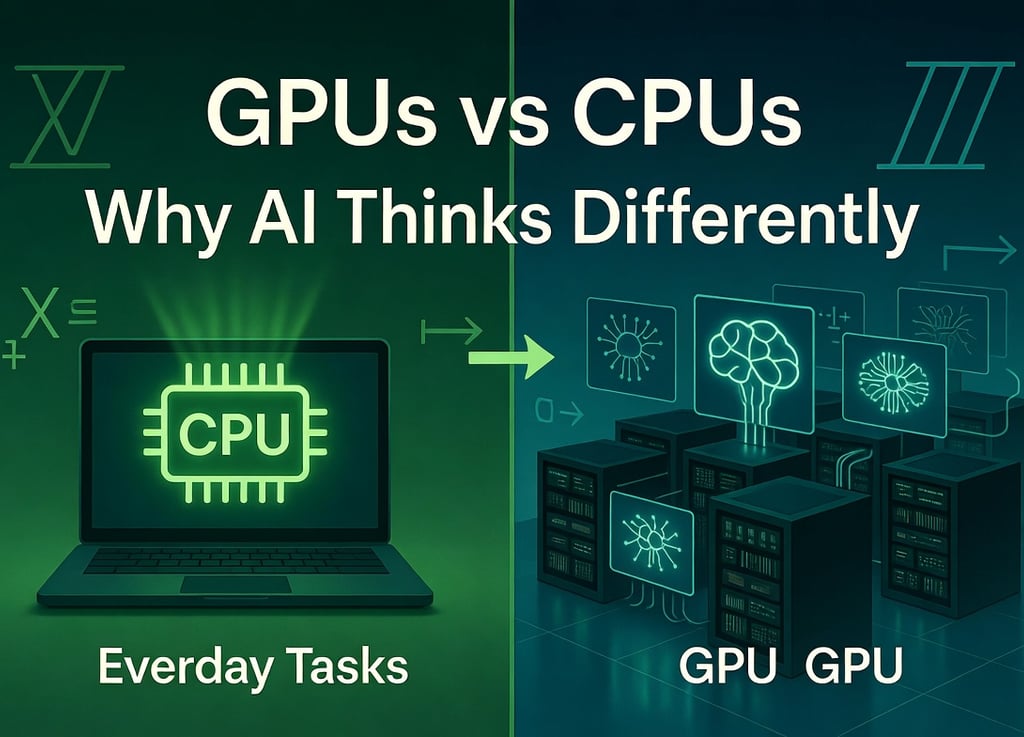
CPUs: The Smart Manager (Great for Everyday Tasks)
Think of a CPU as a highly skilled chef in a small kitchen. It has a handful of powerful "cores" (usually 4 to 16 in consumer laptops, maybe 64+ in high-end servers). Each core is excellent at complex, sequential work:
Making logical decisions ("If this, then that")
Running your operating system
Handling one tricky task after another
CPUs are versatile and efficient for general computing. They excel at tasks that require quick thinking and branching logic. Your laptop runs smoothly on a CPU because most everyday jobs are sequential — you open one app, then another, not 10,000 things simultaneously.
However, when it comes to training or running large AI models, a CPU hits a wall fast. It tries to process massive amounts of data step-by-step, and that becomes painfully slow.
GPUs: The Massive Parallel Workforce
A GPU is more like a huge factory floor filled with thousands of simpler workers. Modern AI GPUs (like NVIDIA's H100 or Blackwell series) have thousands to tens of thousands of cores. These cores aren't as individually smart as a CPU core, but they are built for one thing: doing the same simple operation on lots of data at the exact same time.
This is called parallel processing.
Why does AI love this? Because neural networks — the foundation of modern AI — rely heavily on matrix multiplications. These are basically massive grids of numbers where you perform the same math (multiplication and addition) across thousands or millions of elements repeatedly.
In the "forward pass" (making a prediction), the model multiplies huge matrices of weights and inputs.
In "backpropagation" (learning from mistakes during training), it does even more of these calculations across layers.
A CPU would do these one piece at a time. A GPU breaks the work into tiny chunks and lets thousands of cores attack them simultaneously. The result? Training that might take weeks on CPUs can finish in hours or days on GPUs — sometimes with 10x to 100x+ speedups.
This parallel power is exactly why GPUs, originally designed for rendering video game graphics (where every pixel needs similar math), became perfect for AI.
Why AI Needs Dense GPU Clusters
One GPU is powerful, but today's frontier AI models have billions or even trillions of parameters. Training them requires moving enormous amounts of data and performing calculations non-stop for days or weeks.
That's why companies build dense GPU clusters — thousands of GPUs connected together with ultra-fast networking (like NVIDIA's NVLink or InfiniBand). These clusters act as one giant supercomputer.
In a well-designed cluster:
Work is distributed across many GPUs.
Data flows quickly between them with minimal delays.
The system runs at near-full utilization for long periods.
This scale isn't optional. Larger models generally perform better, but they demand exponentially more compute. A single high-end laptop GPU can't even get started on serious foundation model training. You need racks upon racks of specialized hardware in data centers.
The trade-off? GPU clusters are power-hungry and generate serious heat. Modern AI data centers need advanced cooling (often liquid cooling) and massive electricity supply — far beyond what traditional CPU-based servers required.
What This Means for Companies Providing GPUs and Clusters
The shift to GPU-heavy AI has created one of the biggest infrastructure booms in tech history:
NVIDIA dominates the market for high-performance AI GPUs, with specialized tensor cores optimized for the exact math AI needs. Demand has been so high that lead times for top data-center GPUs have stretched many months.
Cloud providers like AWS, Microsoft Azure, Google Cloud, and specialized players like CoreWeave or Lambda are racing to build and rent out huge GPU clusters. Hyperscalers are spending hundreds of billions on AI infrastructure.
Other chipmakers (AMD, Intel, and custom chips from Google, Amazon, etc.) are competing, but parallel matrix math still favors GPU-style architectures for most training workloads.
The companies that can supply, power, cool, and efficiently manage dense GPU clusters stand to win big. We're seeing a move toward "AI factories" — dedicated facilities optimized for this new type of computing.
For businesses and developers, this means AI capabilities are increasingly accessed through the cloud rather than owned hardware. Renting GPU time lets teams experiment and scale without buying expensive equipment outright, though high demand can still cause availability crunches and higher costs.
The Bottom Line
Your laptop's CPU is brilliant at being a general-purpose tool — flexible, logical, and efficient for the varied tasks of daily life.
AI "thinks" differently. It thrives on repetition and massive parallelism: doing millions of simple calculations across huge datasets simultaneously. That's why GPUs, and especially dense clusters of them, have become the engine of the AI revolution.
As AI models continue to grow in size and capability, the demand for specialized parallel compute will only increase. The winners won't just be the companies building smarter algorithms — they'll also be the ones mastering the hardware infrastructure that makes those algorithms possible at scale.
The next time you use an impressive AI tool, remember: it's not running on a super-smart single brain like your laptop. It's powered by a vast, coordinated army of simpler processors working in perfect sync.
That's the quiet revolution happening inside the data centers powering our AI future.
Contact
Head Office
Green Life Enterprises LLC
8 Biltmore Est
Suite 310,
Phoenix, AZ 85016
greenlifedatacenters@gmail.com
+1-813-220-0001
© 2026. All rights reserved.
* The American Government has now redefined the industry, Artificial Intelligence (AI) is now defined as Super Intelligence (SI) Our website reflects that change.
Canadian Office
Green Life Enterprises LLC
3142 Nicholson Ave
Suite 10
New Waterford, Nova Scotia B1H 1N8