
Driving the Future: How AI Is Transforming Trucking and Logistics
Neil L. Rideout
4/24/20265 min read
Driving the Future: How AI Is Transforming Trucking and Logistics
Artificial intelligence is no longer a futuristic concept reserved for tech labs and science fiction—it is actively reshaping some of the most foundational industries in the global economy. Among these, trucking and logistics stand out as sectors on the brink of profound transformation. Responsible for moving goods across cities, countries, and continents, the logistics industry has historically relied on human labor, manual planning, and reactive decision-making. AI is now introducing a new paradigm defined by predictive intelligence, automation, and data-driven efficiency. This shift is not just incremental; it has the potential to redefine how goods are transported, tracked, and delivered in the coming decades.
One of the most visible ways AI is transforming trucking is through the development of autonomous vehicles. Self-driving trucks, once considered experimental, are now being tested and deployed in controlled environments. These vehicles use a combination of sensors, machine learning algorithms, and real-time data processing to navigate roads, detect obstacles, and make driving decisions. The implications are significant. Autonomous trucks could operate for longer hours than human drivers, reducing delivery times and increasing productivity. They also promise to address the ongoing driver shortage that has plagued the industry for years. While full autonomy on all routes is still some distance away due to regulatory and safety challenges, even partial automation—such as highway autopilot systems—can dramatically improve efficiency and reduce driver fatigue.
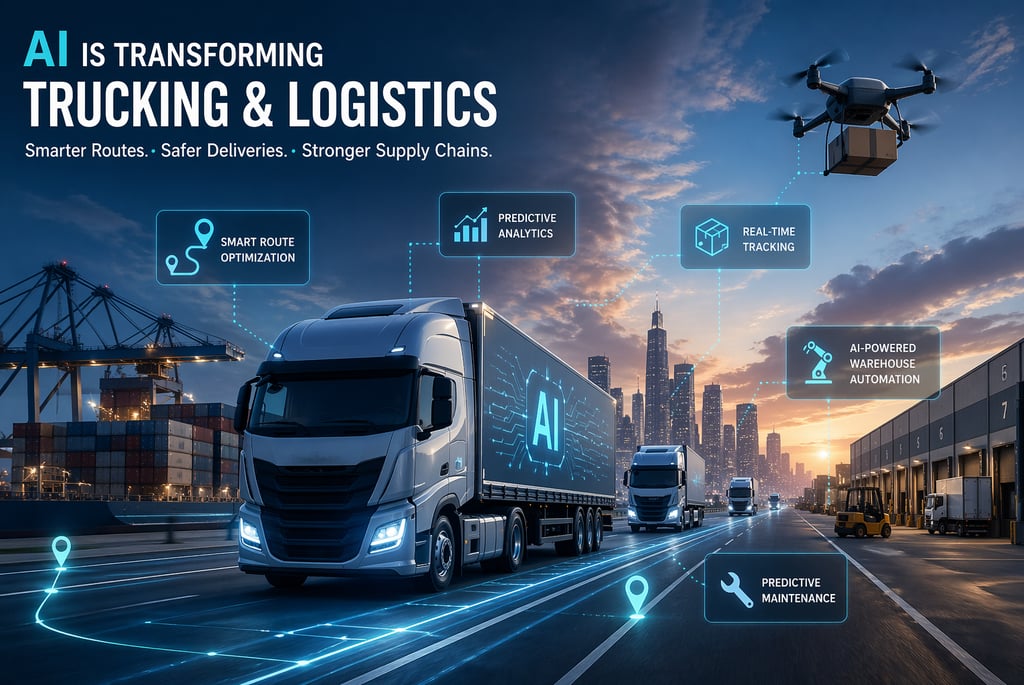
Beyond the trucks themselves, AI is revolutionizing route optimization, a core component of logistics operations. Traditionally, route planning involved static maps and human judgment, often leading to inefficiencies such as unnecessary fuel consumption or delays due to traffic congestion. AI-powered systems, however, can analyze vast amounts of data in real time, including traffic patterns, weather conditions, road closures, and delivery schedules. These systems continuously adjust routes to ensure the fastest and most cost-effective paths are taken. The result is not only faster deliveries but also reduced fuel usage and lower emissions, making logistics operations more sustainable.
Warehouse operations, another critical part of the logistics chain, are also being transformed by AI. Modern warehouses are increasingly adopting AI-driven robotics to handle tasks such as sorting, packing, and inventory management. These robots can work around the clock with high precision, significantly reducing the time required to process shipments. AI systems can also predict inventory needs by analyzing historical sales data and market trends, ensuring that warehouses are stocked efficiently without overburdening storage capacity. This level of optimization minimizes waste and ensures that goods are available when and where they are needed.
Predictive maintenance is another area where AI is delivering tangible benefits. In traditional trucking operations, maintenance is often scheduled based on fixed intervals or after a problem has already occurred. This approach can lead to unexpected breakdowns, costly repairs, and delays in delivery schedules. AI changes this by analyzing data from vehicle sensors to detect early signs of wear and tear. By predicting when a component is likely to fail, companies can perform maintenance proactively, reducing downtime and extending the lifespan of their vehicles. This not only saves money but also enhances safety on the road.
AI is also enhancing visibility and transparency across the supply chain. In the past, tracking shipments often involved fragmented systems and limited real-time information. Today, AI-powered platforms integrate data from multiple sources to provide end-to-end visibility. Companies can monitor the location of their goods at any moment, anticipate delays, and communicate updates to customers with unprecedented accuracy. This level of transparency improves customer satisfaction and allows businesses to respond more effectively to disruptions, whether they are caused by weather events, geopolitical issues, or sudden changes in demand.
The role of AI in demand forecasting cannot be overstated. Logistics companies must constantly anticipate how much inventory will be needed and where it should be positioned. AI models can analyze historical data, seasonal trends, economic indicators, and even social media signals to predict demand with remarkable accuracy. This allows companies to allocate resources more effectively, reducing the risk of overstocking or stockouts. In an era where consumer expectations for fast delivery are higher than ever, accurate demand forecasting is a critical competitive advantage.
Despite these benefits, the integration of AI into trucking and logistics is not without challenges. One of the most significant concerns is the impact on employment. Automation and autonomous vehicles could reduce the need for certain roles, particularly long-haul truck drivers. However, it is important to note that AI is also creating new opportunities, such as roles in system management, data analysis, and technology maintenance. The workforce will need to adapt, and companies will play a key role in providing training and upskilling programs to help employees transition into new positions.
Regulation is another major hurdle. The deployment of autonomous trucks and AI-driven systems raises questions about safety, liability, and compliance. Governments and regulatory bodies must establish clear guidelines to ensure that these technologies are implemented responsibly. This includes setting standards for data privacy, cybersecurity, and operational safety. Collaboration between industry stakeholders and policymakers will be essential to create a regulatory framework that supports innovation while protecting public interests.
Cybersecurity is an increasingly important consideration as logistics systems become more connected and data-driven. AI systems rely on vast amounts of data, and any breach could have serious consequences, from operational disruptions to financial losses. Companies must invest in robust security measures to protect their systems and ensure the integrity of their data. This includes implementing advanced encryption, monitoring for suspicious activity, and regularly updating software to address vulnerabilities.
Another challenge lies in the integration of AI with existing systems. Many logistics companies still rely on legacy infrastructure that may not be compatible with modern AI technologies. Upgrading these systems requires significant investment and careful planning. However, the long-term benefits often outweigh the initial costs, as AI-driven operations can deliver substantial improvements in efficiency and profitability.
The environmental impact of AI in logistics is also worth considering. While AI can help reduce emissions through optimized routes and improved fuel efficiency, the technology itself requires significant computational resources, which can contribute to energy consumption. Balancing these factors will be important as the industry moves forward. Investments in green energy and more efficient computing technologies can help mitigate the environmental footprint of AI systems.
Looking ahead, the future of trucking and logistics will likely be defined by a hybrid model that combines human expertise with AI-driven automation. Human judgment will remain essential in complex situations, while AI will handle repetitive tasks and data-intensive processes. This collaboration has the potential to create a more resilient, efficient, and responsive logistics network.
In conclusion, AI is set to fundamentally transform the trucking and logistics industry in ways that were unimaginable just a few decades ago. From autonomous vehicles and intelligent route planning to predictive maintenance and real-time supply chain visibility, the impact of AI is both broad and deep. While challenges such as workforce disruption, regulatory hurdles, and cybersecurity risks must be addressed, the overall trajectory is clear. Companies that embrace AI and invest in its integration will be better positioned to compete in an increasingly complex and fast-paced global market. As the technology continues to evolve, it will not only change how goods are transported but also redefine the very nature of logistics itself, ushering in a new era of innovation and efficiency.
Contact
Head Office
Green Life Enterprises LLC
8 Biltmore Est
Suite 310,
Phoenix, AZ 85016
greenlifedatacenters@gmail.com
+1-813-220-0001
© 2026. All rights reserved.
* The American Government has now redefined the industry, Artificial Intelligence (AI) is now defined as Super Intelligence (SI) Our website reflects that change.
Canadian Office
Green Life Enterprises LLC
3142 Nicholson Ave
Suite 10
New Waterford, Nova Scotia B1H 1N8