
AI: The Future Co-Teacher Transforming Classrooms
Neil L. Rideout
5/7/20265 min read
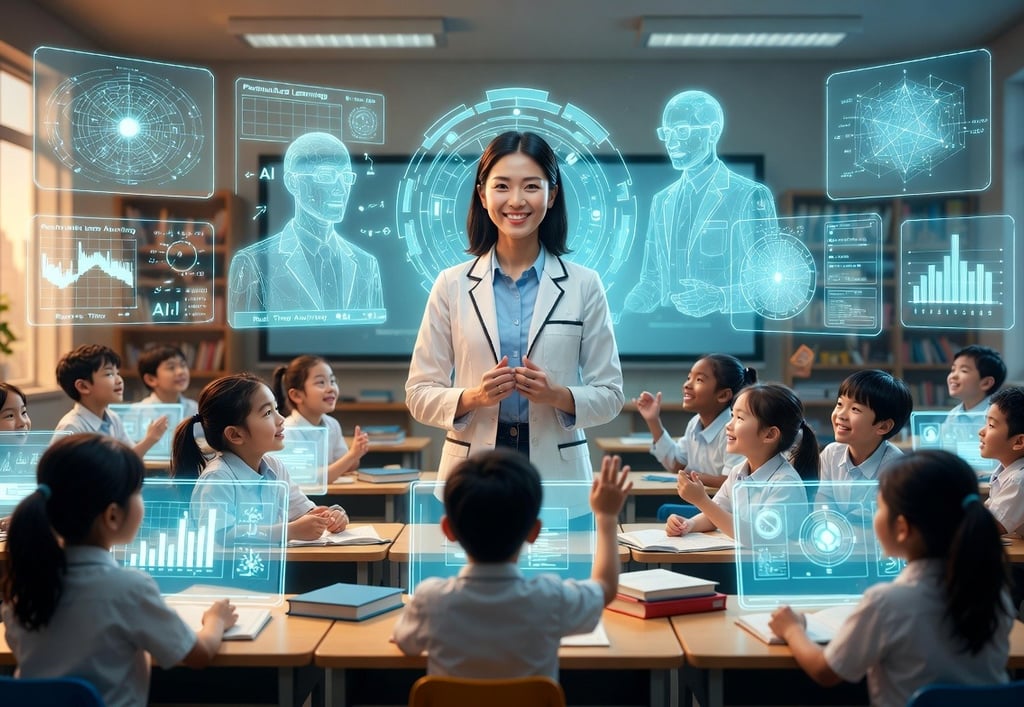
AI: The Future Co-Teacher Transforming Classrooms
The teaching profession stands at the cusp of its greatest evolution. For decades, educators have shouldered immense loads: planning differentiated lessons, grading mountains of assignments, managing classroom behavior, supporting students with diverse needs, and handling endless administrative duties—all while trying to inspire young minds. Artificial Intelligence is poised to change that dramatically. Rather than replacing teachers, AI will act as a powerful co-pilot, handling routine tasks and providing deep insights so educators can focus on what they do best: building relationships, mentoring, and fostering human connection.
By 2030 and beyond, AI integration in education could free up 20-30 hours per week for many teachers, according to various projections from organizations like McKinsey and UNESCO. This isn’t science fiction—it’s the logical extension of tools already emerging today. Here’s how AI will reshape the daily life of schoolteachers in the coming decade.
Personalized Learning at Scale
One of the biggest challenges in traditional classrooms is the wide variance in student abilities. A single class might include gifted learners, students with learning disabilities, English language learners, and everyone in between. AI excels at meeting each student exactly where they are.
Adaptive learning platforms will analyze performance in real-time—tracking not just correct answers but response time, common error patterns, and even engagement levels via facial recognition or interaction data (with strong privacy safeguards). If a student struggles with fractions, the AI can instantly generate additional micro-lessons, visual explanations, or gamified practice tailored to their learning style—visual, auditory, kinesthetic, or a blend.
Teachers will receive daily or weekly “insight dashboards” highlighting which students need small-group intervention, which concepts need reteaching to the whole class, and which students are ready for enrichment. This turns the teacher from a lecturer into a true learning orchestrator. Imagine a middle school math teacher spending her planning period reviewing AI-suggested groupings instead of manually creating three different worksheets.
Intelligent Lesson Planning and Resource Creation
Lesson planning is time-consuming. AI tools will act as expert collaborators. A teacher could input: “Create a 5th-grade science unit on ecosystems aligned with Next Generation Science Standards, incorporating project-based learning, differentiation for ELL students, and hands-on activities with minimal supplies.”
Within seconds, the AI generates a complete unit plan with objectives, activities, assessments, slides, worksheets, extension ideas, and even suggested discussion prompts. It can pull from vast repositories of open educational resources, recent research, and successful lessons from other classrooms (anonymized and shared).
Beyond planning, AI can generate high-quality visuals, interactive simulations, virtual field trips, or augmented reality overlays. History teachers could summon immersive recreations of ancient Rome; biology teachers could explore virtual dissections or climate models. The creative burden lightens while the quality of materials rises.
Automated Assessment and Meaningful Feedback
Grading consumes enormous teacher time. AI can handle objective assessments instantly—multiple choice, short answers, even essays through advanced natural language processing. More importantly, it provides immediate, personalized feedback to students. A student writing an essay on climate change might receive suggestions on strengthening arguments, improving vocabulary, or citing sources properly—before the teacher ever sees it.
Teachers retain oversight. The AI flags complex or creative work for human review and provides aggregated insights: “Class average on thesis development was low—here are three common issues and remediation strategies.” This allows deeper, more targeted feedback rather than surface-level corrections. Formative assessments become continuous rather than periodic.
Administrative Relief and Efficiency
Teachers often spend more time on bureaucracy than instruction. AI-powered systems will streamline attendance tracking, parent communications, report card generation, IEP documentation, and scheduling. Voice-activated AI assistants could draft emails to parents: “Dear Mr. Patel, your daughter excelled in today’s literature discussion. Here’s a summary of her contribution and suggested home extension activities.”
Scheduling meetings, coordinating with specialists, managing supply inventories, and even basic classroom management (reminding students of tasks or helping with transitions) will become semi-automated. This reduces burnout significantly. Studies already show teacher stress and attrition rates are alarmingly high; AI-driven efficiency gains could help retain talented educators.
Supporting Diverse Learners and Inclusion
AI holds particular promise for students with special needs. Real-time speech-to-text, text-to-speech, translation tools, and emotion recognition can create more inclusive environments. For students on the autism spectrum, AI companions might provide predictable social scripting or sensory regulation prompts. Dyslexic students could benefit from specialized reading scaffolds that adapt instantly.
Teachers will receive AI-generated recommendations for accommodations backed by data, making inclusive teaching more effective and less guesswork-intensive. Bias detection in AI systems will be crucial here—ensuring tools don’t disadvantage certain demographics.
Professional Growth and Teacher Coaching
AI won’t just help teachers with students; it will help them grow professionally. Virtual AI coaches could analyze lesson recordings (with consent) and provide non-judgmental feedback: “You used excellent wait time today. Consider incorporating more student-to-student talk in the next observed segment.” AI could recommend relevant research papers, online courses, or peer connections based on a teacher’s specific goals and classroom data.
Mentorship becomes scalable. New teachers could have an AI “veteran colleague” available 24/7 for advice on classroom management or curriculum questions.
Predictive Analytics and Early Intervention
By analyzing patterns across attendance, engagement, grades, and even social-emotional indicators (where ethically appropriate), AI can flag students at risk of falling behind or facing challenges long before they become crises. A sudden drop in participation might trigger a gentle alert to the teacher or counselor, prompting timely support.
This shifts education from reactive to proactive, potentially reducing achievement gaps and dropout rates.
Challenges and the Human Element
None of this future arrives without careful implementation. Data privacy is paramount—student information must be fiercely protected. Algorithmic bias needs constant auditing. Teachers must receive proper training; the best outcomes will come from human-AI collaboration, not blind reliance on technology. Over-dependence could erode critical thinking or relationship-building if not balanced.
Importantly, AI cannot replicate empathy, moral guidance, creativity in the deepest sense, or the nuanced cultural understanding great teachers provide. The technology amplifies human strengths rather than replacing them. Parents and communities will still crave human teachers who know their children’s names, celebrate their victories, and provide role models.
A New Golden Age for Teaching
The teachers who thrive in the AI era will be those who embrace the tools as partners. They’ll spend less time on drudgery and more on mentorship, project facilitation, emotional coaching, and community building. Classrooms will become more dynamic, equitable, and responsive.
School districts that invest wisely—infrastructure, training, ethical frameworks—will see improved student outcomes, higher teacher satisfaction, and better retention. Those that resist or implement poorly will fall behind.
The future of education isn’t about robots replacing teachers. It’s about liberating teachers to do the profoundly human work that drew them to the profession in the first place. AI handles the mechanics so teachers can focus on the magic.
As we stand on this threshold, one thing is clear: the teachers of tomorrow won’t be less important—they’ll be more empowered, more effective, and more valued than ever before. The classroom of 2035 won’t look like today’s, but the heart of education—the caring, inspiring teacher—will remain irreplaceable at its center.
Contact
Head Office
Green Life Enterprises LLC
8 Biltmore Est
Suite 310,
Phoenix, AZ 85016
greenlifedatacenters@gmail.com
+1-813-220-0001
© 2026. All rights reserved.
* The American Government has now redefined the industry, Artificial Intelligence (AI) is now defined as Super Intelligence (SI) Our website reflects that change.
Canadian Office
Green Life Enterprises LLC
3142 Nicholson Ave
Suite 10
New Waterford, Nova Scotia B1H 1N8