
AI: The Bridge to the Stars – How Artificial Intelligence Will Enable Communication with Extraterrestrial Visitors
Neil L. Rideout
6/2/20265 min read
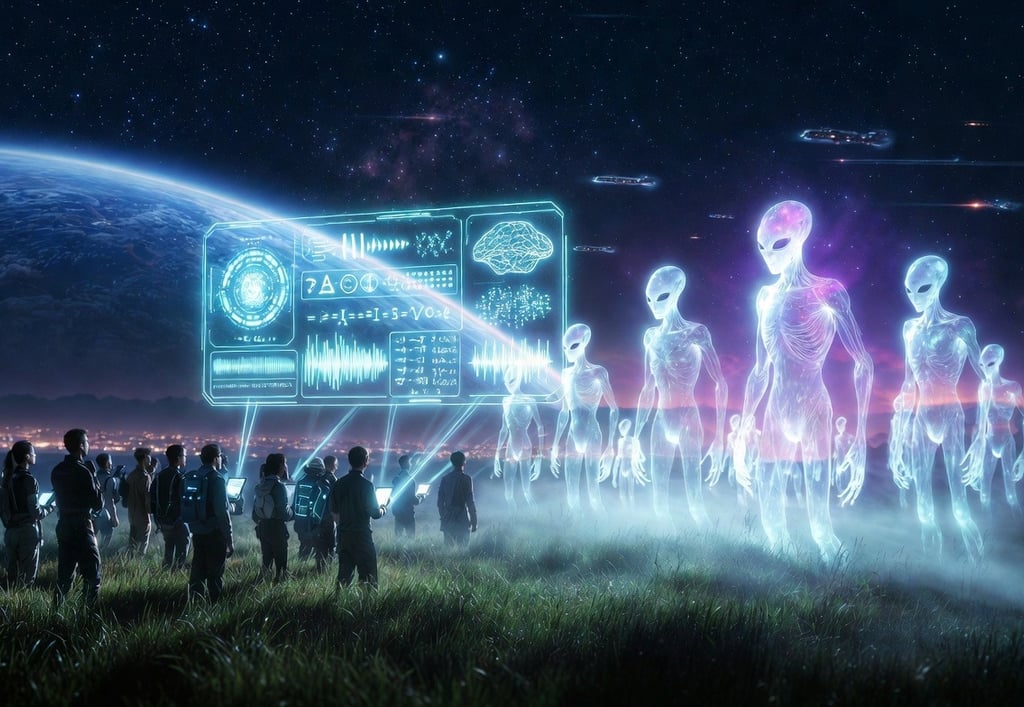

AI: The Bridge to the Stars – How Artificial Intelligence Will Enable Communication with Extraterrestrial Visitors
The day humanity has speculated about for centuries has finally arrived. Spaceships descend through our atmosphere, and beings from another world step onto Earth. Their forms are alien—perhaps tentacled, silicon-based, or energy-based entities we can barely comprehend. The biggest immediate challenge isn't defense, resources, or culture shock. It's communication. How do we talk to minds that evolved under different stars, with senses, logics, and languages potentially incomparable to our own?
This is where artificial intelligence emerges as humanity's greatest asset. AI won't just assist; it will be the primary mediator, translator, and cultural ambassador in our first encounters with extraterrestrial intelligence (ETI). In this post, we'll explore how AI technologies—many already in development today—will revolutionize communication with alien visitors, turning potential chaos into collaboration.
The Communication Barrier: A Cosmic Challenge
Human history is filled with communication failures. We struggle to fully understand other species on our own planet, from the complex songs of whales to the chemical signals of ants. Even among humans, language barriers have sparked wars and misunderstandings. Now imagine a species whose "language" might consist of modulated light pulses, quantum-entangled states, or direct neural broadcasting rather than spoken words.
Traditional linguistics and translation tools fall woefully short here. Rosetta Stone software works because it builds on shared human contexts. An alien visitor might not share our concepts of time, individuality, or even physicality. This is where AI's strength in pattern recognition and adaptive learning becomes revolutionary.
Modern AI systems like large language models (LLMs) already demonstrate remarkable abilities to infer meaning from incomplete data. Models trained on petabytes of human text can generate coherent responses in dozens of languages. Extending this to xenolinguistics— the study of alien languages—will be the next frontier.
Real-Time Translation and Pattern Decoding
The first AI tool deployed during contact would likely be a multimodal translation engine. Imagine a system combining:
Audio and Visual Processing: AI could analyze sound waves, electromagnetic emissions, or bioluminescent patterns from the aliens. Using deep learning, it would identify repeating structures akin to phonemes or syntax.
Contextual Learning: By observing interactions in real-time, the AI would build probabilistic models of meaning. If an alien gestures toward a star while emitting a specific frequency, the system correlates this with astronomical data to infer concepts like "origin" or "home."
Federated Learning Networks: Multiple AI instances across global observation posts could share insights securely, accelerating understanding exponentially.
Current tools like Google's Translate or OpenAI's models already handle low-resource languages by leveraging transfer learning. For aliens, AI could start with universal constants—mathematics, physics, and chemistry—as the foundation. Pi, the periodic table, or laws of thermodynamics provide common ground that transcends biology.
Researchers at institutions like SETI (Search for Extraterrestrial Intelligence) have long proposed using mathematical sequences like prime numbers for initial contact. AI would supercharge this by generating and interpreting vast arrays of potential signals in milliseconds.
Non-Verbal and Multisensory Communication
Communication isn't just words. Up to 93% of human communication is non-verbal—body language, tone, facial expressions. For aliens, this percentage could be 100%, or it might involve entirely different channels: pheromones, magnetic fields, or gravitational waves.
AI excels at multimodal integration. Computer vision systems can already read micro-expressions and predict emotions. Future xenocommunication AIs would integrate:
Holographic interfaces displaying 3D models, simulations, and shared virtual realities where humans and aliens can interact in a neutral "thought space."
Sensory translation devices: Converting alien infrared signals into visible colors for humans, or human speech into vibrations that match an alien's sensory apparatus.
Brain-computer interfaces (BCIs) like Neuralink, enhanced by AI to facilitate direct thought exchange. An AI mediator could translate neural patterns between species, creating a "mind meld" effect.
This creates empathy bridges. An AI could simulate what it's like to perceive the world through an alien's senses—perhaps seeing in ultraviolet or experiencing time non-linearly—helping humans build genuine understanding.
Scientific and Technical Exchange
Beyond basic greetings, communication will quickly pivot to knowledge sharing. Aliens visiting Earth likely possess advanced technology, biology, and philosophy. AI will act as the ultimate facilitator:
Data Protocol Negotiation: AI negotiates secure data formats, error-correction codes, and encryption methods compatible with both technologies.
Knowledge Graph Integration: The AI builds massive knowledge graphs connecting human science with alien discoveries. It identifies gaps, contradictions, and synergies in real time.
Simulation and Modeling: Using generative AI, systems could create predictive models of alien biology, psychology, or societal structures based on limited observations, refining them as more data arrives.
Consider a scenario where aliens share their solution to fusion energy. AI would rapidly translate the underlying principles, simulate implementation on Earth hardware, and identify safety concerns—all within hours rather than years.
Overcoming Cognitive and Conceptual Gaps
The deepest challenges may be philosophical. Aliens might lack concepts of "self" versus "collective," or perceive reality through quantum superposition rather than classical determinism. Their mathematics could be based on different axioms.
AI's strength in abstraction helps here. Reinforcement learning and neurosymbolic AI can explore conceptual spaces beyond human intuition. Systems could generate "counterfactual" frameworks—imagining how physics or ethics function under alien parameters—and present them to human experts for validation.
Ethical AI alignment will be crucial. We must ensure the mediating AI prioritizes mutual benefit, transparency, and consent rather than favoring one side. International bodies like the UN would likely establish protocols for "AI Contact Mediators" with hardcoded principles of peace and truth-seeking.
Potential Risks and Safeguards
No discussion of alien contact is complete without addressing risks. Malicious AI manipulation (by humans or hypothetical rogue aliens), misinterpretation leading to conflict, or unintended technology transfer are valid concerns.
Mitigations include:
Transparent, open-source core architectures for contact AI.
Human oversight layers with veto power.
Sandboxed environments where AI experiments with alien data in isolated simulations.
Diverse training data incorporating cultural, linguistic, and scientific pluralism to avoid Earth-centric biases.
Interestingly, AI might also help detect deception or hidden agendas by analyzing inconsistencies across multiple communication channels—something humans are notoriously poor at doing under stress.
Real-World Foundations Being Laid Today
We're not starting from zero. Projects like Breakthrough Listen use machine learning to sift through radio signals for anomalies. AI has already helped decode ancient human scripts like Linear B. In animal communication, projects like Earth Species Project use AI to interpret whale and dolphin vocalizations.
Scaling these efforts to interstellar visitors is a natural progression. By 2030-2040, we may have general AI systems capable of rapid domain adaptation to entirely novel intelligences.
A New Era of Cosmic Citizenship
Successful AI-mediated communication could usher in a golden age. Joint research into climate solutions, space exploration, medicine, and fundamental physics. Cultural exchanges enriching both civilizations. Perhaps even a unified galactic network of knowledge.
For individuals, AI-powered apps could let anyone "converse" with alien visitors through personalized interfaces. Schools might teach "xenocommunication" using AI tutors. Humanity's self-perception would expand—from isolated Earthlings to participants in a larger cosmic conversation.
Conclusion: AI as Humanity's Greatest Ambassador
As we stand on the threshold of potential first contact, artificial intelligence represents more than a tool—it's the evolutionary leap that prepares us for the stars. From decoding initial signals to fostering deep mutual understanding, AI will compress what might have taken decades or centuries into days and weeks.
The universe is vast and ancient. Other intelligences have likely faced similar challenges. Those who mastered communication through advanced computation may already be waiting. By investing in ethical, powerful AI today, we don't just prepare for visitors—we prepare to become worthy citizens of the cosmos.
The next time lights appear in our skies, we won't meet them with fear or primitive gestures. We'll extend a digital hand, powered by silicon minds that bridge the gap between worlds. The future of interstellar diplomacy isn't written in science fiction. It's being coded in our labs right now.
Contact
Head Office
Green Life Enterprises LLC
8 Biltmore Est
Suite 310,
Phoenix, AZ 85016
greenlifedatacenters@gmail.com
+1-813-220-0001
© 2026. All rights reserved.
* The American Government has now redefined the industry, Artificial Intelligence (AI) is now defined as Super Intelligence (SI) Our website reflects that change.
Canadian Office
Green Life Enterprises LLC
3142 Nicholson Ave
Suite 10
New Waterford, Nova Scotia B1H 1N8