
AI-Powered Communications: The Dawn of a Hyper-Connected Future
Neil L. Rideout
5/11/20265 min read
AI-Powered Communications: The Dawn of a Hyper-Connected Future
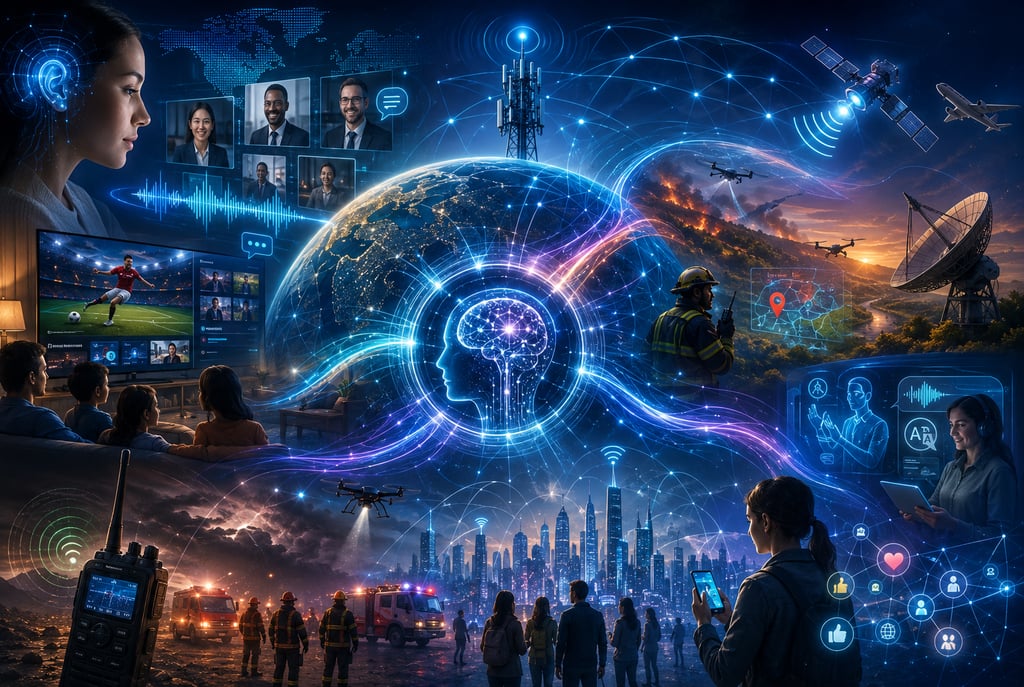
Artificial intelligence is fundamentally reshaping how humans connect, share information, and respond to crises. From the seamless flow of everyday conversations to life-saving emergency alerts, AI is enhancing speed, reliability, accessibility, and personalization across all communication channels. What once relied on static infrastructure and human operators is evolving into intelligent, adaptive systems that anticipate needs, bridge language barriers, and optimize bandwidth in real time. This transformation promises not just faster data transfer, but more meaningful, efficient, and resilient global connectivity.
Revolutionizing Internet Communications
The backbone of modern life—the internet—is undergoing its most profound upgrade yet with AI integration. Traditional networks struggle with congestion, latency, and inefficient resource allocation. AI-driven systems like predictive traffic management use machine learning algorithms to analyze usage patterns and dynamically route data through the least congested paths. This results in near-zero latency for applications like video calls, cloud gaming, and remote work.
AI enhances user experience through intelligent assistants and natural language processing (NLP). Real-time translation tools, powered by models like those behind Google Translate or advanced multimodal LLMs, break down language barriers instantaneously. A video conference between executives in Tokyo, São Paulo, and Berlin can feature live subtitles and voice dubbing that preserve tone, emotion, and cultural nuances.
Personalization reaches new heights. AI algorithms curate content feeds not just based on past behavior but by predicting future interests with remarkable accuracy. Email clients filter spam with near-perfect precision while prioritizing important messages using contextual understanding. Chatbots and virtual agents handle complex customer service queries, escalating only when human empathy or creativity is truly needed. Security improves dramatically too: AI detects phishing attempts, anomalous login patterns, and deepfake media in milliseconds, protecting users from sophisticated threats.
Emerging 6G networks will leverage AI even more deeply. AI-orchestrated spectrum sharing and beamforming will deliver terabit speeds with ultra-reliable low-latency communication (URLLC). Edge AI processing—running computations on devices rather than distant servers—will enable immersive augmented reality (AR) overlays during calls, where participants see shared virtual whiteboards or translated gestures in real time.
Transforming Television Broadcasts and Media Delivery
Television and broadcasting are shifting from one-to-many linear models to intelligent, personalized experiences. AI enables hyper-personalized content delivery. Streaming platforms already use recommendation engines; future systems will generate or adapt content on the fly. Imagine live sports broadcasts where AI automatically creates multiple camera angles, highlights packages tailored to individual viewers' favorite teams or players, and even real-time statistical overlays powered by computer vision.
In news broadcasting, AI can monitor multiple sources, fact-check in real time, and generate initial drafts of reports or graphics. Human journalists retain editorial control, but AI handles tedious tasks like transcribing interviews, translating segments for international audiences, or creating accessible closed captions with emotional context. During major events, AI-driven multi-language dubbing allows a single broadcast to reach global audiences without delay.
Advertising becomes far more effective and less intrusive. AI analyzes viewer attention, sentiment, and context to insert relevant, non-disruptive ads. Dynamic product placement in movies or shows can be customized per household. For live events, AI can stabilize shaky drone footage, enhance low-light images, or even reconstruct missing segments from archival data.
Sustainability benefits emerge too. AI optimizes broadcast tower power usage and content delivery networks (CDNs), reducing energy consumption while maintaining quality. Interactive TV evolves with AI companions that answer questions about the show in real time or facilitate group watch parties with synchronized reactions across continents.
Enhancing Emergency Radios and Critical Communications
In life-or-death scenarios, reliable communication is non-negotiable. AI is upgrading emergency radio systems that have long relied on analog or basic digital tech. Modern AI-enhanced radios use cognitive radio technology to automatically scan and switch frequencies, avoiding jamming or interference. Machine learning models predict signal degradation due to weather, terrain, or solar activity, proactively rerouting messages through mesh networks or satellite backups.
During disasters, AI-powered systems analyze incoming reports from multiple sources—social media, sensors, satellite imagery—and generate coherent situational awareness maps for first responders. Natural language understanding allows voice commands in noisy environments or for injured individuals. AI can summarize lengthy radio traffic into actionable bullet points or translate between different agencies using incompatible protocols.
Integration with IoT devices creates smart emergency ecosystems. Wearables detect falls or vital sign anomalies and automatically trigger AI-coordinated alerts with precise location data. Drones equipped with AI communication relays extend coverage into remote or damaged areas. Predictive analytics forecast disaster impacts, enabling preemptive evacuation warnings tailored to individual risk profiles and preferred communication channels (voice, text, visual alerts for the hearing impaired).
Public alert systems like Wireless Emergency Alerts improve with AI by reducing false positives and customizing messages for cultural and linguistic relevance. In wildfire-prone areas, AI might integrate weather data, wind patterns, and historical fire behavior to deliver hyper-local evacuation routes via radio, apps, and smart speakers simultaneously.
Other Transformative Applications
Mobile and Voice Communications: AI noise cancellation creates crystal-clear calls in any environment. Voice cloning for accessibility allows those with speech impairments to communicate naturally. Semantic search in call histories finds specific conversations by meaning rather than keywords.
Satellite and Global Connectivity: Companies like Starlink combined with AI optimize constellation routing for continuous coverage. AI handles handoffs between satellites and terrestrial networks seamlessly, bringing high-speed internet to remote regions, ships, and aircraft. Disaster recovery accelerates as AI deploys temporary mesh networks using balloons or autonomous vehicles.
Business and Enterprise Communications: AI meeting assistants transcribe, summarize, and extract action items from video calls. Sentiment analysis flags team morale issues early. Secure enterprise messaging uses AI to detect insider threats or compliance violations.
Education and Social Communications: AI tutors provide real-time feedback during virtual classes. Social platforms use AI to moderate content at scale while preserving free speech, detecting harmful patterns beyond simple keywords. Cross-cultural exchanges become frictionless with AI mediators suggesting polite phrasing or cultural context.
Accessibility: AI dramatically improves communication for people with disabilities. Real-time sign language translation, image descriptions for the blind, and brain-computer interfaces for those with severe motor limitations are advancing rapidly.
Creative and Entertainment: AI co-creation tools help filmmakers generate storyboards or musicians collaborate across distances with shared virtual studios.
Challenges and Ethical Considerations
While the benefits are immense, challenges remain. Privacy concerns arise from AI's data hunger—strong encryption and federated learning offer paths forward. Bias in models could perpetuate inequalities in translation or content recommendation. Job displacement in traditional media roles requires reskilling initiatives. Regulatory frameworks must balance innovation with security, especially for critical infrastructure like emergency systems.
Deepfake technology poses risks to trust in broadcasts and calls, necessitating robust watermarking and detection AI in a continuous arms race. Energy consumption of large AI models must be addressed through more efficient architectures and renewable-powered data centers.
A Connected Tomorrow
By 2030 and beyond, AI will make communication feel almost telepathic—anticipating needs, removing barriers, and strengthening societal resilience. Emergency services will respond faster and more effectively. Global collaboration will accelerate scientific discovery and cultural exchange. Information will flow not just abundantly but meaningfully.
The integration of AI into communications represents more than technological progress; it embodies humanity's drive to connect more deeply despite physical or linguistic distances. As these systems mature, they will empower individuals, safeguard communities during crises, and foster a more informed, empathetic global society. The future isn't just connected—it's intelligently, compassionately, and resiliently interwoven.
Contact
Head Office
Green Life Enterprises LLC
8 Biltmore Est
Suite 310,
Phoenix, AZ 85016
greenlifedatacenters@gmail.com
+1-813-220-0001
© 2026. All rights reserved.
* The American Government has now redefined the industry, Artificial Intelligence (AI) is now defined as Super Intelligence (SI) Our website reflects that change.
Canadian Office
Green Life Enterprises LLC
3142 Nicholson Ave
Suite 10
New Waterford, Nova Scotia B1H 1N8