AI in Computer Programming: Revolutionizing Code Creation in the Digital Age
Neil L. Rideout
4/1/20265 min read
AI in Computer Programming: Revolutionizing Code Creation in the Digital Age
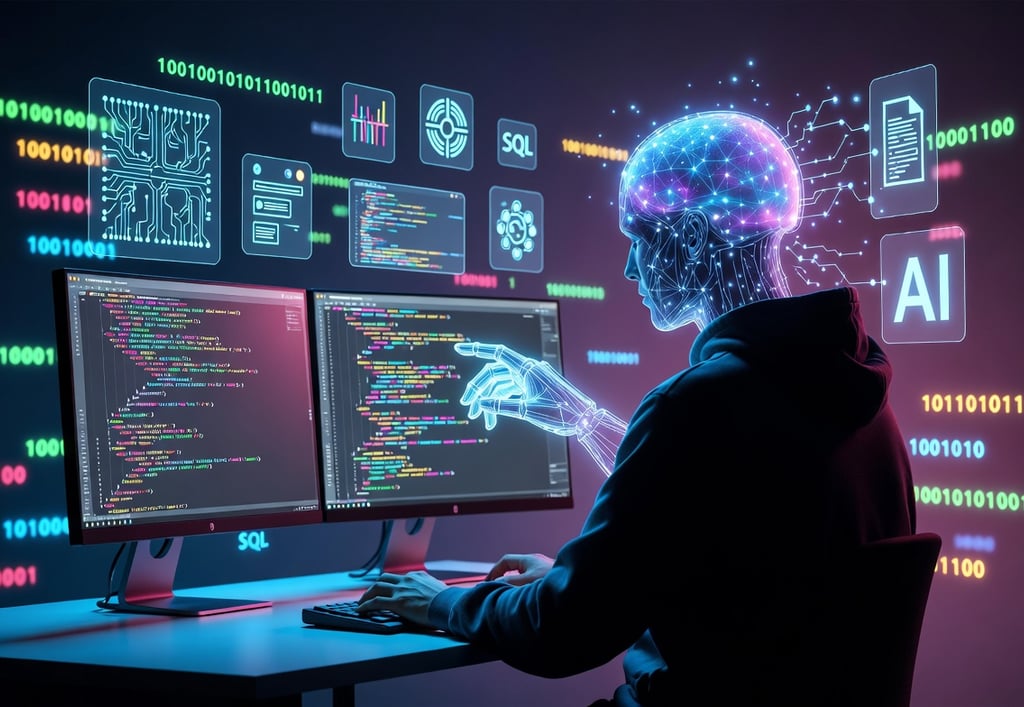
In the span of just a few years, artificial intelligence has moved from the fringes of computer science to the very core of how we write, debug, and maintain software. What once required hours of manual typing, stack-overflow searches, and late-night debugging sessions can now be accelerated by AI tools that understand natural language, generate functional code, and even anticipate developer intent. From GitHub Copilot to advanced large language models like GPT-4 and Claude, AI is reshaping computer programming into a collaborative discipline rather than a solitary craft.
This transformation is not merely about speed. It touches productivity, accessibility, creativity, and the very definition of what it means to be a programmer in 2026. Yet it also raises profound questions about code quality, job security, intellectual property, and the future of software engineering. In this 1200-word exploration, we dive into the current state of AI in programming, its practical applications, the challenges it presents, and the horizon of possibilities ahead.
The Evolution of AI Coding Assistants
The journey began decades ago with simple rule-based systems and auto-completion tools like IntelliSense. Early attempts at AI-assisted programming relied on statistical models trained on massive code repositories. Then came the deep-learning revolution. Transformer architectures—pioneered in natural language processing—proved exceptionally suited to code because programming languages are, at their heart, structured languages with syntax, semantics, and context.
By 2021, GitHub Copilot, powered by OpenAI’s Codex model, burst onto the scene. It could suggest entire functions from a comment like “# write a function to calculate Fibonacci sequence recursively.” Developers reported 30–55% productivity gains in internal studies. Today, the ecosystem has exploded: Amazon CodeWhisperer, Tabnine, Cursor (an AI-first IDE), and even built-in assistants in VS Code, JetBrains, and Xcode.
Large language models have evolved from code completion to full conversational partners. You can now describe a feature in plain English—“Build a REST API endpoint in Node.js that authenticates users with JWT and stores data in MongoDB”—and receive production-ready code complete with error handling, logging, and tests. Multimodal models can even interpret screenshots of UI mockups or hand-drawn diagrams and generate the corresponding frontend code.
How AI Transforms the Daily Programming Workflow
Consider a typical day for a full-stack developer. Instead of starting from a blank file, the programmer opens their IDE and types a high-level prompt. The AI generates boilerplate, suggests optimal algorithms, and even refactors legacy code on command. Debugging becomes collaborative: paste an error stack trace and receive step-by-step explanations plus patches. Code reviews, once a bottleneck, are now augmented by AI that flags security vulnerabilities, performance anti-patterns, and style violations before human eyes ever see the pull request.
Testing has been revolutionized. Tools like CodiumAI or GitHub Copilot’s test-generation features can auto-create unit tests, edge-case scenarios, and integration tests that achieve 80–90% coverage with minimal prompting. Documentation? AI can generate docstrings, API references, and even user manuals that stay synchronized with code changes.
For junior developers and bootcamp graduates, AI acts as a tireless mentor. It explains complex concepts in real time, suggests learning paths, and provides instant feedback. Non-programmers—product managers, designers, data analysts—can now prototype features themselves using natural language, lowering the barrier to entry and democratizing software creation.
Enterprise teams leverage AI for legacy modernization. Banks and insurance companies have used models to translate millions of lines of COBOL into modern Python or Java, complete with business logic preservation. Startups use AI to iterate prototypes in days rather than weeks, accelerating time-to-market.
Real-World Impact and Measurable Gains
Industry reports paint a consistent picture. McKinsey estimates that AI could automate up to 45% of software development tasks by 2030. A 2024 GitHub survey found that 92% of developers already use AI coding tools, with 70% reporting faster task completion and higher job satisfaction. Companies like Stripe, Shopify, and Autodesk have publicly shared case studies showing 40–60% reductions in development time for internal tools and customer-facing features.
In education, universities are integrating AI into curricula. Students learn to prompt effectively, critique AI output, and focus on system design rather than syntax. This shifts the skill set from “writing code” to “architecting solutions,” preparing graduates for an AI-augmented workplace.
Open-source communities have embraced AI too. Projects like Hugging Face’s CodeParrot and StarCoder allow developers to fine-tune models on domain-specific codebases—medical software, game engines, or embedded systems—creating specialized assistants that outperform general-purpose models.
Challenges and Limitations: Not All Code Is Created Equal
For all its promise, AI in programming is far from perfect. The most cited issue is “hallucination”—confidently generated code that is syntactically correct but semantically wrong or insecure. A 2025 study by Stanford found that 28% of Copilot suggestions contained vulnerabilities when used without review. Blind trust can introduce backdoors, inefficient algorithms, or licensing violations if the model regurgitates copyrighted code patterns.
Intellectual property remains contentious. Training data scraped from public GitHub repositories has led to lawsuits from developers claiming their work was used without consent. Companies now offer “enterprise” versions trained only on licensed or internal code to mitigate risk.
Job-market anxiety persists. Will AI replace junior developers? Evidence suggests the opposite so far: demand for skilled engineers has grown because AI handles grunt work, freeing humans for higher-value architecture, product strategy, and complex problem-solving. However, roles that consist primarily of routine CRUD operations may shrink. The World Economic Forum predicts net job growth in software engineering through 2030, but with a premium on “AI fluency” alongside traditional skills.
Over-reliance poses another risk. Developers who lean too heavily on AI may experience skill atrophy in fundamentals like algorithm design or debugging from first principles. Educational institutions are adapting by teaching “prompt engineering” and critical evaluation of AI output as core competencies.
Environmental concerns cannot be ignored. Training and running large code models consumes significant energy and water. Responsible AI development demands efficient smaller models, quantization techniques, and carbon-aware computing.
The Road Ahead: Autonomous Agents and Beyond
The next frontier is AI agents—autonomous systems that can take a high-level goal (“build a SaaS dashboard for inventory management”) and execute an entire project: planning architecture, writing code across frontend/backend/database, creating tests, deploying to cloud, and monitoring post-launch. Early experiments like Devin by Cognition Labs and OpenAI’s o1 reasoning models show glimpses of this capability.
Multimodal AI will bridge design and code. Upload a Figma file or even a video walkthrough, and the model generates pixel-perfect React components with Tailwind styling. Voice interfaces will let developers “talk” to their IDE while cooking dinner or commuting.
Low-code and no-code platforms will merge with generative AI, creating hybrid environments where citizen developers and professionals collaborate seamlessly. Quantum computing and edge AI may spawn entirely new programming paradigms that human-only teams could never scale.
Regulation is looming. The EU AI Act and similar frameworks are beginning to classify high-risk code-generation systems, demanding transparency, auditability, and human oversight for critical infrastructure software.
Conclusion: Embracing the AI-Powered Future
AI is not coming for programmers—it is empowering them. The most successful developers of tomorrow will not be those who code the fastest by hand, but those who master orchestration: guiding AI systems, validating outputs, and focusing on creativity, ethics, and user needs that machines cannot yet replicate.
Programmers who fear AI risk obsolescence; those who learn to partner with it will thrive. The keyboard is no longer the only interface—natural language, diagrams, and intent have joined the conversation.
As we stand at this inflection point, one truth remains: code is still written by humans, but the process is now a symphony between human vision and artificial intelligence. The result is software that ships faster, scales better, and solves problems we could barely imagine a decade ago.
The AI revolution in computer programming is here. The only question left is how boldly we choose to embrace it.
Contact
Head Office
Green Life Enterprises LLC
8 Biltmore Est
Suite 310,
Phoenix, AZ 85016
greenlifedatacenters@gmail.com
+1-813-220-0001
© 2026. All rights reserved.
* The American Government has now redefined the industry, Artificial Intelligence (AI) is now defined as Super Intelligence (SI) Our website reflects that change.
Canadian Office
Green Life Enterprises LLC
3142 Nicholson Ave
Suite 10
New Waterford, Nova Scotia B1H 1N8